
Seasonal affiliate link updates work on a fixed rhythm: refresh existing pages six to eight weeks before search demand peaks, publish new pages eight to twelve weeks ahead, stop structural edits by the first week of November, and from then on only verify links. A link that still loads is not necessarily a link that still earns, so every update pass needs a destination check, not only a status-code check. The classification used throughout this article is Broken, Needs Attention and Healthy. The free sample from Affiliate Link Audit shows how those three labels look on a real page set.
TL;DR
- Publish new seasonal pages eight to twelve weeks before the search peak and refresh last year's pages six to eight weeks before it (AffSERP's seasonal calendar).
- Treat the first week of November as the last window for seasonal changes in Q4. After that, the work is link verification, not editing.
- Check fast-moving offers daily or several times a day, stable products weekly and evergreen posts monthly (Goho Money).
- Test destinations, not status codes: unavailable products, homepage redirects and unverifiable tracking paths all return 200 OK.
- Finish with a post-season review, then roll last year's winners into next year's calendar.
Table of Contents
- Why seasonal pages decay faster than evergreen pages
- When to update: the Q4 calendar
- What to check on every seasonal page
- How often to re-check: by page tier
- Prioritizing which pages to audit first
- Refreshing Black Friday and Cyber Monday content
- Compliance checks that belong in every update pass
- Fixing what the audit finds
- The post-season review
- Promo: audit before the next peak
- Perspective
- FAQ
- Sources
Why seasonal pages decay faster than evergreen pages
A seasonal page is a commercial page with a deadline. Gift guides, Black Friday roundups and holiday comparison pages carry the highest concentration of time-sensitive claims: prices, stock status, promotional terms and merchant campaigns. Each of those can change independently of your editorial opinion.
One analysis of content refresh workflows describes this as the factual layer: pricing, plan names, features and availability go stale on their own, even when your opinion of the product never changes. That layer is also the one readers notice first, because an outdated price is visible at a glance.
For affiliate publishers, there is a second failure mode that readers do not see at all. The link itself degrades. A product is discontinued, a merchant sunsets a campaign, a tracking path is restructured, or a deep link is redirected to a generic homepage. The page still ranks, the click still happens, and the visit ends somewhere that cannot convert. Last year's seasonal pages are the most exposed, because they were built for a promotion that no longer exists, and they are often the first pages that search engines resurface when demand returns.
When to update: the Q4 calendar
Two timing rules recur across the sources on seasonal content. New pages need lead time because ranking takes time, so they go live two to four months ahead of the demand peak. Existing pages need a refresh in the weeks before the peak, followed by a post-season review straight afterward, while the data is fresh.
The AffSERP calendar, published in October 2026, turns those rules into a Q4 schedule:
| Window | Task |
|---|---|
| Early September | List every seasonal page, new and existing |
| Mid-September | Publish the first batch of new gift guides |
| Early October | Publish the remaining new gift guides |
| Mid-October | Refresh last year's pages |
| Late October | Add internal links between seasonal pages |
| First week of November | Last seasonal change |
| Black Friday to mid-December | Leave pages alone; check links weekly |
| Early January | Record what ranked; plan next year |
That sequence is documented by AffSERP, and it matches the practice Digiday described among large publishers: Black Friday content starts in earnest the first week of November, with articles refreshed almost daily with new links and information. The same report quotes a senior shopping editor saying that, for the most part, Halloween is when Christmas ends, with her focus returning to evergreen content once holiday pages are live.
If you are reading this in November
If the structural window has closed, the work that remains is narrower and still valuable:
- Verify every link on your highest-traffic seasonal pages this week.
- Fix or replace anything classified as Broken.
- Review anything classified as Needs Attention against the live merchant page.
- Do not rewrite headings, URLs or page structure. Late structural edits add risk without leaving time for the page to be re-crawled.
- Schedule the post-season review for early January.
For recurring planning, the pattern is more useful than the dates: the calendar repeats every year, and Q4 is only the largest instance. Valentine's Day, spring tax season, back-to-school and summer travel each follow the same eight-to-twelve-week and six-to-eight-week logic.
What to check on every seasonal page
A seasonal link update is an audit of five properties. Checking only the first one is where most publisher routines stop.
- Destination status. Does the URL return a 404, a 410 or a server error? This is the only check that most generic link checkers perform.
- Destination content. Does the landing page still show the product you recommended? A product page that has been replaced by a "no longer available" notice still returns 200 OK.
- Redirect path. Does the link resolve to the intended product, or to a category page, search results page or homepage? A redirect to a generic homepage keeps the click and discards the intent behind it.
- Tracking path. Does the link still pass through the affiliate tracking structure you were given, or has the parameter pattern changed? A tracking path that can no longer be verified belongs in Needs Attention, not Healthy.
- Offer match. Does the price, promotion or plan named in your copy match what the reader sees after the click? One practical guide to auditing existing commercial pages lists the same core questions: is the product still available, are prices accurate, do links work and does the landing page match the recommendation.
Properties two through four are why a 200 OK response does not mean an affiliate link is healthy. Properties four and five also determine whether a link is still earning, which a status code cannot tell you.
A three-label classification
The audit logic uses three labels, which keep the action list short and the evidence specific:
| Label | Meaning | Action |
|---|---|---|
| Broken | Confirmed failure: dead URL, discontinued product, redirect to a generic page | Replace or remove |
| Needs Attention | Link loads, but evidence is ambiguous: tracking path unverifiable, offer mismatch, unusual redirect | Review manually against the live merchant page |
| Healthy | Destination, redirect and tracking path all behave as intended at the time of the check | Re-check on schedule |
Separating Broken from Needs Attention matters operationally. Broken items can be fixed in a batch. Needs Attention items require a person to open the merchant page and decide, and mixing the two lists wastes the time of whoever is doing the fixing.
How often to re-check: by page tier
Not every seasonal page deserves the same frequency. High-intent pages with changing promotions need the closest attention, while stable explanatory content can stay focused on usefulness and internal linking, as Encore Aff's Q4 guidance puts it. A workable tiering:
- Tier 1: fast-moving offers. Deal roundups and price-led pages. Daily or several times a day during peak periods.
- Tier 2: stable products. Gift guides with durable products. Weekly.
- Tier 3: evergreen posts. At least monthly. For deeper updates across a whole catalog, one maintenance calendar suggests reviewing important commercial pages monthly and doing deeper updates at least twice a year, with link auditing as the second week of a four-week cycle.
For off-season pages, a longer cycle is reasonable: top earners about every three months, mid-tier pages every six months and low-priority informational pages up to a year, according to BlogSepaise. Where you cannot guarantee real-time accuracy, display a last-checked timestamp or use a soft call to action such as "Check current price."
Merchant terms can set the pace
Some programs fix the update interval contractually. The Walmart Affiliates terms, for example, require affiliates to update product information, including price and availability, within 24 hours of a change in the data feed or on the merchant site. If any of your seasonal pages depend on a program with a comparable clause, that clause overrides your general schedule. A five-step test of affiliate program terms shows how to read those clauses against your live pages.

Prioritizing which pages to audit first
The objective is not to touch every seasonal page. It is to prepare the pages most likely to create approved value in the busiest period. When time is limited, rank pages on three inputs from your own analytics:
- Traffic in the last comparable season. Last year's November and December sessions are a better predictor than current-month traffic.
- Outbound affiliate clicks. A page with strong traffic but few outbound clicks has a content problem. A page with strong clicks deserves link verification first.
- Commissions per page, where your affiliate dashboards report them. Pages with traffic and clicks but little reported earnings are candidates for Needs Attention review. This is a prompt for investigation, not proof of a lost commission: dashboards report on their own schedules, and attribution has many causes.
Start with the ten pages at the top of that ranking. The same approach is laid out for one common case in a guide on auditing the top ten pages for outdated Amazon links, and the underlying method for older posts is covered in auditing old blog posts.
Refreshing Black Friday and Cyber Monday content
Event pages need a different routine from year-round pages because the offer changes while the page is live.
- Keep the URL, replace the content. A stable URL carries ranking history forward. Digiday's reporting quotes a publishing executive describing Black Friday maintenance as a year-round effort: posts are updated through the year to signal continued authority on the topic, not rebuilt every November.
- Verify before publishing and again near the promotion start. A Black Friday checklist for publishers recommends checking priority links before publication and near the start of the promotion, and re-checking when a merchant changes the offer, a reader reports a problem or monitoring finds a mismatch.
- Remove expired promotional claims. Last year's "20% off through Monday" is a factual error on this year's page. Replace date-bound language with wording that stays accurate, and send readers to the merchant for the current terms.
- Leave structure alone after the first week of November. Changes to link targets and prices continue; changes to headings and layout stop.
On peak days, the checklist is short: Tier 1 links daily, a spot check of Tier 2, and a log of anything reclassified.
Compliance checks that belong in every update pass
Seasonal updates are also the moment disclosures drift. A new link added to a gift guide without the surrounding disclosure is a common error.
The Federal Trade Commission's guidance states that when a review has a clear and conspicuous disclosure of your relationship and the reader can see both the disclosure and the link at the same time, readers have the information they need. Practical guidance for publishers adds that the disclosure should appear before the affiliate link. Some programs add their own requirement: the Walmart terms require a clear and conspicuous advertisement disclosure placed next to the qualifying links and compliance with the FTC's endorsement guidelines.
For link attributes, Google's documentation says paid links should carry rel="sponsored", noting that nofollow remains acceptable though sponsored is preferred. Either one is enough; both are not required. A six-step FTC disclosure audit covers the sequence for U.S. publishers in detail. For legal questions about your specific arrangements, consult an attorney.

Fixing what the audit finds
An audit identifies; the publisher repairs. Three kinds of findings recur on seasonal pages:
- Discontinued or unavailable products. Replace with the current model or an equivalent product that matches the same reader intent. A better product from a different program is a legitimate replacement only if the program terms allow the placement.
- Dead or restructured programs. When a merchant closes its program, replacing it by intent first keeps the page useful to the reader while you source an alternative.
- Tracking that cannot be verified. Compare the link against the program's current link format, then confirm in the network dashboard that test clicks register. If they do not, work through the evidence in an audit-first approach to tracking problems.
When you change links on pages that also feed AI search results, the same pages are worth reviewing for how they are cited. A guide to AI search content audits covers that layer separately from link health.
The post-season review
The January review is where next year's calendar gets built. For each seasonal page, record five items:
- Peak-period traffic and outbound clicks.
- Links reclassified during the season, and why.
- Merchants whose offers changed mid-season.
- Pages that were late and what delayed them.
- Pages worth retiring, merging or promoting.
Save that record next to the calendar. A publisher who repeats the same schedule with better data each year does less emergency work every November. A weekly audit routine between seasons keeps the January record short, because fewer links reach Broken status unnoticed.
Promo: audit before the next peak
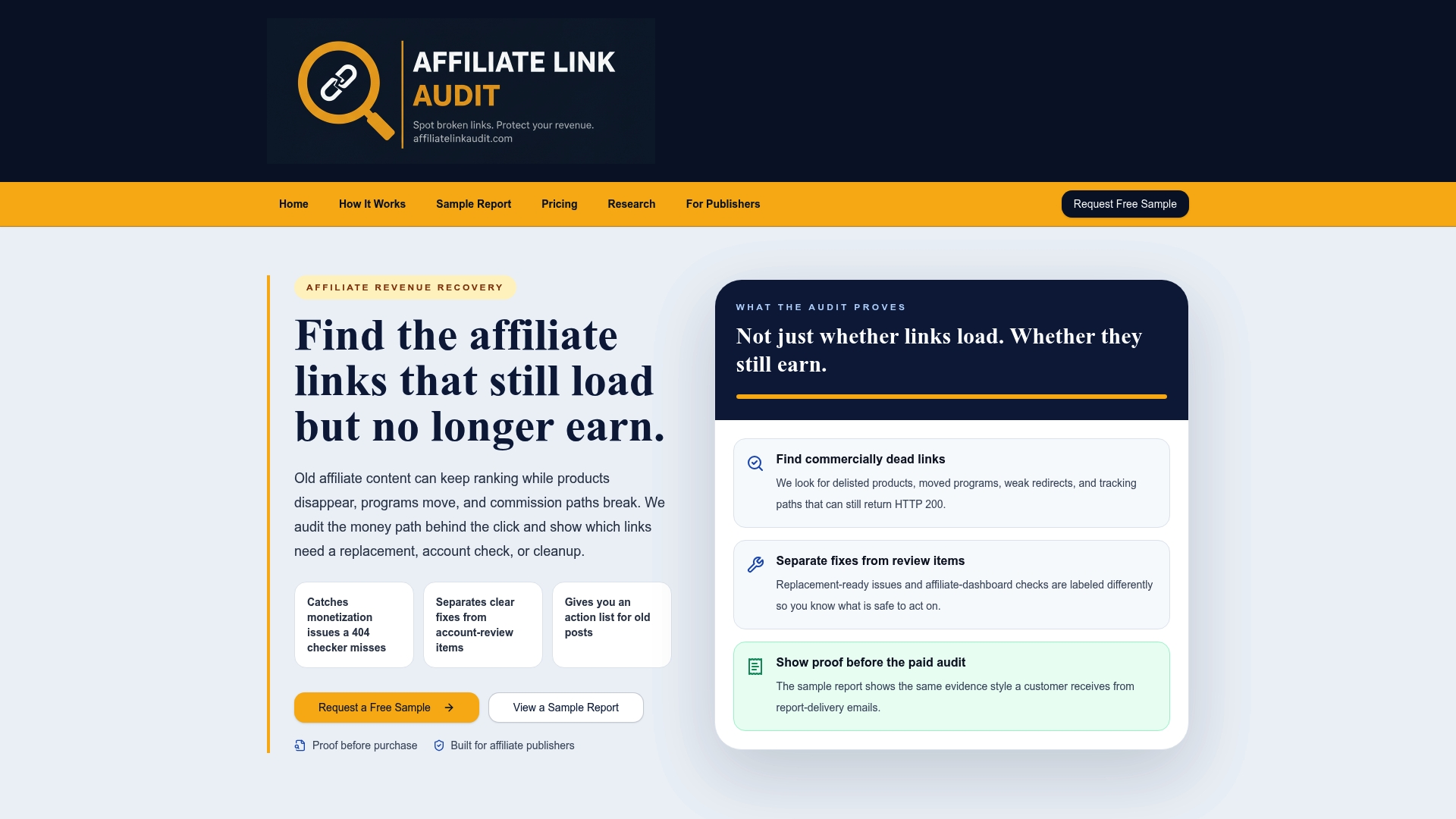
The Full Audit is a one-off, $97 report for publishers with monetized content. It evaluates links that still load as well as links that return errors, classifies findings by verified issue type, and separates clear fixes from items that need manual review, with a prioritized action plan and suggested replacements. Every audit starts with a free sample report, so the evidence is visible before you purchase. The audit identifies commercially unhealthy links; it does not repair links or verify commission crediting, and the publisher decides what to change.
Request the free sample report or review the Full Audit page. For a closer look at the aggregate picture, the Affiliate Link Health Benchmark 2026 sets out the methodology and findings.
Perspective
Seasonal pages concentrate risk. They carry the most traffic, the most time-sensitive claims and the most merchant change in the shortest window, which is why a status-code check alone leaves the largest gap exactly where it matters.
Our position is that a link has three states, not two. Broken links are confirmed failures. Healthy links behave as intended when tested. The space between them, links that return 200 OK yet point to an unavailable product, a generic homepage or a tracking path we cannot verify, is where we classify items as Needs Attention and hand the publisher evidence to decide with.
We do not repair links, and we do not claim to verify commission crediting or measure lost income. We identify and prioritize, and the audit separates clear fixes from review-needed items so that a limited pre-season window is spent on the right pages first.
Michael N.
FAQ
How early should I update seasonal affiliate links?
Refresh existing seasonal pages six to eight weeks before the search peak, and publish new ones eight to twelve weeks ahead. For Q4, that places refreshes in mid-October at the latest. Link verification continues through the season.
Should I change seasonal pages during Black Friday week?
Change links, prices and expired claims as needed, but avoid structural edits. The first week of November is the last practical window for headings, layout and URL changes. During the peak, check links on a daily or weekly cycle by page tier.
What is the difference between Broken and Needs Attention?
Broken means the evidence confirms a failure, such as a dead URL or a discontinued product. Needs Attention means the link loads but something is ambiguous, such as an unverifiable tracking path or a mismatch with the offer. The first is replaced; the second is reviewed manually.
Do I need rel="sponsored" on every affiliate link?
Google recommends rel="sponsored" for paid links and accepts nofollow as an alternative. One of the two is enough. The disclosure to readers is a separate requirement and should be clear, conspicuous and placed before the link.
Sources
- Seasonal Affiliate Content: When to Publish Gift Guides
- Q4 Affiliate Marketing Strategy: How Publishers Can Prepare for Peak Season
- Affiliate Content Maintenance Calendar
- Seasonal Content Calendar for Retail Affiliate Sites
- Black Friday Affiliate Content Checklist for Publishers
- Digiday: A look at publishers' pre-Black Friday commerce content playbooks
- How to Monitor Merchant Pricing Changes Across Affiliate Programs
- AI Content Refresh Workflow for Affiliate Sites
- Walmart Affiliates terms
- Affiliate Links Frequently Asked Questions
- FTC's Endorsement Guides: What People Are Asking
- Qualify Your Outbound Links to Google
- AI Content Audit: How to Check Your Pages for AI Search
Recommended
- Audit Affiliate Links Weekly to Stop Hidden Commission Losses for Publishers
- Publishers, Replace Dead Affiliate Programs: 3 Labels, Intent First
- Stop Revenue Leaks for Publishers: Prioritize Broken Affiliate Links
- Editors, Audit Old Blog Posts: Affiliate Link Evidence, SEO & FTC
This article was produced with AI assistance and reviewed for accuracy. Findings language ("Broken," "Needs Attention," "Healthy") reflects Affiliate Link Audit's evidence-based classification system.