
The single best first move is to run a focused affiliate link audit and classify every link as Broken, Needs Attention, or Healthy. This stops the clearest revenue leaks within a day of triage and produces a prioritized fix list inside about a week. From there, replacement decisions become a matter of sequencing, not guesswork.
TL;DR:
- Rank repairs by pageviews, historical revenue or revenue per click, and replacement fit; a lower payout can outperform when it matches reader intent.
- Route links through a centralized redirect, then test replacements on a few pages before sitewide rollout to confirm clicks register and conversions hold.
- After a swap, compare clicks and conversions with prior results, reconcile network reports against analytics, and check priority pages weekly for four weeks.
- A paid audit becomes more useful when hundreds of links or several networks make tracking hard to verify; request sample evidence before paying in full.
- The FTC requires clear affiliate disclosures near the link or within the review, so readers see the relationship alongside the recommendation.
Table of Contents
- Step-by-step affiliate link audit: quick triage and full audit checklist
- Centralize and manage affiliate links so replacements are fast and low-risk
- Prioritize replacements by traffic, intent fit, and revenue impact
- Where to find replacement offers and how to evaluate them quickly
- Measure and verify replacements: what to monitor and how to test tracking
- Publisher perspective and evidence: classification system and what an audit delivers
- DIY audit versus ordering a paid audit
- How Affiliate Link Audit can help
- FAQ
- Sources
Step-by-step affiliate link audit: quick triage and full audit checklist
A dead affiliate program rarely announces itself. Commission structures change, merchants discontinue products, and tracking paths quietly stop crediting clicks while the link itself still resolves to a live page. Distinguishing a genuinely broken link from one that loads but no longer earns requires a structured pass through the site, not a spot check.
For a quick triage, pull your top pages by organic traffic, scan each monetized anchor for outright 404s or redirects to a merchant's homepage, and patch those first since they represent total, obvious loss. A full audit takes longer but catches the subtler failures:
- Crawl the site and inventory every affiliate link, including those embedded in older posts that still rank.
- Map each link to its parent program or network so you know who to contact if a fix requires coordination.
- Test each destination for HTTP status, redirect behavior, and whether the landing page still matches the product described in your content.
- Verify tracking by checking redirect chains and destination behavior, a check that modern browsers like Google Chrome make straightforward to confirm.
- Classify each link as Broken, Needs Attention, or Healthy based on what the evidence shows.
A solo publisher with a few hundred posts can usually complete triage in a single day and a full classification pass within a week, working through pages in batches of traffic rank. A small team can split the inventory and verification steps in parallel, cutting that timeline roughly in half. For prioritization, a simple scoring metric, pageviews multiplied by historical revenue per click, gives a defensible order of operations before you touch the outdated links on your highest-traffic pages.
Centralize and manage affiliate links so replacements are fast and low-risk
Hardcoded affiliate links scale poorly. Every program change or merchant swap means editing each post individually, and on a site with hundreds of monetized pages that workload compounds fast. Centralizing links through a redirect layer means a single update propagates everywhere the link appears.
- Self-hosted redirects (a plugin or a custom script that routes a short internal URL to the live affiliate destination) give full control but require some technical setup.
- Link manager SaaS tools handle redirects, reporting, and sometimes cloaking in one interface, trading a subscription fee for less maintenance.
- Cloaked links hide the raw affiliate URL behind a branded path, which also makes a future swap invisible to the reader.
Rotators or weighted links let you split traffic between an old and a new offer before committing fully, which is useful when testing whether a replacement actually converts as well as the original did. This kind of staged testing pairs well with the prioritization methods we outline for publishers chasing the biggest revenue gaps first.
Pro Tip: Route new affiliate links through a centralized redirect from day one, even on a small site, so a future program closure means one edit instead of dozens.
Prioritize replacements by traffic, intent fit, and revenue impact
Not every broken link deserves the same urgency. A dead link on a page with negligible traffic can wait; a dead link on a page driving thousands of monthly visits cannot.
- Rank pages by combining pageviews, historical revenue (or a revenue-per-click proxy when exact figures are unavailable), and how precisely the replacement offer matches the content's original intent.
- Weight intent fit heavily: a reader who clicked a link expecting a specific product converts at a materially different rate when sent to a loosely related offer, regardless of that offer's payout.
- Run a three-step triage: confirm the link is actually broken or underperforming, check whether a closer-fit replacement exists, and schedule the swap by rank.
Say a page earning $400 a month from an affiliate link loses that program entirely. A replacement offer paying a higher commission but serving a different product category typically converts worse than a lower-paying offer that matches what the reader originally searched for, because the traffic was never shopping for the higher-paying alternative in the first place. Matching intent, not maximizing payout, is what actually restores the lost revenue.
Where to find replacement offers and how to evaluate them quickly
Once you know which pages need new offers, the search for replacements has a few reliable channels: established affiliate networks, direct merchant programs, outreach to brands you already cover editorially, and a quick look at what competing publishers in the same niche link to.
- Check that the replacement matches the original content's intent before checking its payout.
- Review cookie length, since a short window can undercount conversions that happen days after the click.
- Confirm tracking reliability by looking for a network with consistent reporting rather than sporadic dashboards.
- Weigh merchant stability: a newer or less established brand carries more risk of repeating the same dead-link problem.
- Favor offers that integrate easily with your existing link management setup rather than requiring a separate tracking system.
Stage any replacement on a handful of pages first, confirm clicks are registering correctly, then propagate the change sitewide once you trust the data.
Measure and verify replacements: what to monitor and how to test tracking
A replacement link is only a win if it actually tracks and converts. Monitoring after the swap matters as much as the audit that identified the problem in the first place.
- Track placement-level click-through rate to confirm readers are still engaging with the new link at a similar rate.
- Watch conversion rate and compare it against what the original offer produced on that page.
- Cross-check network-reported clicks against your own analytics to catch attribution gaps early.
Affiliate marketing remains a sizable channel in 2026, even as platform generosity has eroded. Review42's analysis documents Amazon Associates' commission rates falling from roughly 9.25% at their 2012 peak to around 3.14% after 2020, a decline that makes diversification and intent-fit replacement strategies more relevant than chasing any single program's payout.
For verification, combine test purchases, UTM parameters, and direct network report matching, then hold priority pages to a weekly check for the first four weeks before dropping to a monthly cadence once the replacement proves stable.
Publisher perspective and evidence: classification system and what an audit delivers
A three-label system keeps audit findings actionable instead of overwhelming. Broken means the link fails outright: a 404, a dead redirect, or a destination with no trace of the original product. Needs Attention covers links that load but show warning signs, a homepage redirect, a discontinued listing, or tracking that cannot be confirmed. Healthy means the link resolves correctly and tracking behavior checks out.

A professional audit delivers a prioritized fix list, evidence attachments such as screenshots and test-click records, and suggested replacement directions for each flagged link. We detect links that are commercially unhealthy and provide the evidence; the publisher decides what to fix. Fixing high-traffic Broken links first typically recovers the largest share of lost clicks because the pages were already earning attention before the link failed.
DIY audit versus ordering a paid audit

Handling the audit yourself makes sense when a site carries a modest link count and the owner has time to work through the checklist above in a sitting or two. Once a catalog grows into the hundreds of monetized links, or tracking spans multiple networks with inconsistent reporting, a paid audit tends to be faster and more reliable than a manual pass, simply because verifying tracking across networks takes specialized attention.
A sound paid audit should hand back a sample of evidence before asking for full payment, so you can judge the quality of the findings against your own knowledge of the site. Before choosing either path, ask yourself: how many monetized links exist, how confident am I in current tracking, and how much is an hour of my own audit time actually worth against the fee.
— Michael N.
How Affiliate Link Audit can help
We detect broken and commercially unhealthy affiliate links, classify each as Broken, Needs Attention, or Healthy, and hand back a prioritized repair plan so you know exactly where to start. Every engagement begins with a free sample report showing real evidence before you commit to anything.
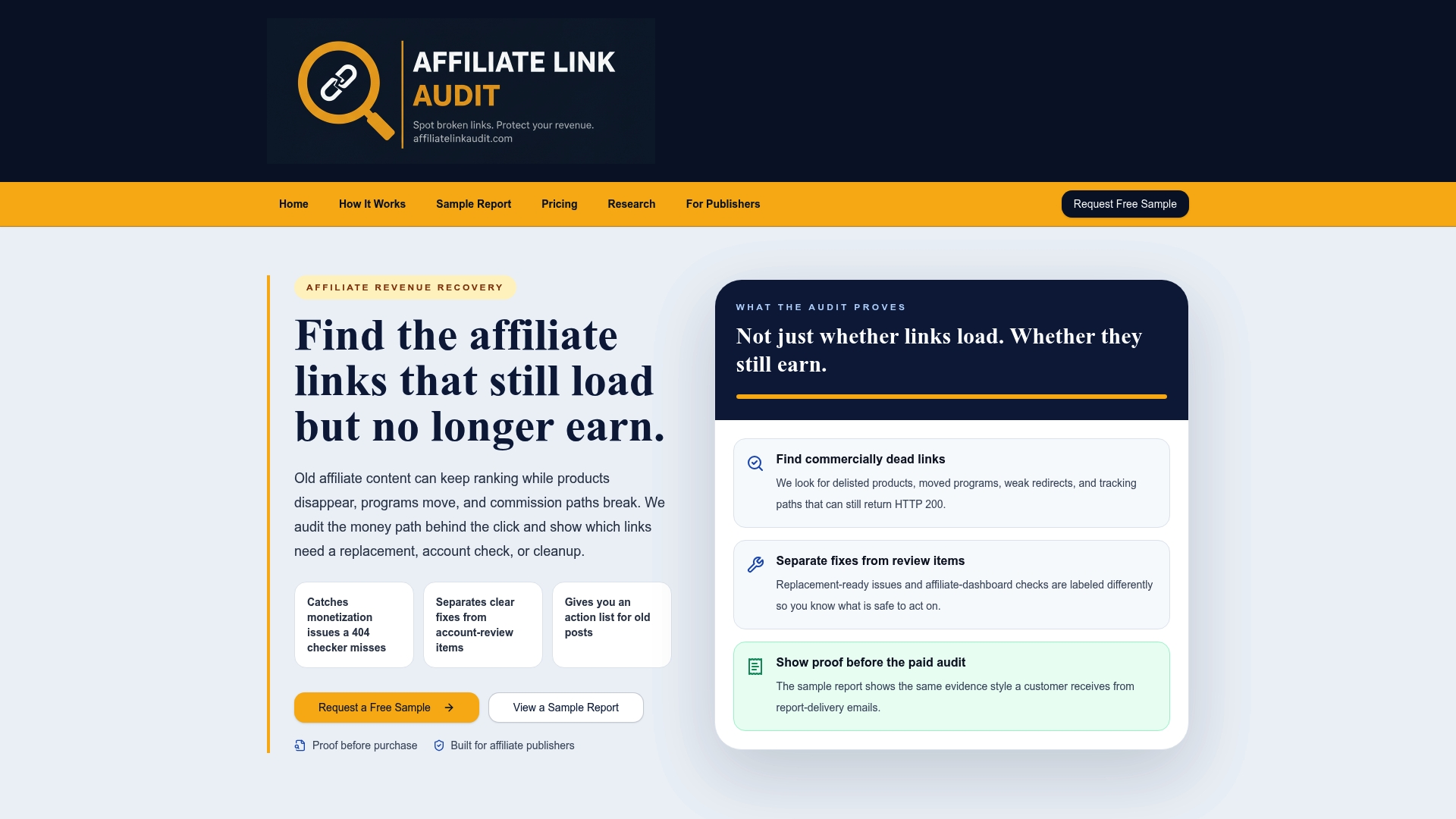
When you are ready for full coverage, the Full Audit runs $97 one-off and applies the same evidence-first process across your entire monetized catalog. For implementation help after the fixes are identified, outside partners like Coastal Connect support publishers who need content or technical updates made.
FAQ
Is affiliate marketing still worth it in 2026?
Affiliate marketing remains a substantial channel in 2026, though commission structures have tightened at major programs over the past decade, as Review42 documents with Amazon Associates' rate decline from roughly 9.25% to around 3.14%. Publishers who diversify programs and prioritize intent-fit replacements tend to protect revenue better than those relying on a single merchant.
What are the big 3 niches in affiliate marketing?
There is no official, universally agreed list of exactly three niches, since program availability and competition shift by market and year. Finance, technology, and health and wellness are commonly cited as large, well-established categories, but the right niche for any given site depends on its existing audience and content.
What are the top 5 affiliate programs?
No single ranked list of five programs applies universally, since program quality depends on your niche, audience intent, and tracking reliability rather than a fixed hierarchy. Evaluating any program on cookie length, payout consistency, and merchant stability matters more than relying on a generic top-five list.
Is affiliate marketing outdated?
Affiliate marketing is not outdated, but the mechanics have changed as platforms adjust commission rates and tracking standards. Publishers who audit links regularly and replace dead or underperforming offers with intent-matched alternatives continue to see the channel perform.
Do affiliate links need an FTC disclosure?
Yes. The FTC's Endorsement Guides require clear and conspicuous disclosure of affiliate relationships, placed near the link or within the review so a reader sees both at the same time. Updating disclosures is a reasonable step to include whenever you audit and replace affiliate links on a page.
Sources
- FTC's Endorsement Guides: What people are asking
- Affiliate marketing statistics (2026) | Review42
Recommended
- Stop Revenue Leaks for Publishers: Prioritize Broken Affiliate Links
- Publishers: Audit Affiliate Program Terms With 5 Step Link Tests
- Publishers: $97 Affiliate Monetization Audit Prioritizes Revenue Fixes
- Stop Losing Commissions: Audit Cloaked Affiliate Links for Publishers
This article was produced with AI assistance and reviewed for accuracy. Findings language ("Broken," "Needs Attention," "Healthy") reflects Affiliate Link Audit's evidence-based classification system.