
Any material connection between a publisher and a brand, commissions, free products, employment, or perks, triggers a legal obligation to disclose that connection clearly and conspicuously under FTC rules. The disclosure must sit next to the endorsement or affiliate link itself, not buried in a footer or an "about" page, so a consumer sees both at once. There is no exemption for small creators, occasional posts, or "everyone already knows" affiliate links.
TL;DR:
- Disclosures must be placed directly next to affiliate links or endorsements, not in footers or separate pages, to be effective and compliant.
- Any relationship that could influence a consumer's perception, including free products or employment ties, requires clear disclosure regardless of creator size or frequency of posts.
- Content formats like images, videos, and live streams need disclosures integrated into the visual or audio content itself, often requiring repetition for longer or live content.
- Disclosures should use plain language, be easily visible on mobile screens, and avoid vague terms like "affiliate link," ensuring readability and clarity at a glance.
- Regular affiliate link audits are essential to identify dead or non-earning links, maintain compliance, and protect reputation, especially for older or evergreen content.
Table of Contents
- What Counts as an FTC Affiliate Disclosure Under Federal Law
- Who Actually Has to Disclose Affiliate Relationships
- Making a Disclosure Clear and Conspicuous
- Disclosure Rules for Social Posts, Images, Video, and Live Streams
- Copy-Paste Disclosure Templates for Common Formats
- What FTC Enforcement Actually Looks Like
- A Practical Checklist for Auditing Your Own Disclosures
- Why Transparency Protects More Than a Publisher's Legal Standing
- Find the Links Your Disclosures Are Protecting Nobody From
- Where to Read the Official FTC Rules Yourself
- Sources
- FAQ
What Counts as an FTC Affiliate Disclosure Under Federal Law
The FTC's Endorsement Guides define a material connection as any relationship between an endorser and a brand that could affect how a reasonable consumer weighs the endorsement. That covers affiliate commissions, free or discounted products, employment ties, event perks, early access to products, and even family relationships with a brand's staff. The guides exist because consumers assume an independent recommendation carries more weight than a paid one, and the FTC's own guidance treats that assumption as something worth protecting.
The legal text lives in the eCFR at 16 C.F.R. Part 255, commonly called the Endorsement Guides, and it applies to any U.S. commerce regardless of the publisher's platform or content format. Review sites, comparison blogs, and "best of" roundups fall squarely under this rule. Labeling a link simply as an "affiliate link" is not automatically enough. The FTC's own Q&A guidance warns that shorthand terms may not register with an ordinary reader, so the disclosure needs to say what the relationship actually means for them.
Who Actually Has to Disclose Affiliate Relationships
The disclosure requirement covers anyone with a material connection to what they're promoting: bloggers, YouTubers, Instagram and TikTok creators, podcast hosts, and email newsletter writers who earn commissions on links. It also covers company employees who post about their employer's products on personal accounts, and reviewers who receive free samples even if they never mention the source in their review copy.
A few edge cases trip people up, including situations common to sellers on platforms like BananaSpace. Receiving one free product to "try" still counts, even without a formal affiliate agreement, if the review could be influenced by it. Joining an affiliate network like an established program creates the connection the moment a link goes live, not just when a sale converts.
Geography matters less than most creators assume. If the content reaches U.S. consumers, or a U.S. company is the advertiser, FTC jurisdiction generally applies regardless of where the creator is physically based. A publisher outside the United States promoting a U.S. retailer's products to a U.S. audience doesn't get a pass just because they're not domestically located.

Making a Disclosure Clear and Conspicuous
"Clear and conspicuous" has a specific legal meaning, not a vibe. The 2023 Guides published in the Federal Register define it as difficult to miss and easily understood by an ordinary consumer without needing to hunt for it, hover over it, or scroll past unrelated content first.
Placement is where most publishers get it wrong. A single disclosure at the very top of a page can work for short content, but the FTC's own Q&A guidance makes clear that once affiliate links are scattered through a long article, a top-of-page notice alone stops being adequate. Long-form reviews, buying guides, and "top 10" listicles generally need the disclosure repeated near each cluster of links, not just once at the start.
Wording matters just as much as position. Compare these two approaches:
- Weak: "affiliate link" (no context on what that means for the reader)
- Weak: a disclosure link buried in a hover tooltip or a tiny footer note
- Strong: "This post contains affiliate links. If you buy through them, I may earn a commission at no extra cost to you."
- Strong: "I received this product for free from [Brand] in exchange for an honest review."
Pro Tip: Check every disclosure on a phone screen, not just a desktop preview. Text that reads fine at 100% zoom on a laptop often shrinks into an unreadable gray sliver on mobile, and mobile is where most affiliate traffic actually lands.
Disclosure Rules for Social Posts, Images, Video, and Live Streams
Visual and audio content carries its own set of traps because there's no scrollable page to place a disclosure on. The FTC's Disclosures 101 guidance requires the disclosure to live inside the visual or audio portion of the content itself, not tucked into a caption a viewer may never open or a video description almost nobody reads.
Practical application by format:
- Images and Instagram Stories: superimpose readable text directly on the image; a caption-only disclosure doesn't count if the image itself is the endorsement.
- Video: state the disclosure verbally near the start, and repeat it if the paid segment appears later; a description-box disclosure alone is treated as insufficient because most viewers never open it.
- Live streams: overlay the disclosure on screen and repeat it at intervals, since viewers join mid-stream and miss anything said only once at the beginning.
- Platform labels: a built-in tag like a "Paid Partnership" label can supplement a disclosure, but FTC staff has warned it shouldn't be the only disclosure a creator relies on.
Duration matters too. A disclosure that flashes for a fraction of a second technically appears on screen but fails the "easily noticed" standard the Federal Register guidance describes.
Copy-Paste Disclosure Templates for Common Formats
Here are working templates for the placements publishers ask about most often. Adjust the brand name and specifics, but keep the core structure.
- Blog post, top-of-article: "Heads up: this post contains affiliate links. I earn a commission if you make a purchase, at no extra cost to you."
- Inline sentence near a specific link: "I use [Product] myself, and if you buy it through this link, I earn a commission."
- Social media caption (short form): "#ad" or "#sponsored" placed at the very start of the caption, not buried after several lines of hashtags.
- Instagram Story overlay: a text sticker reading "Paid partnership with [Brand]" placed over the visible portion of the image, not hidden in a swipe-up link alone.
- Video opener (spoken): "Quick note before we start: [Brand] sent me this product for free to review."
- Affiliate-only button or image link: a short line directly above or below the button, such as "Affiliate link: we may earn a commission from this purchase," rather than relying on the button's own label.
Inadequate alternatives to avoid: disclosures placed only in an author bio, only in a site-wide terms page, only in a video description, or written in language ("*", "sponsored content may apply") too vague for an ordinary reader to parse quickly.
What FTC Enforcement Actually Looks Like
The FTC doesn't rely only on case-by-case complaints. In 2021, it sent a Notice of Penalty Offenses to more than 700 companies, warning that deceptive endorsement practices could expose them to civil penalties under the agency's Penalty Offense Authority. That notice signals a company or publisher knew the rules and chose to ignore them, which raises exposure in any future enforcement action.
Civil penalties tied to knowing violations of the Endorsement Guides can run into real money per violation, and the FTC has shown a willingness to name specific advertisers in public actions. Reputational damage tends to outlast any fine: once a publisher gets called out publicly for hidden affiliate relationships, that story follows the brand.
When the FTC does act, it typically expects corrective disclosures going forward, corrections to past deceptive content where feasible, and evidence of internal review processes. A documented audit trail showing a publisher actively checks and fixes its disclosures carries real weight if scrutiny ever arrives.

A Practical Checklist for Auditing Your Own Disclosures
Run this sequence across a site's affiliate content on a regular schedule, not just once.
- Inventory every page carrying affiliate links. Pull a full list from your CMS or affiliate network dashboard, including older posts still ranking in search.
- Check disclosure proximity on each page. Confirm the disclosure sits near the link cluster, not only at the top of a long article.
- Review the wording itself. Flag any page using only "affiliate link" or a symbol with no plain-language explanation.
- Check embedded video and social content. Confirm spoken or on-screen disclosures exist independent of captions or descriptions.
- Test everything on mobile. Text that's readable on desktop often fails on a phone screen.
- Verify link destinations, not just disclosure text. A link can display a normal 200 OK status while still routing to a discontinued product, a generic homepage, or a tracking path that no longer earns commission.
Classify every finding using three labels: Broken (dead or clearly non-functional), Needs Attention (loads normally but shows signs of commercial trouble, like a redirect to a homepage or an out-of-stock page), or Healthy (loads and appears to function as intended).
Pro Tip: Run this audit quarterly for high-traffic evergreen content and twice a year for the rest of the site. If your affiliate footprint has grown past a few hundred links, a manual pass stops being realistic, and that's the point where a specialist audit earns back the time it costs.
Why Transparency Protects More Than a Publisher's Legal Standing
Clear disclosures do more than satisfy a regulator. Readers who understand a recommendation is compensated tend to trust the surrounding content more, not less, because the transparency signals the publisher has nothing to hide. That trust compounds over years of published content, which is exactly why a single sloppy disclosure buried in old posts can quietly undercut conversion rates long after the post stopped getting active edits.
The same instinct that drives good disclosure practice, checking your own work rather than assuming it's fine, should extend to the affiliate links themselves. A disclosure next to a dead or non-earning link protects you legally but still wastes the reader's click. For anything beyond routine legal questions, especially edge cases involving employment relationships or cross-border content, consult an attorney rather than relying on general guidance alone.
— Michael N.
Find the Links Your Disclosures Are Protecting Nobody From
A disclosure next to a broken or non-earning link is compliant but pointless, since the click it protects never converts anyway. Affiliate link audit exists for that exact gap: most link checkers stop at flagging 404 errors, but a link returning a normal 200 OK can still be commercially dead, pointing to a discontinued product, a generic homepage redirect, or a tracking path that no longer earns commission.
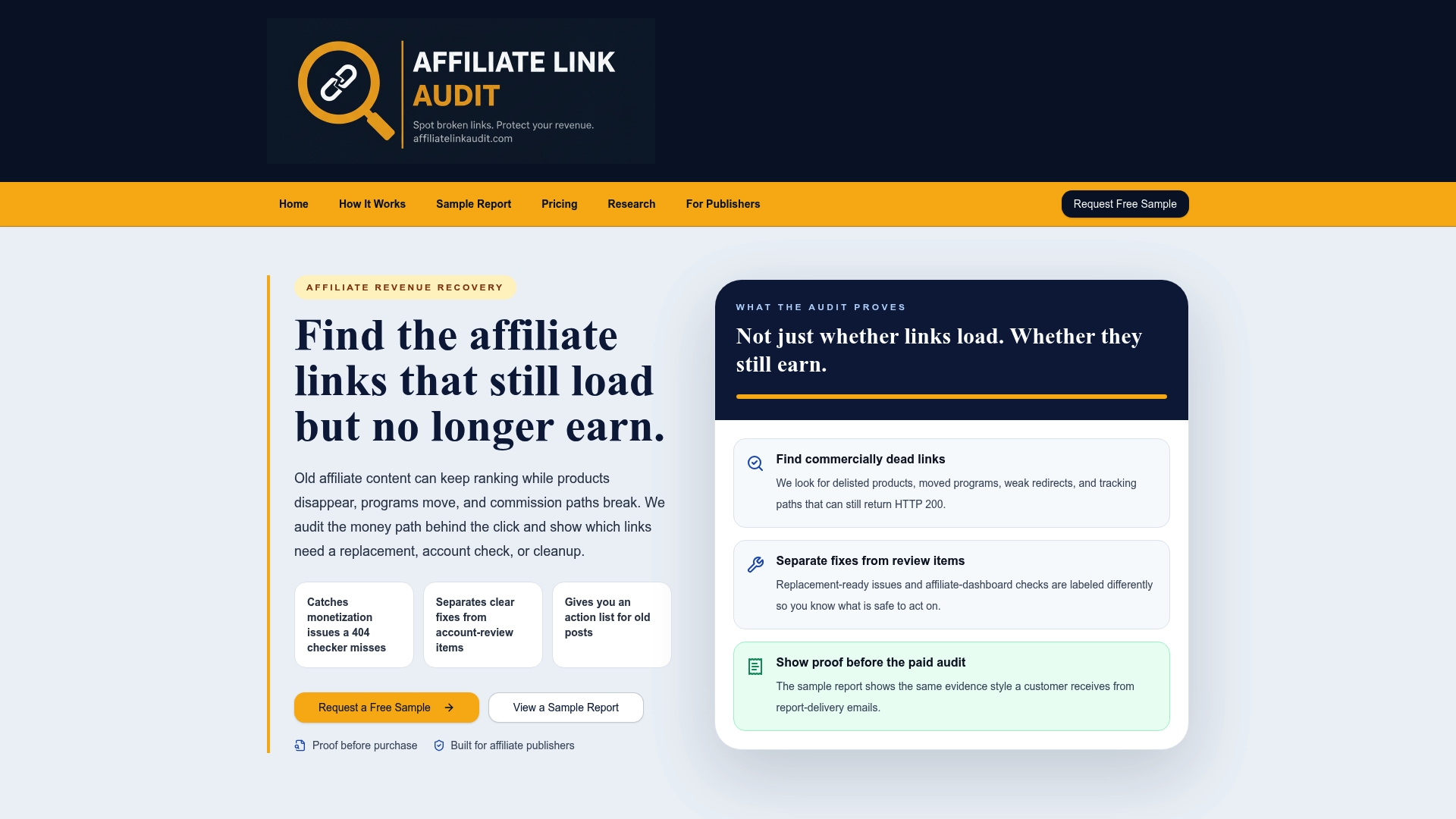
Every engagement starts with a free sample report, so you can see exactly how findings get classified as Broken, Needs Attention, or Healthy before paying for anything. To be direct about scope: we detect commercially unhealthy links and hand you the evidence. We don't verify actual commission crediting or guarantee recovered revenue, and we don't automatically fix anything, you decide what to repair and when. If your evergreen content has been live for a few years, run the Full Audit for $97 and get a prioritized action plan separating clear fixes from items that need a manual look.
Where to Read the Official FTC Rules Yourself
Nothing here replaces the primary source text, and the FTC publishes it in plain language for a reason. Start with Disclosures 101 for Social Media Influencers for the plainest walkthrough of platform-specific rules, then read the Endorsement Guides Q&A for scenario-based answers. The full regulatory text sits in 16 C.F.R. Part 255, and the 2023 updates are documented in the Federal Register notice. For anything involving significant revenue, employment relationships, or multi-platform campaigns, run the specific scenario past a lawyer familiar with advertising law rather than extrapolating from general guidance.
This article is general information, not a substitute for advice from a qualified lawyer. Consult a qualified legal professional about your own circumstances before acting on anything here.
Sources
- Influencers: Are your 'material connection' disclosures clear and conspicuous? | FTC Business Center blog
- Guides concerning the use of endorsements and testimonials in advertising | Federal Register
FAQ
Do you legally have to disclose affiliate links?
Yes. Any affiliate link that earns a commission creates a material connection under FTC rules, and that connection requires a clear and conspicuous disclosure placed near the link itself, not just somewhere on the site.
What are the FTC's guidelines for affiliate marketing disclosure?
The core rule requires disclosure whenever a material connection, commission, free product, employment tie, or similar perk, could affect how a consumer views an endorsement. The disclosure needs to be placed where the reader sees it alongside the link or recommendation, using plain language rather than vague shorthand like "affiliate link" alone.
What are the FTC influencer disclosure guidelines for social media and video?
Influencer disclosures must live inside the visual or audio content itself: superimposed text on images and Stories, spoken or on-screen text in video, and repeated overlays during live streams. Platform tools like a "Paid Partnership" label can help, but FTC guidance treats them as a supplement, not a full substitute for a direct disclosure.
What are FTC disclosures, exactly?
An FTC disclosure is a plain-language statement telling a consumer about a financial or personal relationship between an endorser and a brand that could influence the endorsement's credibility. It has to be clear enough that an ordinary reader understands it immediately, without needing to click, hover, or scroll to find it.
How much can a publisher be fined for missing disclosures?
The FTC's Notice of Penalty Offenses put more than 700 companies on notice that deceptive endorsement practices can lead to civil penalties, though exact amounts depend on the specific violation and whether the FTC treats it as a knowing repeat offense. Beyond any fine, public enforcement actions tend to cause lasting reputational damage that outlasts the penalty itself.
How does Affiliate link audit help with disclosure compliance?
Affiliate link audit doesn't provide legal review of disclosure wording, but it identifies the affiliate links sitting near those disclosures that may no longer be commercially healthy. Findings come classified as Broken, Needs Attention, or Healthy, starting with a free sample report before any paid commitment.
Recommended
This article was produced with AI assistance and reviewed for accuracy. Findings language ("Broken," "Needs Attention," "Healthy") reflects Affiliate Link Audit's evidence-based classification system.