
In this article, "affiliate program terms" refers to affiliate link health, not merchant contract language. A quality audit labels each monetized link Broken, Needs Attention, or Healthy, then delivers a prioritized action plan backed by evidence rather than assumptions. Publishers use that classification to decide what to fix first, what to hand to a developer, and what to leave alone.
TL;DR:
- Links returning a 200 OK status can still be commercially dead due to soft 404s or JavaScript-driven destinations, requiring full rendering tests for accurate classification.
- Prioritized fixing focuses on high-traffic pages with broken links or homepage redirects that can be resolved quickly, while low-traffic issues are deferred.
- Evidence supporting link classification includes HTTP status codes, redirect chains, screenshots, and URL parameters, which must be paired for reliable audit results.
- A comprehensive report details each link's classification with suggested actions, guiding either editorial fixes or developer tasks based on severity.
- Automated checks often miss soft failures, so render-based testing and redirect logging provide a more complete picture of link health and commercial viability.
Table of Contents
- How audits classify links: Broken, Needs Attention, Healthy
- Step-by-step testing checklist: tools and reproducible tests
- Prioritizing fixes: how to build a practical action plan
- Disclosure and compliance checks to include in an audit
- What an audit deliverable contains and how to use it
- Common blind spots and why prioritized audits pay off
- How Affiliate Link Audit helps: sample report and ordering a full audit
- Sources
- FAQ
How audits classify links: Broken, Needs Attention, Healthy
Classification depends on what the link's destination actually does, not just whether the page loads. A link returning a normal 200 OK status can still be commercially dead, which is the distinction most basic link checkers miss.
- Broken: the link returns an HTTP 404 or 410, points to a removed product page, redirects to a generic homepage, or throws a server error.
- Needs Attention: the page loads (often a 200 OK) but the commercial path is compromised: a homepage redirect that skips the product, a missing or malformed tracking parameter, a soft 404 that displays "page not found" content while returning a 200 status, or a JavaScript-rendered destination that hides the real page from a simple crawl.
- Healthy: the destination matches the intended product or merchant page, and the tracking parameters used in the anchor are verifiable in the resulting URL.
Every classification in a serious audit is paired with evidence: the HTTP status code returned, the recorded redirect chain, and a screenshot of the landing page at the time of the test. Without that evidence, a label is just an opinion, and an editor or developer has nothing to act on beyond "trust the report."
Step-by-step testing checklist: tools and reproducible tests
Reproducibility separates an audit from a spot check. The same link, tested the same way twice, should produce the same classification, along with an artifact trail a publisher can review independently.
- Run the URL Inspection live test, but record the full redirect chain separately: Google's own documentation notes that the tool can display a tested or indexed result without exposing every hop the link took to get there.
- Capture the raw HTTP status code and response headers for each request in the chain, and cross-reference against Google's guidance on 404 errors to separate a harmless 404 from a soft 404 that returns 200 while showing error content.
- Render the page fully, using a rich-results or full-rendering test, to catch JavaScript-driven routing that can hide the real destination or product listing from a basic crawler.
- Verify the tracking parameters in the final URL by capturing the full querystring and confirming the affiliate identifier survived the redirect chain, without asserting that any commission was actually credited.
- Log the evidence set: redirect-chain output, request and response headers, a timestamped screenshot, and the final classification.
Pro Tip: Never classify a link from a single screenshot alone; pair the visual with the status code and redirect log so the finding holds up under review.
Soft 404s and JavaScript-routed pages produce the majority of false positives in link checks that stop at a simple "does it load" test. A render-based pass catches what a status-code check alone will miss.

Prioritizing fixes: how to build a practical action plan
A list of broken links is not an action plan. Prioritization has to weigh how much traffic a link receives, how often the same broken destination appears across the site, how easy the fix is, and whether the issue carries compliance exposure alongside a commercial one.
- Immediate: high-traffic pages with Broken links or homepage redirects, typically a text swap or a single server-side redirect an editor or developer can resolve within days.
- High priority: Needs Attention findings on frequently linked products, such as a missing tracking parameter repeated across several posts, usually resolved with a bulk find-and-replace plus a redirect rule.
- Low priority: low-traffic pages or single-instance issues where the fix effort outweighs the likely benefit, logged for a later batch rather than immediate work.
Effort estimates vary by fix type: a text or anchor swap is an editorial task measured in minutes per link, an affiliate parameter correction is a quick technical edit, and a server-side redirect setup is a developer task that may take longer depending on the platform. A useful report surfaces each finding with a priority score, the recommended action, the suggested owner (editor or developer), and the supporting evidence, so the publisher's queue is built from the audit rather than assembled after the fact. Findings on link concentration and revenue exposure follow patterns documented in the Affiliate Link Health Benchmark 2026.
Disclosure and compliance checks to include in an audit
Link health and disclosure compliance are separate risks, but a thorough audit records both while it has the page open. The FTC's endorsement guidance calls for disclosure of material connections that is clear and conspicuous, meaning a reader should not have to search for it or interpret vague wording.
- Location check: is the disclosure placed near the affiliate link itself, not buried in a footer or a separate policy page.
- Phrasing check: does the disclosure state the relationship in plain language rather than ambiguous terms.
- Repetition check: when a review is split across sections or pages, does each section with a monetized link carry its own disclosure.
Remediation is usually a short fix: a one-line disclosure placed immediately above or below the affected content, worded to state the compensation relationship plainly rather than hint at it.
What an audit deliverable contains and how to use it
A completed audit report itemizes every tested link with its classification (Broken, Needs Attention, or Healthy), the evidence collected, a priority score, the recommended action, and a suggested owner.
- Editorial tasks: text and anchor swaps, disclosure additions, and product-link replacements that a content editor can execute directly from the report.
- Developer tickets: server-side redirects, tracking parameter fixes, and template-level issues that require code changes.
- Review-needed items: findings that are ambiguous enough, such as a redesigned merchant site, that a human judgment call is required before acting.
The report identifies links that are commercially unhealthy, discontinued products, homepage redirects, or unverifiable tracking, and provides the evidence behind each finding. It does not verify actual commission crediting, guarantee revenue recovery, or confirm lost income; the publisher reviews the evidence and decides what to fix. A sample report lets a publisher see the format and depth of evidence before committing to a full audit.
Common blind spots and why prioritized audits pay off
The most common surprise in an audit is the volume of links returning a normal 200 OK while pointing to a homepage, a discontinued product, or a redirect that drops the tracking parameter entirely. A text swap by an editor often resolves the anchor itself, while a developer-side redirect is what actually restores the tracking path. Prioritized, evidence-backed findings turn that distinction into a schedule instead of a guessing exercise.
— Michael N.
How Affiliate Link Audit helps: sample report and ordering a full audit
Affiliate Link Audit detects links that are commercially unhealthy, whether Broken, Needs Attention, or Healthy, and separates clear fixes from items that need manual review before the publisher spends time on either.
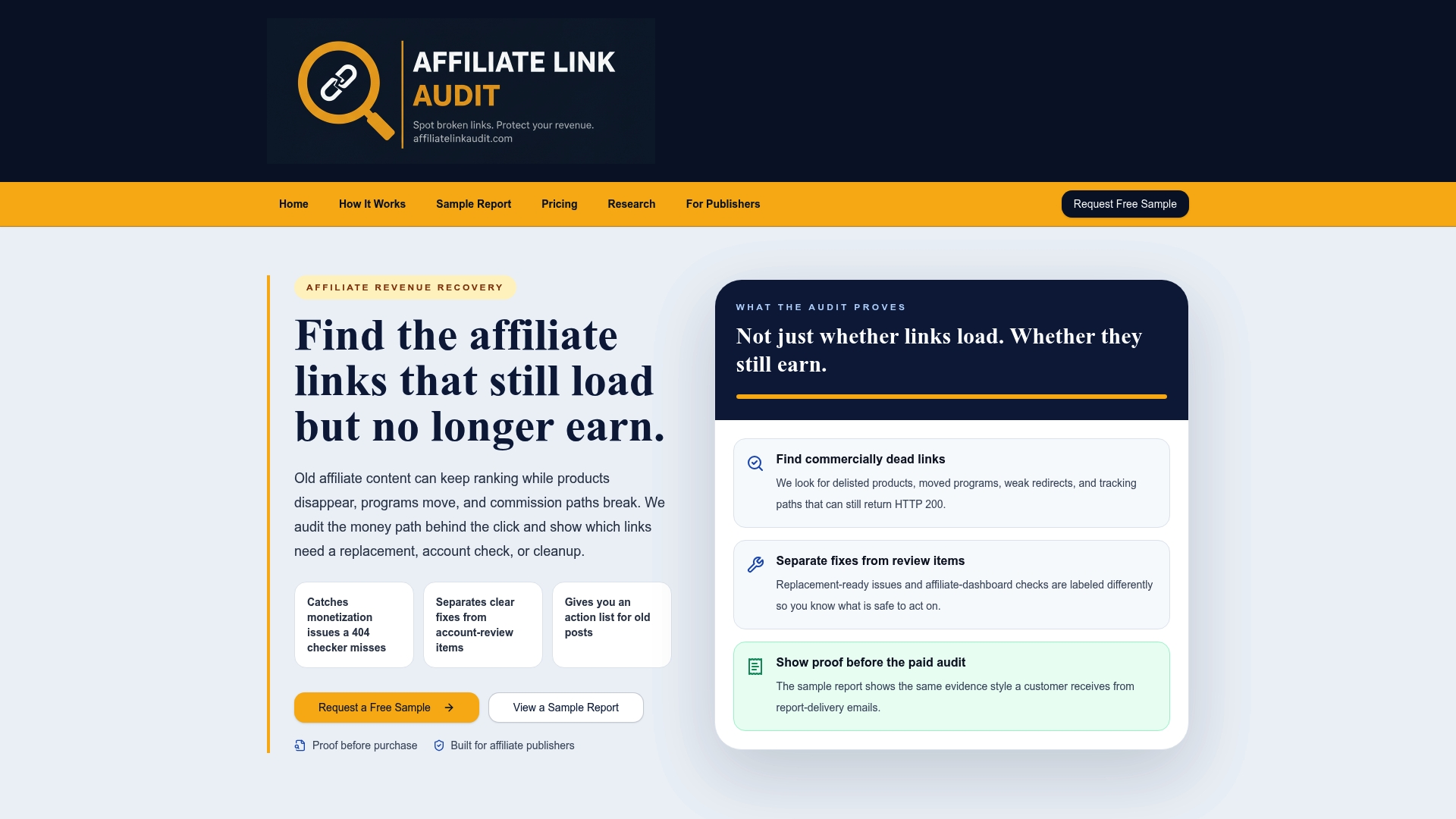
- The audit provides a prioritized action plan with evidence, not a raw list of URLs.
- Publishers ready for a full scan can order the Full Audit for $97 one-off.
Publishers managing a large archive of older content can review the publisher-focused audit details for how findings map to editorial and development workflows.
Sources
- Fix search-related JavaScript problems - Google Search Central
- FTC's endorsement guides — What people are asking
FAQ
What does "affiliate program terms" mean in a link audit?
Here, it refers to the health and commercial viability of affiliate links on a publisher's site, not the merchant's contract language. Each link is classified as Broken, Needs Attention, or Healthy based on its actual destination and tracking behavior.
What is the difference between Needs Attention and Broken?
A Broken link returns an error, a removed page, or a hard homepage redirect with no recoverable path. A Needs Attention link loads normally but the commercial flow is compromised, such as a soft 404, a missing tracking parameter, or a JavaScript-hidden destination.
Does an audit guarantee recovered commission?
No. An audit identifies links that are commercially unhealthy and documents the evidence, but it does not verify actual commission crediting or guarantee revenue recovery; the publisher decides what to fix. A free sample report shows the evidence format before ordering a full audit.
How much does a full audit cost?
The Full Audit from Affiliate Link Audit is priced at $97 one-off, available at Affiliatelinkaudit. A free sample report is also available at no cost for publishers who want to preview the methodology first.
Can automated tools catch every broken affiliate link?
Basic automated checks catch hard errors like 404s but often miss soft 404s, JavaScript-routed pages, and homepage redirects that still return a 200 OK status. Render-based testing combined with redirect-chain logging, as described in Google's Search Central documentation, catches more of these cases than status-code checks alone.
Recommended
- Affiliate Link Audit for Publishers
- Affiliate Link Health Benchmark 2026
- Travel Publisher Link Health Research
This article was produced with AI assistance and reviewed for accuracy. Findings language ("Broken," "Needs Attention," "Healthy") reflects Affiliate Link Audit's evidence-based classification system.