
Run an audit that detects broken and commercially non-earning affiliate links, classifies each one as Broken, Needs Attention, or Healthy, and prioritizes fixes by impact times effort. This sequence, detect, classify, prioritize, forms the operational backbone of affiliate link best practices for any publisher managing monetized content at scale. A sample audit report from a service such as Affiliate Link Audit illustrates what the evidence and the resulting action plan typically look like.
TL;DR:
- Automated and manual checks reveal that many links return a 200 OK status but still fail to generate revenue due to redirects or disallowed content.
- Prioritization scores combine traffic volume, merchant commission rate, and fix effort to identify the most impactful links needing repair or review.
- Continuous monitoring, with weekly automated crawls and quarterly deep audits, is essential to maintain affiliate link health over time.
- Disclosures must be placed close to links with plain language, ensuring compliance and transparent communication for all content channels.
- Fixing problematic links involves updating URLs, replacing discontinued merchants, or adjusting placement, then verifying impact through tracking metrics.
Table of Contents
- Quick Audit Checklist for Publishers
- How to Detect Broken and Commercially Non-Earning Links
- Classify Findings and Prioritize Fixes
- Disclosure and Legal Best Practices to Check During an Audit
- Monitoring and Maintenance Workflow
- What a Professional Audit Report Includes
- Implementing Fixes and Measuring Impact
- Why Audits Are a High-Leverage Editorial Habit
- Getting Started With Affiliate Link Audit
- Sources
- FAQ
Quick Audit Checklist for Publishers
Before committing to a full audit, publishers can run a condensed version internally or hand this scope directly to an auditor.
- Crawl all monetized pages for HTTP status codes, redirect chains, and timeout errors.
- Flag any affiliate link returning a 200 OK status that redirects to a homepage or a discontinued product page.
- Spot-check a sample of surviving links manually: confirm landing-page relevance, search the merchant site for the original product, and verify the affiliate ID is still present in the final URL.
- Rank pages by affiliate traffic and historical click volume, then schedule deep checks for the highest-traffic pages first.
This order matters because automated checks are fast and cheap, while manual confirmation is slow and should be reserved for links that pass the first filter but still warrant scrutiny.
How to Detect Broken and Commercially Non-Earning Links
Detection splits into two layers: technical crawling and affiliate-specific verification. Each layer catches failures the other misses, which is why audits that rely on status codes alone routinely understate the scale of revenue leakage.
Automated crawlers handle the technical layer. They request every affiliate URL on a site, log the HTTP status code returned, and follow redirect chains to their final destination. The behavior these crawlers detect is well documented in RFC 7231, which specifies how 4xx and 5xx status codes and redirect responses are meant to function. A publisher relying only on this layer will catch dead links, but not links that technically load while failing commercially.
The affiliate-specific layer requires more work:
- Confirm that tracking parameters are present in the final URL after any redirect, not just in the original link.
- Test whether the merchant page still sets the expected affiliate cookie, since some redirects strip tracking silently.
- Check the buy box or product-availability indicator on the landing page rather than assuming a loading page means an active offer.
- Compare the landing page's content against what the anchor text promised, since a generic category page is a weaker outcome than the specific product page.
A link returning 200 OK can still be commercially broken when it redirects to a merchant's homepage, lands on a page for a discontinued product, or loads a page missing the content the anchor text promised. Headless browser crawlers, targeted API checks against merchant catalogs, and manual confirmation on a sample of results together cover what a status-code-only tool cannot.
Pro Tip: Run headless-browser checks on your highest-traffic affiliate pages monthly, since client-side redirects and cookie drops rarely show up in a simple status-code crawl.
Classify Findings and Prioritize Fixes
Every link an audit touches should land in one of three categories: Broken, Needs Attention, or Healthy. Each label requires its own type of evidence before it is assigned.
- Broken links return a 4xx or 5xx status, redirect to an unrelated domain, or point to a page confirmed discontinued. The evidence captured should include the status code, the redirect chain, and a timestamp.
- Needs Attention links load successfully but show a weaker signal: a homepage redirect, a missing tracking parameter, or a landing page that no longer matches the anchor text. These require a screenshot of the landing page and a note on what diverges from the expected outcome.
- Healthy links load the intended page, retain tracking parameters through any redirect, and set the expected cookie. Evidence here is a confirmation log rather than a correction.
Once classified, fixes are ranked with a simple scoring model: traffic weight for the page, estimated conversion likelihood based on content type, the affiliate commission rate tied to that merchant, and the estimated time to fix. Multiplying traffic and conversion signals against commission rate, then dividing by fix effort, produces a priority score that ranks Broken and Needs Attention items side by side. Needs Attention items generally require more manual review than Broken ones, since the evidence is ambiguous by definition and a human has to judge whether the divergence is material.
Disclosure and Legal Best Practices to Check During an Audit
An audit scope that stops at technical link health misses a compliance dimension that carries its own risk. The FTC's Endorsement Guides require clear and conspicuous disclosure of material connections, with examples that address affiliate links specifically. Separate FTC staff guidance states that disclosures placed close to the link or the recommendation itself are preferred over disclosures buried elsewhere on the page.
An audit should check for:
- Disclosure presence on every page carrying affiliate links, not just on a general site-wide policy page.
- Physical proximity between the disclosure language and the links it covers, rather than a disclosure separated by unrelated content.
- Plain language such as "this post contains affiliate links" rather than vague shorthand that a reader might not recognize.
- Parity across channels, meaning a video and its description carry matching disclosure language rather than one omitting it.
A platform-level disclosure toggle is not a substitute for a native disclosure near the link itself, since the guidance centers on what the reader sees in context, not what a platform records in the background.
Monitoring and Maintenance Workflow
Link health degrades continuously, which means a one-time audit without a follow-up cadence loses value within months.
- Run automated crawls weekly across all monetized content to catch new 4xx and 5xx errors early.
- Schedule manual spot checks monthly on a rotating sample of high-traffic pages to catch homepage redirects and tracking drift that status codes miss.
- Run a full deep audit quarterly, covering every affiliate link rather than a sample.
- Trigger an off-cycle check whenever an affiliate program changes its terms, a merchant migrates its site, or a seasonal promotion ends.
- Build a link-health check into editorial QA so that updated or republished posts get their affiliate links reverified before going live again.
What a Professional Audit Report Includes
A useful audit deliverable separates evidence from judgment, giving the publisher both the proof and a ranked list of what to do with it. A sample report demonstrates the fields a complete audit should return:
- The affiliate URL and its anchor text as it appears on the page.
- The observed behavior, including status code, redirect chain, or cookie-setting result.
- The classification label: Broken, Needs Attention, or Healthy.
- An estimated traffic figure for the hosting page and a computed priority score.
- A recommended fix, whether that means updating the link, replacing the merchant, or retiring the link entirely.
Separating confirmed Broken items from Needs Attention items that require human judgment saves editorial time, since a publisher can act on the clear fixes immediately while scheduling review for the ambiguous ones. Readers who want to see this format applied at scale can review benchmark research alongside the sample report.
Implementing Fixes and Measuring Impact
Once an action plan exists, the fixes themselves fall into a handful of categories, each with its own verification step.
- Update a broken URL to the correct product page, then reload the page and confirm the new link sets the expected tracking parameter.
- Replace a discontinued merchant link with an active alternative, then verify the affiliate ID persists through checkout.
- Repair or rebuild a tracking parameter that a redirect stripped, confirming the cookie fires before publishing the fix.
- Add or reposition a disclosure where the audit flagged one missing or poorly placed.
- Retire a link entirely when no suitable replacement exists, rather than leaving a Needs Attention item unresolved indefinitely.
After fixes go live, track affiliate conversion rate, clicks-to-earnings ratio, and revenue per thousand visits over a defined window, typically 30 to 60 days, to confirm the change had the intended effect rather than assuming it from the fix alone.
Pro Tip: Sample a handful of fixed links for manual click-through and conversion verification rather than trusting dashboard numbers alone, since dashboard reporting can lag or misattribute affiliate activity.

Why Audits Are a High-Leverage Editorial Habit
A recurring audit is one of the higher-leverage activities available to a publisher sitting on years of monetized content, because the cost of running one is small relative to the clicks quietly wasted on dead or redirected links. The most consistent surprise in this work is how many links return a normal 200 OK status while setting no usable tracking at all, a gap that status-code monitoring alone will never surface. Treating link health as an ongoing discipline, not a one-time cleanup, is what separates publishers who catch this early from those who discover it a year of lost clicks later.
— Michael N.
Getting Started With Affiliate Link Audit
Affiliate Link Audit identifies broken and commercially non-earning affiliate links, evaluates whether links that still load are actually functioning, and returns a prioritized action plan that separates clear fixes from items flagged for manual review. The classification system follows the three labels of Broken, Needs Attention, and Healthy used throughout this guide.
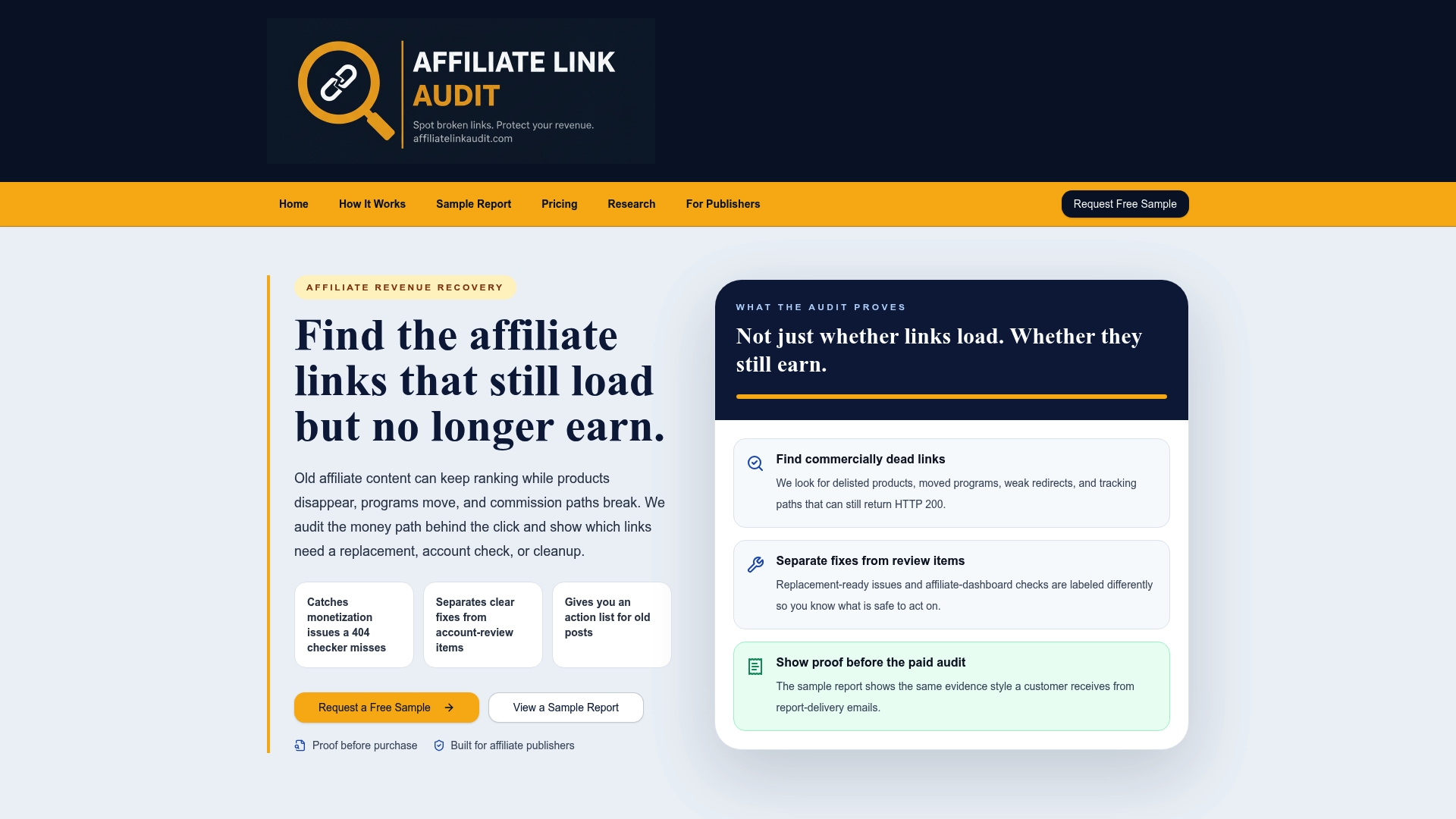
Readers can start with a free sample report to see the evidence format before committing to anything, or move directly to a Full Audit priced at $97 one-off for a complete scan of a site's affiliate links. Publishers managing larger content libraries can review the publisher-focused workflow for how audits fit into an editorial calendar. We detect links that are commercially unhealthy, discontinued products, homepage redirects, unverifiable tracking, and provide evidence; the publisher decides what to fix. We do not verify actual commission crediting or guarantee recovered revenue, and we do not automatically fix or rectify links ourselves.
FAQ
How many affiliate links should a post have?
There is no fixed number; the right count depends on content length and how many genuinely relevant products exist for the topic. The better practice is auditing existing links for relevance and function rather than targeting a specific quantity per post.
What counts as a broken affiliate link?
A broken link returns a 4xx or 5xx HTTP status, redirects to an unrelated domain, or points to a confirmed discontinued product page. A link can also be commercially broken while returning a 200 OK status if it redirects to a merchant's homepage or loses its tracking parameter.
Where should affiliate disclosures be placed?
FTC staff guidance recommends placing disclosures close to the affiliate link or recommendation itself, using plain language rather than vague shorthand. A disclosure buried in a separate policy page does not meet this standard.
How often should I audit my affiliate links?
A practical cadence runs automated crawls weekly, manual spot checks monthly, and a full deep audit quarterly, with off-cycle checks triggered by merchant migrations or program changes. Affiliate Link Audit's Full Audit service, priced at $97 one-off, covers the full-site deep audit portion of that cadence.
Does a 200 OK status mean an affiliate link is healthy?
Not necessarily. A link can return 200 OK while redirecting to a homepage, losing its tracking parameter, or landing on a page for a product that no longer exists, which is why audits test beyond status codes to confirm commissionable behavior.
Recommended
- Affiliate Link Audit for Publishers
- Affiliate Link Health Benchmark 2026
- Travel Publisher Link Health Research
This article was produced with AI assistance and reviewed for accuracy. Findings language ("Broken," "Needs Attention," "Healthy") reflects Affiliate Link Audit's evidence-based classification system.