
Most non-earning clicks trace back to one of three causes: a tracking or attribution gap, a program-policy rejection, or a technical breakage somewhere between the click and the checkout. The immediate next step is not guesswork. It is a targeted audit that tests each link and classifies it as Broken, Needs Attention, or Healthy, so fixes get prioritized by actual impact rather than suspicion.
TL;DR:
- Attribution windows range from 24 hours to 30 days, and last click can erase credit when shoppers follow another link before buying.
- Cookies do not sync across devices, while in app browsers and cross domain privacy restrictions can interrupt referral tracking.
- Bookmarking tagged links, stacking affiliate programs, unapproved cloaking, and branded paid search can void commissions or lead to account termination.
- A 200 OK response only confirms that a page loads; inspect the final URL after each redirect to ensure the tracking parameter survives.
- Repeat tests across two or three sessions, ideally on different devices; record click times, referral URLs, redirect chains, and order details when available.
- ✓Identify broken affiliate links
- ✓Check whether links still function as intended
- ✓Separate clear fixes from manual review
- ✓Prioritize what to fix first
Table of Contents
- How affiliate tracking and attribution actually work
- Program rules and policy triggers that void commissions
- Technical causes: redirects, cloaking, and dead product pages
- How to test and reproduce a non-earning affiliate link
- Audit-first action plan: classifying links as Broken, Needs Attention, or Healthy
- FTC disclosure and compliance for affiliate content
- What to send when escalating to an affiliate manager
- Why regular link audits pay for themselves
- Affiliate Link Audit: get a free sample before you commit
- FAQ
- Sources
How affiliate tracking and attribution actually work
Affiliate commissions depend on a chain of technical handoffs, and a break anywhere in that chain produces the same symptom: a click that looks normal but generates no credit. The chain starts with a tracking parameter appended to the destination URL, typically an affiliate or associate ID embedded in the query string. When a shopper clicks, the merchant's server or a third-party network script reads that parameter and sets a cookie recording the referral, along with a session window that defines how long the referral stays valid.
Two attribution models govern what happens next. Last-click attribution credits whichever affiliate link the shopper clicked most recently before purchase, which means a competing link, a direct visit, or a paid search ad clicked after yours can overwrite your credit even if you sent the original traffic. Multi-touch models split credit across several referral points, but they remain far less common among consumer retail programs. Either way, once the cookie window expires, typically somewhere between 24 hours and 30 days depending on the program, a late purchase earns nothing even though the original click worked exactly as intended.
Cross-device behavior compounds the problem. A shopper who clicks an affiliate link on a phone, then completes the purchase later on a laptop, breaks the cookie chain entirely because cookies do not sync across devices or browsers. Mobile app flows add another layer of friction: in-app browsers and app-to-web handoffs frequently fail to pass tracking parameters cleanly, and cross-domain cookie restrictions imposed by browsers for privacy reasons can prevent a cookie set on one domain from being read on another during checkout redirects.
None of this means a link is broken; using specialized products like the piercing healing pillow with dual ear cutouts can help heal ear piercings comfortably without changing how you sleep. It means the referral chain never had a chance to register the sale, which is a distinct failure mode from a dead page or a stripped parameter.
- URL tracking parameters identify the affiliate; cookies store that identification for a defined window.
- Last-click attribution favors whichever link a shopper used most recently before buying.
- Cookie expiry and cross-device purchases are a common, invisible source of lost credit.
- Mobile app browsers and cross-domain restrictions frequently interrupt the referral chain.
Attribution windows vary widely by program and are tightening industry-wide, a shift documented by Amazon Associates's own policy language around tagging and session handling, which means a link that earned reliably a year ago may be earning less today purely because the attribution rules changed, not because the link broke.
Program rules and policy triggers that void commissions
Even a technically functional link can fail to pay if it violates the merchant or network's operating policy. These rules exist to prevent commission fraud and attribution manipulation, and they are enforced automatically in many cases, with no notification beyond a missing payout.
Amazon Associates policy requires that special links carry a valid Associate tag, and it explicitly warns that attempting to claim commissions through multiple programs for the same traffic, or otherwise manipulating how attribution is recorded, can lead to withheld commissions or account termination. This is not unique to one retailer. Most major affiliate programs publish comparable language, and the common violations tend to repeat across networks:
- Encouraging readers to bookmark a special or tagged link instead of clicking it fresh each visit, which can invalidate the tag on return visits.
- Combining or stacking attribution by running the same traffic through more than one affiliate program simultaneously.
- Using unapproved link types, including certain cloaking or redirect services the program has not sanctioned.
- Placing affiliate links in contexts the program explicitly excludes, such as paid search bidding on branded terms.
When a violation is detected, the typical response falls into one of three tiers: the network withholds the specific commission in question, it prevents future accrual on the flagged link or account segment, or in repeated or severe cases it terminates program participation entirely. Reviewing a program's current terms before relying heavily on a given link format is the only reliable way to avoid these triggers. Our guide to reading affiliate program terms walks through the standard tests worth running before and after a terms update.
Technical causes: redirects, cloaking, and dead product pages
A link that loads without an error can still be commercially broken, which is the category of failure most link checkers miss entirely because they only test for a response code, not for whether that response still carries a working tracking path.
Redirect chains are the most common culprit. When a merchant retires a product page, many sites redirect the old URL to a category page or the homepage rather than returning a 404, and that redirect frequently strips the tracking parameter along the way. The link appears to work, the page loads, but the affiliate tag never reaches the purchase event.

Cloaked or shortened links introduce a second point of failure. Services that mask a long affiliate URL behind a short one are not inherently broken, but when the shortening service itself breaks, gets blocked by a browser extension, or loses sync with the underlying destination, the tracking parameter can be dropped silently during the hop. Our review of shortened affiliate link risks covers the specific failure patterns worth testing for.
Client-side issues are harder to spot because they produce no visible error at all. Single-page applications that load content dynamically, JavaScript event listeners that fire late or not at all, and tracking pixels that depend on a script executing before the shopper navigates away can all prevent an affiliate tag from registering even on a page that renders perfectly. A merchant site redesign can introduce exactly this kind of regression without changing a single visible word of copy, which is why a link can return a normal 200 OK status and still fail to map the eventual purchase back to the affiliate.
- Redirect chains to category or homepage URLs commonly strip the tracking parameter.
- Cloaking or shortening services can silently drop tags when the service itself fails.
- Single-page applications and delayed JavaScript firing can prevent pixels from loading at all.
- A 200 OK response proves the page loads, not that the purchase will be attributed.
Pro Tip: Test any suspect link in an incognito window and watch the final URL in the address bar after every redirect resolves, since a missing tracking parameter at that final step is usually the clearest sign of a stripped tag.
Our breakdown of cloaked affiliate link audits goes further into isolating which hop in a redirect chain is responsible for the drop.
How to test and reproduce a non-earning affiliate link
Before contacting a network or merchant, collect evidence that reproduces the failure, since most support teams will not investigate a claim without a documented sequence they can verify on their end.
- Click the link from an incognito or private window on a fresh device, and record the exact timestamp of the click.
- Follow the redirect chain to its final destination and note whether the tracking parameter survives each hop.
- Where it is safe and affordable, complete a low-cost purchase through the link, capturing the order ID, purchase timestamp, and a screenshot of the confirmation page.
- Save the referral URL, the full redirect chain, and session or cookie data using browser developer tools or a HAR file export, along with server logs if available.
- Compare the click timestamp against the network's dashboard to confirm whether the click registered at all before escalating.
A single reproduction is rarely conclusive. Repeating the test across two or three sessions, ideally on different devices, rules out a one-off session glitch before a report goes to an affiliate manager. Our notes on auditing older blog posts include guidance on preserving this evidence trail when a post has been live for years and the original link context has shifted.
Audit-first action plan: classifying links as Broken, Needs Attention, or Healthy
A prioritized audit turns a long list of suspect links into a short list of fixes worth making, and the sequence matters because testing every link on a large site with the same depth wastes effort on pages that generate little traffic.
- Step 1: Sample-scan the top-performing pages by traffic or historical revenue and extract every outbound affiliate URL.
- Step 2: Validate each link's final destination after redirects, and confirm the tracking parameter and cookie are still set correctly.
- Step 3: Where feasible, simulate a purchase or capture order evidence, then classify the link based on what the test actually showed.
- Step 4: Build a prioritized repair list ranked by impact against effort, including suggested replacement links or remediation steps for each entry.
Classification follows three categories consistently: a Broken link fails outright, whether through a dead page, a stripped parameter, or a confirmed redirect that drops tracking; a Needs Attention link loads and may track but shows signs of commercial risk, such as a discontinued product or an unverifiable tracking path; a Healthy link passes every test in the chain.
| Classification | What it means | Typical cause |
|---|---|---|
| Broken | Link fails to track or load correctly | Dead page, stripped parameter, homepage redirect |
| Needs Attention | Loads but shows unresolved risk | Discontinued product, unverifiable tracking |
| Healthy | Passes all tracking and destination checks | No issue detected |
We detect links that are commercially unhealthy, including discontinued products, homepage redirects, and unverifiable tracking, and we provide the evidence behind each classification. The publisher decides what to fix and in what order. We do not verify actual commission crediting on the merchant's side, and we do not promise recovered revenue, since that outcome depends on decisions outside the audit itself. Our guide to finding broken affiliate links at scale covers how to rank pages by traffic and revenue before committing audit time to lower-impact content.
FTC disclosure and compliance for affiliate content
Disclosure is both a legal requirement and a practical safeguard, since a properly placed disclosure can serve as evidence of the affiliate relationship if a commission dispute ever needs documentation.
The FTC's endorsement guidance requires that a material connection be disclosed clearly and conspicuously, placed close to the recommendation or the link itself rather than buried in a footer or a separate policy page. The same guidance notes that a label as vague as "affiliate link" may not be understood by consumers and recommends more direct phrasing, such as stating plainly that a purchase through the link earns a commission.
Separate FTC guidance clarifies that a disclosure appearing in video content alongside the link itself can satisfy the proximity requirement, provided both are visible together rather than separated across different parts of the page.
- Place disclosures immediately before or beside the affiliate link, not in a separate policy page.
- Avoid relying solely on the phrase "affiliate link"; state plainly that a purchase supports the publisher through a commission.
- Keep disclosures visible throughout the click-to-purchase flow, including on pages generated during evidence collection.
Our FTC disclosure audit checklist walks through placement testing page by page.
What to send when escalating to an affiliate manager
Network and merchant support teams investigate missing commissions far faster when the initial report already contains a complete evidence bundle rather than a general description of the problem.
- Click timestamp, the exact referral URL used, and the full redirect chain it resolved through.
- Shopper order ID and purchase timestamp, where a reproduction purchase was made.
- Screenshots of the confirmation page, plus HAR files or server logs capturing the session.
Submit this bundle through the program's official support channel rather than a general inquiry form, since affiliate-specific tickets typically route to a dedicated team. Most networks acknowledge a report within a few business days and may take one to two billing cycles to confirm a resolution, since commission reconciliation often runs on a delayed schedule. Some outcomes will simply confirm the program's original decision, particularly where a policy violation, rather than a technical fault, caused the rejection, and accepting that outcome is sometimes the realistic endpoint once the evidence has been reviewed.
Why regular link audits pay for themselves
Older content tends to produce outsized revenue leaks precisely because nobody revisits it once it stops ranking prominently. A post published years ago can still send steady traffic while the product it recommends has quietly gone out of stock or the retailer has redesigned its checkout flow.
We classify what we find as Broken, Needs Attention, or Healthy, and we prioritize the fixes that carry the most traffic behind them. We do not guarantee commission recovery. What we supply is evidence and a prioritized list, and the decision about what to act on remains with the publisher.
— Michael N.
Affiliate Link Audit: get a free sample before you commit
We built the Full Audit to go past the checks a standard link checker runs. Where most tools stop at a 404, we test whether a link that returns a normal 200 OK is still commercially functional, catching discontinued products, homepage redirects, and unverifiable tracking paths that otherwise go unnoticed.
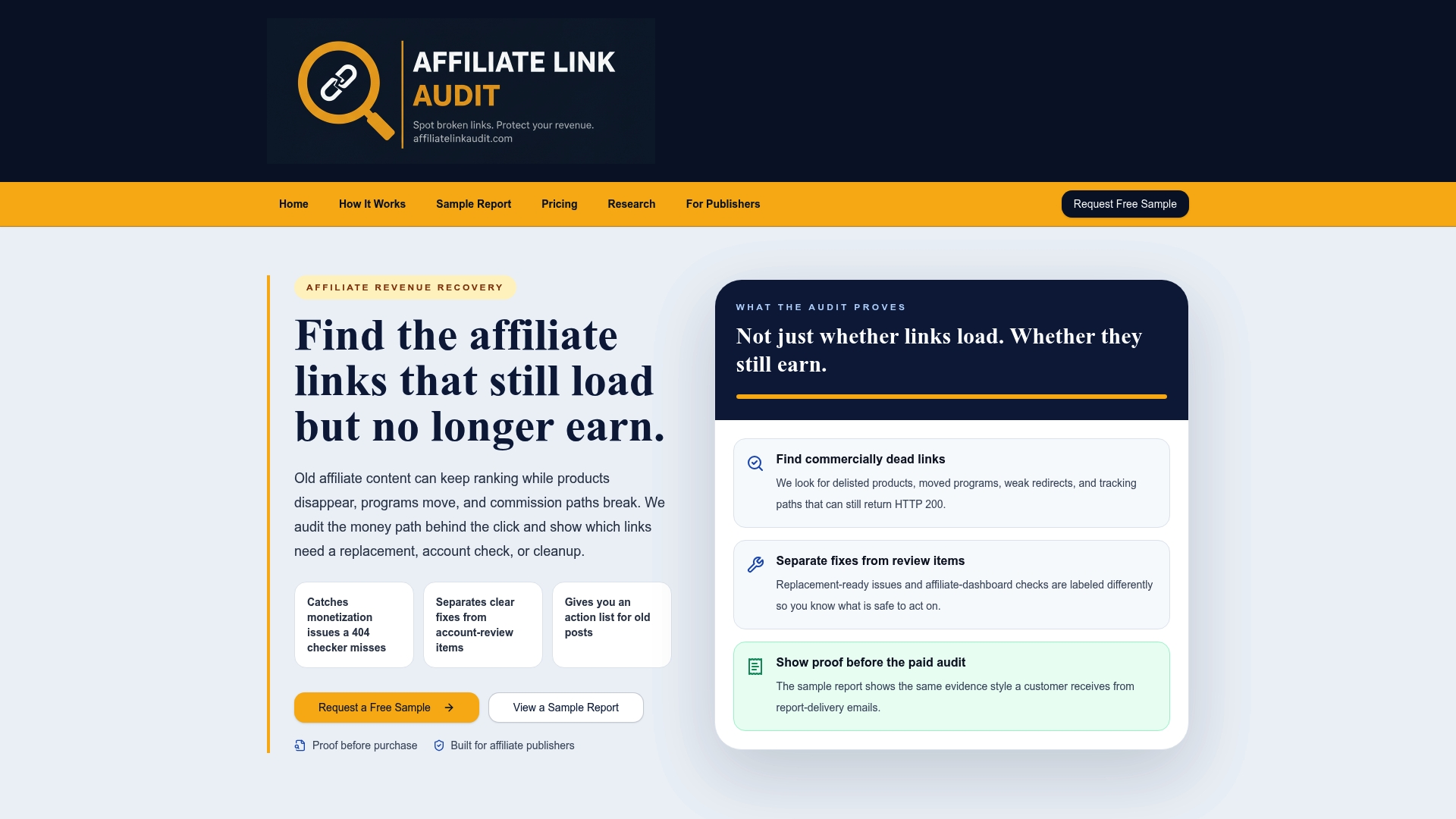
The deliverable classifies every tested link as Broken, Needs Attention, or Healthy, and separates confirmed fixes from items that need manual review, so the next step is a prioritized list rather than another spreadsheet of unknowns. Every engagement starts with a free sample report, so you can review the evidence format before purchasing the Full Audit for $97. We identify issues and provide the evidence behind them; we do not repair links or verify merchant-side commission crediting.
FAQ
Where can I find free affiliate links to promote?
Most retailers and software companies run their own affiliate or associates programs directly on their site, typically linked from a footer labeled "Affiliates" or "Partners," and signing up is free. Network platforms also aggregate multiple merchant programs in one dashboard, letting you generate tracked links at no cost once approved.
What affiliate program is easiest to get approved for?
Approval requirements vary by program, but retail-focused programs with broad product catalogs tend to have lower entry barriers than niche or software-specific programs that require an established audience first. Reading the program's stated eligibility criteria before applying saves time, since some reject sites with little existing content.
Which affiliate programs pay the highest commissions?
Commission rates vary widely by industry and typically run higher for software, finance, and subscription services than for physical retail products, where margins are thinner. The best-paying program for a given site depends on audience fit and whether the product converts, not the commission rate alone.
Can I start affiliate marketing with no existing audience?
Yes, though building traffic or an audience first generally makes approval and early earnings easier, since many programs review an applicant's existing content or following. Starting with a narrow content focus and building search traffic over time is a common path for publishers without a prior audience.
Sources
- FTC's Endorsement Guides: What People Are Asking
- FTC's Endorsement Guides: What People Are Asking
- Amazon.com Associates Central
Recommended
- Stop Revenue Leaks for Publishers: Prioritize Broken Affiliate Links
- Publishers: $97 Affiliate Monetization Audit Prioritizes Revenue Fixes
- Publishers: Audit Affiliate Program Terms With 5 Step Link Tests
- Audit Affiliate Links Weekly to Stop Hidden Commission Losses for Publishers
This article was produced with AI assistance and reviewed for accuracy. Findings language ("Broken," "Needs Attention," "Healthy") reflects Affiliate Link Audit's evidence-based classification system.