
An audit of old blog posts produces a prioritized, evidence-backed list of affiliate links classified as Broken, Needs Attention, or Healthy, each paired with a suggested replacement or editorial action. The methodology draws on Google's link-qualification guidance for implementation checks and the FTC's Endorsement Guides for disclosure requirements. Affiliate Link Audit's sample report shows what a completed deliverable looks like in practice.
TL;DR:
- Most affiliate links that return a 200 status code may still be outdated or no longer valid; a healthy link must confirm product availability and correct landing page.
- Regular audits should prioritize high-traffic, high-intent posts with easily fixable links, while low-traffic or low-commitment links can be deferred unless systemic issues are detected.
- Proper link markup with rel="sponsored" and clear, proximate disclosures are crucial for compliance but do not influence the technical health of the affiliate link.
- Manual validation remains necessary for ambiguous links, especially those returning 200 codes but potentially no longer directing to the intended product.
- Conducting and documenting recurring audits with clear evidence helps prevent disputes, ensures compliance, and maintains affiliate revenue integrity.
Table of Contents
- What an affiliate link audit actually checks
- Quick prioritization framework: score and rank findings
- Step-by-step audit workflow to build the prioritized report
- Evidence and reporting: exact fields every finding should include
- Compliance checks to flag: rel attributes and disclosures
- Publisher perspective: common mistakes in maintaining old content
- Affiliate Link Audit: sample report and full audit offer
- Sources
- FAQ
What an affiliate link audit actually checks
An audit examines three distinct layers of an affiliate link, and conflating them is the most common error in informal link-checking. The technical layer covers HTTP status codes, redirect chains, and homepage redirects, along with the subtler case of a link that returns 200 OK but lands on a page with no trace of the original product. The commercial layer asks whether the product is still sold, whether the landing page matches the anchor text's intent, and whether tracking identifiers are present in the final URL. The implementation layer checks markup, specifically whether the link carries the appropriate rel attribute and whether a disclosure sits near enough to the recommendation to satisfy readers and regulators.
Each finding gets one of three labels, and the terms carry specific meaning rather than a general impression of link quality:
- Broken: the link returns an error, redirects to an unrelated domain, or lands on a page where the referenced product cannot be found.
- Needs Attention: the link resolves to a 200 status but shows signs of commercial decay, such as a generic homepage redirect, an out-of-stock product, or a missing tracking identifier.
- Healthy: the link resolves correctly, the product is available, the landing page matches the anchor text, and tracking parameters are intact.
These definitions matter because a 200 status code alone tells a publisher almost nothing about whether the link still earns.
Quick prioritization framework: score and rank findings
A raw list of findings is not a work plan. Turning it into one requires scoring each flagged link against a small set of axes and ranking the results.
- Traffic: pageviews to the source post over a defined window, since a fix on a low-traffic post returns little value regardless of severity.
- Conversion intent: whether the anchor text and surrounding content suggest a reader ready to buy, versus a passing mention.
- Content relevance: whether the post itself still matches current search intent for its target query.
- Ease of fix: whether a direct replacement URL exists or whether the section needs a rewrite.
A simple weighted formula works well: multiply a 1 to 5 traffic score by a 1 to 5 conversion-intent score, then adjust for ease of fix. High-traffic, high-intent, easy-fix links go into an immediate bucket. Moderate scores go into a scheduled bucket tied to the next content sprint. Low-traffic or low-intent findings, even when Broken, drop into a low-priority bucket unless the same merchant or redirect pattern recurs across multiple posts, which signals a systemic issue worth escalating to a developer rather than fixing link by link.
Pro Tip: When three or more posts share the same broken redirect pattern, treat it as one ticket, not several, since the fix is almost always identical.
Step-by-step audit workflow to build the prioritized report
The workflow that produces a defensible report runs in five stages, moving from scope definition to a formatted handoff document.
- Define scope: set a date range for eligible posts, decide which content types qualify (reviews, roundups, comparison posts), and apply a traffic cutoff so the audit does not spend equal effort on a post with negligible visits.
- Crawl and collect: for every affiliate link found, record the original URL, the full redirect chain, the HTTP status at each hop, the anchor text used, and basic page metrics for the source post.
- Validate manually where automation is ambiguous: a 200 response does not confirm the product still exists, so ambiguous cases require a manual merchant search to confirm current availability and price.
- Classify and score: apply the Broken, Needs Attention, or Healthy label, then run the prioritization scoring from the previous section.
- Format the handoff: attach evidence to each finding and structure the output so an editor or developer can act without re-checking the work.
Two categories of information belong in every crawl record:
- Source post URL, publish date, and the anchor text tied to the flagged link.
- Redirect chain, final destination, HTTP codes, and any tracking parameters observed.
A semi-automated crawler can flag candidates quickly, but the manual validation step is what separates a defensible finding from a guess, particularly for links that resolve to 200 but no longer point at a purchasable product.
Evidence and reporting: exact fields every finding should include
A finding without evidence is an opinion, and opinions do not survive an editorial dispute or a client invoice review. Each entry in the report should carry a fixed set of fields so the classification can be checked independently later.
- Link identity: source post URL, the exact link text used, and the original affiliate URL as it appeared in the page.
- Path record: the full redirect chain and the final landing URL, with HTTP status codes at each step.
- Proof of state: a screenshot of the landing page, a saved copy of the HTTP response, and a timestamped capture so the finding can be reproduced later.
- Commercial markers: tracking identifiers present or absent in the final URL, noted separately from the product availability check.
- Suggested action: a replacement URL where one is confidently available, or a flag for manual review when no clean replacement exists.
The report should stick to the three classification terms throughout and avoid any claim that commission was actually being lost or would be recovered by a fix. An audit detects links that are commercially unhealthy, discontinued products, homepage redirects, or unverifiable tracking, and hands the publisher evidence. The publisher decides what to fix and what the financial impact was.
Compliance checks to flag: rel attributes and disclosures
Two compliance items belong in every audit alongside the technical and commercial checks, and they get recorded as separate fields rather than folded into the Broken or Healthy label.
- Link markup: Google's guidance on qualifying outbound links recommends rel="sponsored" for affiliate links, with rel="nofollow" still accepted; an audit should record whether the attribute is present and correct, since a missing or wrong attribute is a search-quality signal issue, not proof that the link fails to earn.
- Disclosure proximity and clarity: the FTC's Endorsement Guides require that a material connection be disclosed clearly and near the recommendation itself, and the revised guides adopted in the Federal Register in July 2023 give worked examples of what counts as adequate placement.
A recurring finding across audits is that disclosure language, when present, often sits far enough from the affiliate link that readers may not connect the two. The eCFR's current text of 16 CFR Part 255 works through examples of exactly this gap between a disclosure's existence and its effectiveness. These findings are implementation and compliance flags. They say nothing about whether a link is still generating commission.
Publisher perspective: common mistakes in maintaining old content

The most consistent mistake among publishers is treating a 200 status code as proof a link works, when it only proves the server responded. A related mistake is fixing links without preserving the redirect chain or a screenshot, which leaves no record if a dispute arises later about whether a link was broken at the time of audit. Weak or misplaced disclosures are a third recurring gap, often inherited from templates written years before current guidance existed.
The practical fix is structural: fold link audits into a recurring maintenance cycle, ideally quarterly, rather than treating them as a one-time cleanup. Each finding in the resulting report should get an assigned owner and a deadline, the same way a bug ticket would, so fixes do not stall in a shared spreadsheet nobody checks twice.
— Michael N.
Affiliate Link Audit: sample report and full audit offer
Running this workflow manually across years of archived posts takes time most editorial teams do not have, particularly the merchant-availability checks that resist full automation. This service performs the manual and semi-automated checks described above and returns the same structure: links classified as Broken, Needs Attention, or Healthy, each with evidence attached and a prioritized order for fixes.
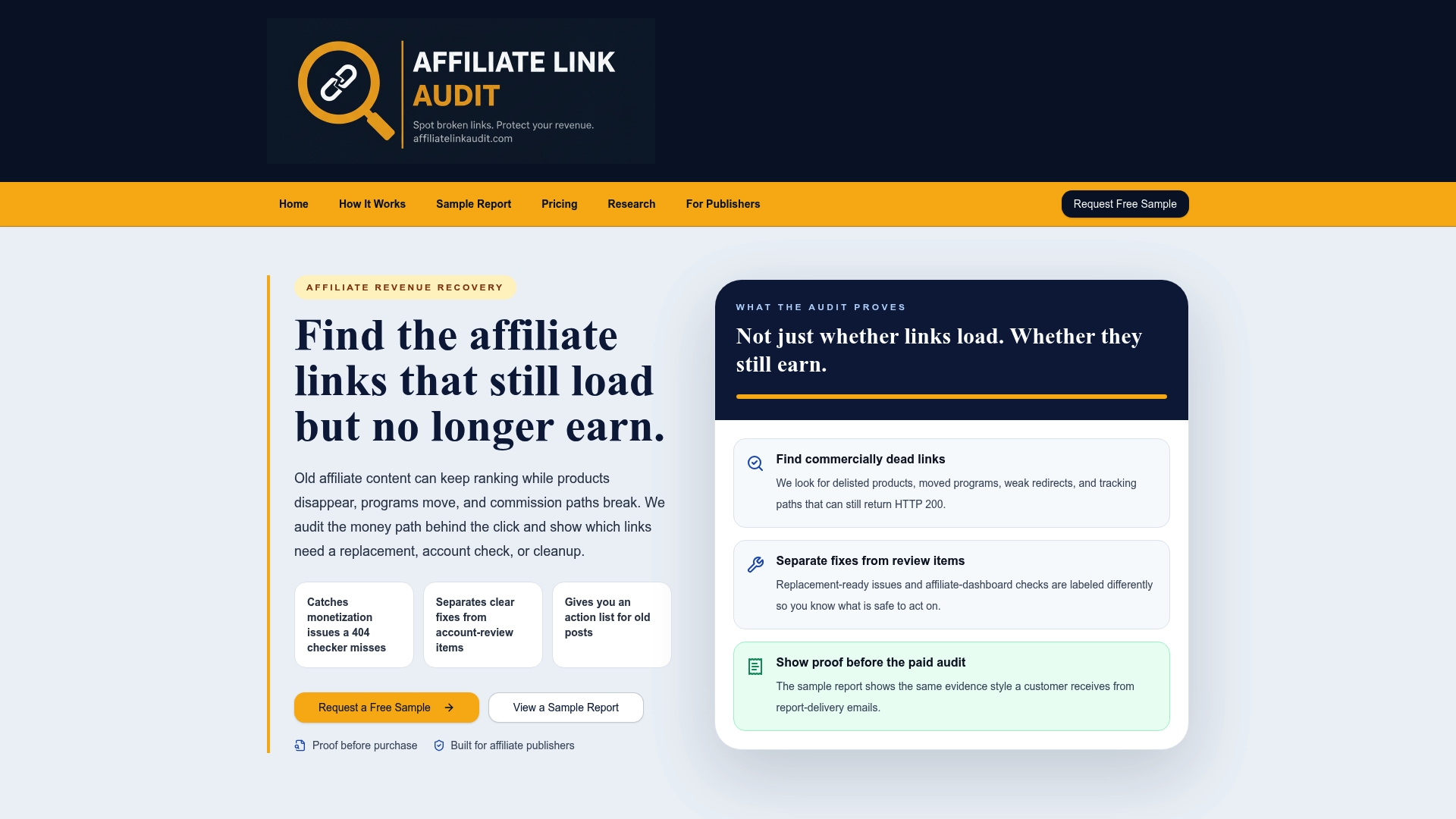
- A Full Audit costs $97 as a one-off service and returns the complete prioritized action plan for a site's archived affiliate content.
- Findings separate confirmed issues from links that need manual editorial review, so a team can act on the clear cases immediately.
Publishers managing their own audits with an in-house crawler can still use the sample report as a template for what a complete finding should contain. Review the Affiliate Link Audit for Publishers page for scope details, or go directly to request a full audit.
Sources
For verification, consult Google's qualifying outbound links guidance, the FTC's Endorsement Guides FAQ, the 2023 Federal Register notice adopting the revised guides, and 16 CFR Part 255 in the eCFR. The Affiliate Link Health Benchmark 2026 offers additional publisher-focused context.
- Qualify outbound links | Google Search Central
- FTC's Endorsement Guides: What People Are Asking | Federal Trade Commission
- Federal Register, Volume 88 Issue 142 (Wednesday, July 26, 2023)
- eCFR :: 16 CFR Part 255 -- Guides Concerning Use of Endorsements and Testimonials in Advertising
FAQ
What counts as a Broken link versus one that Needs Attention?
A Broken link returns an error, redirects to an unrelated domain, or leads to a page where the original product cannot be found at all. A Needs Attention link loads normally but shows signs of commercial decay, such as a homepage redirect or a missing tracking identifier, without being a hard failure.
Does a passing HTTP status mean the affiliate link still earns commission?
No. A 200 OK response only confirms the server returned a page; it says nothing about whether the product is still sold, the tracking identifier is intact, or the link is generating commission. Audits treat destination health and commercial viability as separate checks for this reason, as Google's outbound link guidance implies when it separates markup from performance.
Should affiliate links use rel="sponsored" or rel="nofollow"?
Google recommends rel="sponsored" for affiliate links, though rel="nofollow" remains an accepted alternative according to its outbound link qualification guidance. An audit should record which attribute is used and flag any affiliate link with no qualifying attribute at all.
How often should a publisher re-audit older affiliate posts?
There is no single mandated interval, but folding link checks into a recurring maintenance cycle, commonly quarterly, catches redirect and product-availability decay before it accumulates across hundreds of posts. The Affiliate Link Health Benchmark 2026 provides further publisher-focused context on this cadence.
What does a full audit from Affiliate Link Audit include?
A Full Audit costs $97 as a one-off service and returns a prioritized report classifying each affiliate link as Broken, Needs Attention, or Healthy, with evidence attached for every finding. A free sample report is available first to review the format before purchasing.
Recommended
- Affiliate Link Audit for Publishers
- Affiliate Link Health Benchmark 2026
- Affiliate Link Health Research
This article was produced with AI assistance and reviewed for accuracy. Findings language ("Broken," "Needs Attention," "Healthy") reflects Affiliate Link Audit's evidence-based classification system.