

Use branded shortened links, but only when they preserve affiliate tracking, follow program rules, and are tested before publishing. A link that collapses a long affiliate URL without confirming that tags and redirects still function creates a measurable risk: clicks that never convert to recorded commission. The safest workflow treats every shortened link as a candidate for verification, not a finished asset, before it goes live.
TL;DR:
- Branded short links are most beneficial for high-volume campaigns in paid social, SMS, or print, where clear branding and detailed click data are justified.
- Always verify and test a shortened link on multiple devices before publishing to ensure tracking tags and destinations remain intact throughout redirects.
- Use a consistent creation process that includes adding UTM parameters, customizing the back-half, and confirming the link’s functionality to avoid silent tracking issues.
- Keep a record of the original affiliate URL, disclosure text, and redirect tests to maintain compliance with Amazon and FTC rules, especially during provider migrations.
- Regularly audit existing shortened links to identify those that have broken or lost earning potential, prioritizing links responsible for most traffic and revenue.
Table of Contents
- What shortened affiliate links actually deliver
- Choosing between hosted, branded-domain, and self-hosted shorteners
- Staying compliant with Amazon Associates and FTC disclosure rules
- Reconciling shortener clicks with network conversion data
- A checklist for creating safe, trackable short links
- Protecting your links when you change providers
- Shortening a link the right way, step by step
- Finding the shortened links that quietly stopped earning
- When branded short links earn their overhead
- Affiliate Link Audit: check what your short links are really doing
- Sources
- FAQ
What shortened affiliate links actually deliver
Shortened affiliate links solve a presentation problem more than a performance problem. A long URL packed with tracking parameters looks suspicious in a text message, a social caption, or a printed flyer, and a branded short link reads as more trustworthy to a skeptical audience.
The vendor data available on this point should be read as directional rather than conclusive. According to Bitly's own guidance, branded links can show noticeable increases in click-through rates, with custom domains delivering higher engagement on average. Those figures come from vendor-reported testing, not independent audits, and a higher click rate does not automatically translate into higher recorded commission. The two metrics measure different things.
- Shareability: short links fit character limits on social platforms and look cleaner in printed or verbal contexts.
- Trust signal: a branded domain reduces hesitation compared to an unfamiliar long string of parameters.
- Consistency: a uniform link format across campaigns simplifies internal tracking and content audits.
Shortener dashboards report clicks, referrer data, and campaign tags. They do not report whether a click resulted in a credited commission inside the affiliate network. That reconciliation happens on the network side, and it is a separate step from anything a shortener measures. Short links perform best in social bios, SMS campaigns, and printed materials where a clean, memorable URL matters more than descriptive length.
Choosing between hosted, branded-domain, and self-hosted shorteners
Three technical approaches dominate the affiliate space, and the right choice depends on scale, budget, and how much control the marketer wants over the underlying data.
Hosted services such as Bitly or TinyURL offer the fastest setup: create an account, paste the destination URL, and publish. Centralized analytics dashboards make click tracking straightforward for marketers running a handful of campaigns, though the affiliate stays dependent on the vendor's infrastructure and pricing tiers.
Branded-domain providers like Rebrandly sit a level up, letting marketers replace the generic shortener domain with their own, which supports the trust and branding benefits described above. The tradeoff is typically a recurring subscription cost tied to link volume or custom domain count.
Self-hosted options, including WordPress plugins built for link management and shortening, hand full ownership back to the marketer. Every link lives on infrastructure the marketer controls, which matters for long-term migration planning, but it also means the marketer owns the maintenance burden: updates, redirect rules, and uptime.
A practical selection checklist covers the technical requirements that matter regardless of which category a marketer picks:
- Custom domain support, so the short link carries the marketer's own branding.
- Editable back-half text, allowing descriptive slugs instead of random strings.
- UTM parameter support for campaign-level attribution inside analytics platforms.
- Exportable analytics and API access, so click data can be pulled into other systems.
- Redirect control and a documented migration path if the marketer ever changes providers.
Vendor pricing and feature tiers shift frequently enough that any specific number quoted here would likely be outdated by the time it is read. Marketers should confirm current tiers directly on a vendor's pricing page before committing.
Staying compliant with Amazon Associates and FTC disclosure rules
Shortening an affiliate link does not remove the marketer's obligation to follow program policy and disclosure law, and two sets of rules apply to nearly every affiliate publishing a short link.
Amazon Associates operating policies require that a link not obscure the fact that it leads to an Amazon site, and that tagged link formats remain intact through any redirect. A shortener that strips or alters the Amazon tag, or that hides the Amazon destination behind a misleading domain, creates a policy violation even if the link technically still works.
The FTC's endorsement guidance requires clear and conspicuous disclosure of an affiliate relationship, and a short-form placement such as a social caption or bio link does not exempt the marketer from that requirement. A short link itself is not a disclosure; the disclosure language has to sit near the link in text the audience will actually read.
A pre-publish sequence keeps both obligations in view:
- Copy the final tagged affiliate URL exactly as generated by the network or program.
- Shorten the link through the chosen provider without altering the query string.
- Click the finished short link on both desktop and mobile to confirm the destination and tag survive the redirect.
- Add a disclosure statement in the same post, caption, or bio section as the link, worded so a reader immediately understands the commercial relationship.
- Recheck Amazon-specific links against the current Amazon Associates operating agreement before publishing, since Amazon treats destination clarity and tag preservation as explicit conditions of participation.
Pro Tip: Keep a screenshot of the working redirect and the disclosure text together for each campaign; it becomes useful evidence if a platform or network ever questions a link's compliance.
Reconciling shortener clicks with network conversion data

A shortened link produces two separate data trails, and treating them as one number is the most common measurement mistake affiliates make. The shortener records a click. The affiliate network records a conversion, tied to whatever tracking parameters survived the redirect. These figures will rarely match exactly, and a gap between them is expected, not automatically a sign of a problem.
Preserving the original affiliate parameters through the shortening process is the first requirement for any comparison to make sense. Adding UTM parameters on top, following the stepwise approach Bitly documents for affiliate links, gives campaign-level attribution inside Google Analytics or GA4 without disturbing the underlying affiliate tag. Network guidance from partner programs generally reinforces this: shorteners are a measurement convenience layered on top of network-level attribution, never a replacement for it.
- Export shortener click data on a recurring schedule and match it against network conversion reports for the same campaign window.
- Use API or GA4 integrations where available, so click and conversion data land in one dashboard instead of two.
- Sample-check a handful of high-traffic links each cycle rather than attempting to verify every link at once.
That last point connects directly to an efficient audit posture. Applying an 80/20 lens, where the smaller set of links driving most clicks and revenue gets checked first, keeps a growing link library manageable without requiring a full manual review of every post. The Affiliate Link Health Benchmark 2026 covers this prioritization approach in more detail for publishers managing larger content libraries.
A checklist for creating safe, trackable short links
A consistent creation process removes most of the risk that shortened links introduce, and the sequence below works whether the marketer uses a hosted service, a branded domain, or a self-hosted plugin.
- Start from the final affiliate URL exactly as the network generates it, tags and all.
- Layer UTM parameters onto that URL for campaign, source, and medium tracking before shortening anything.
- Customize the shortener's back-half text so the slug describes the destination or campaign, supporting both clarity and A/B testing between variants.
- Test the finished short link on desktop and mobile browsers, confirming the destination page and every tracking parameter persist through the redirect.
- Tag and label the link inside the shortener's dashboard or a separate spreadsheet, and set a recurring date to recheck it.
Pro Tip: Build a simple naming convention for back-halves, such as campaign plus platform plus month, so a glance at the link list tells you what each one is for without opening the dashboard.
Skipping the testing step is the most common failure point. A shortener that works correctly for one destination can mishandle a URL with unusual characters or multiple parameters, silently dropping the affiliate tag while still delivering the visitor to the right page. The click looks normal to the visitor and the marketer, but the network never receives credit for it.
Protecting your links when you change providers
Ownership determines what happens when a shortener vendor raises prices, shuts down, or simply falls out of favor. A branded domain that the marketer controls, pointed at whichever shortening service is currently in use, keeps every published link working even if the backend provider changes.
- Own the domain used for short links, rather than relying solely on a vendor-assigned subdomain.
- Export the full link list and its analytics history before canceling or switching any shortener subscription.
- Set a redirect fallback and confirm DNS or hosting settings so published links keep resolving during a migration window.
- Consider self-hosting through a WordPress plugin or similar tool for campaigns expected to run for years, where long-term control outweighs the convenience of a hosted dashboard.
Enterprise publishers with large archives of monetized content face the highest exposure here, since a failed migration can silently break tracking across hundreds of old posts at once.
Shortening a link the right way, step by step
The sequence below walks through creating one shortened affiliate link without breaking its tracking, from the original URL to a published, verified campaign asset.
- Locate the final affiliate URL from the network or program dashboard, confirming it includes the correct tag or ID for the account.
- Add UTM parameters for campaign, source, and medium if the campaign needs analytics-level attribution beyond what the network provides.
- Paste the complete URL, tags and UTMs included, into the shortener and set a descriptive back-half rather than accepting a random string.
- Click the generated short link from at least two browsers and one mobile device, watching the final destination URL to confirm every parameter survived the redirect.
- Publish the link with a disclosure statement placed in the same visible section, then let the campaign run for a defined sample period.
- Pull shortener click totals and compare them against the affiliate network's conversion report for the same window, expecting a gap between the two rather than a match.
A mismatch that looks larger than expected is a signal to recheck the redirect and confirm the tag survived, not proof that the network under-reported. The verification step happens before publishing, and the comparison step happens after the campaign has run long enough to generate a meaningful sample.
Finding the shortened links that quietly stopped earning
A link shortener confirms that a URL redirects somewhere. It does not confirm that the destination still sells the product, still carries the original tracking tag, or still resolves to anything beyond a generic homepage. An audit checks further than a status code: it evaluates whether a link that returns normally is still commercially functional.
That distinction separates links into three categories: Broken, Needs Attention, and Healthy. A prioritized list built from that classification lets a publisher focus repair effort on the links most likely to be losing recorded commission, starting with the highest-traffic pages first.

When branded short links earn their overhead
Branded short links pay off for high-volume publishers running paid social, SMS, or print campaigns where a clean domain and click analytics justify the subscription cost. For a small blog with a handful of affiliate links, the compliance overhead and recurring fee can outweigh the branding benefit.
The practical rule: shorten when tracking and testing are part of the workflow, not an afterthought. A short link nobody verifies is a liability wearing a nicer domain.
— Michael N.
Affiliate Link Audit: check what your short links are really doing
Shortening a link and testing it once at launch does not guarantee it still works six months later. Product pages get discontinued, redirects get rerouted to homepages, and tracking tags get stripped by changes on the merchant side, all invisible to a simple click test. Affiliate Link Audit evaluates existing affiliate links, including shortened ones, against exactly that failure pattern, classifying each as Broken, Needs Attention, or Healthy and separating clear fixes from items that need manual review.
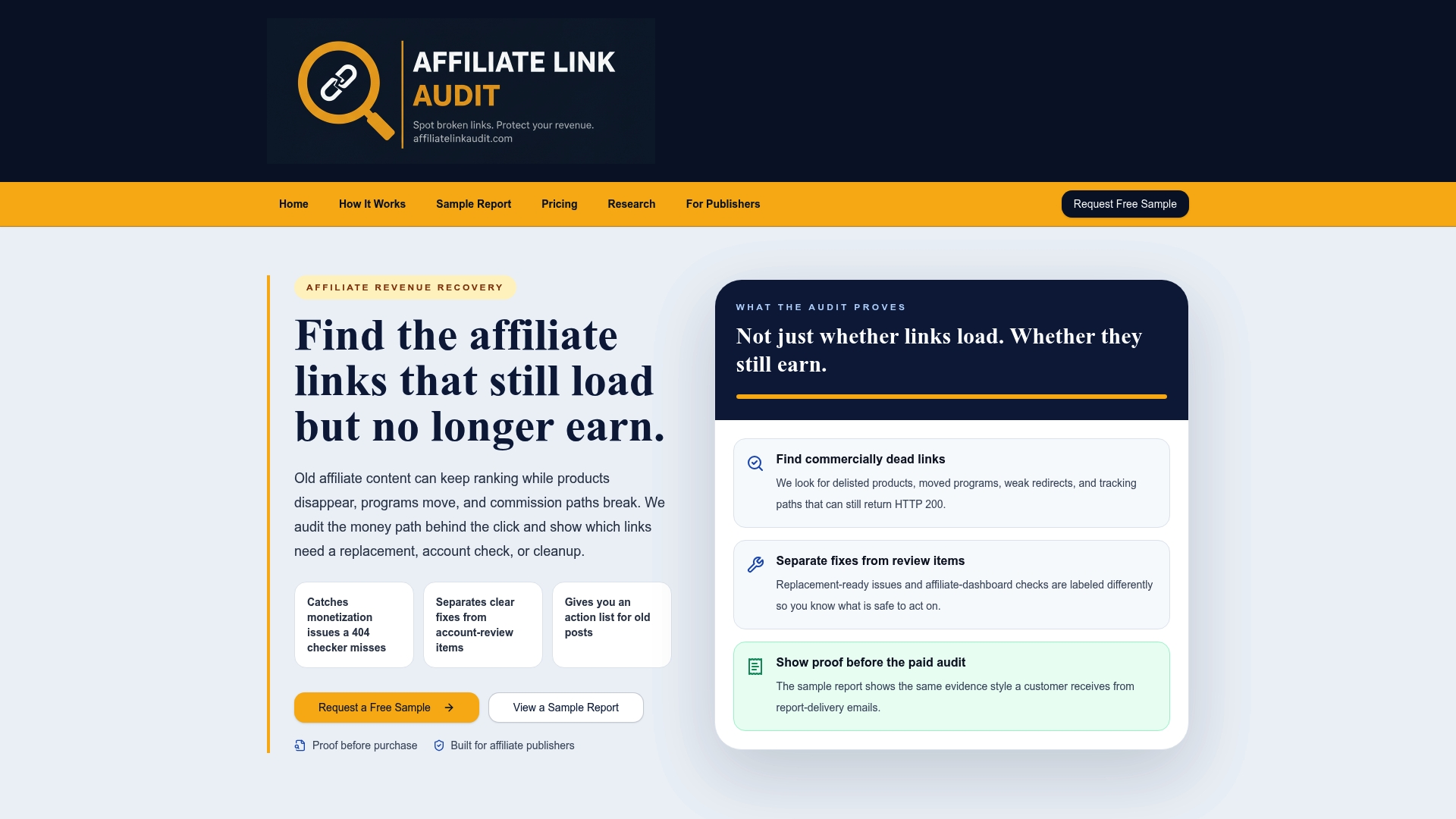
That classification supports the same 80/20 prioritization described earlier: instead of manually clicking through every link in an archive, a publisher gets a prioritized list of what to check first.
| Offering | What it includes |
|---|---|
| Free Sample | A sample audit report showing findings before purchase |
| Full Audit | Complete link classification and prioritized action plan |
Start with the free sample report to see the classification format before committing to a Full Audit.
Sources
- How to Shorten Affiliate Links to Boost Trust and CTR — Bitly blog
- Amazon Associates: Operating policies and requirements
- FTC: Endorsement guides — what people are asking
FAQ
Can I make money by shortening links?
Shortening a link does not generate income by itself; income comes from the affiliate commission tied to the underlying tagged URL. A shortener only changes the link's appearance and adds click analytics, so any earnings still depend on the original affiliate program and its commission structure.
What is the 80/20 rule in affiliate marketing?
Applied to link auditing, the 80/20 approach means checking the smaller set of high-traffic links responsible for most clicks and revenue before reviewing lower-traffic content. It keeps monitoring manageable for publishers with large archives by focusing effort where the payoff is greatest.
What are the best URL shorteners for affiliate links?
There is no single best option; credible choices include hosted services like Bitly, simple tools like TinyURL, branded-domain services like Rebrandly, and self-hosted WordPress plugins for full ownership. The right pick depends on compliance needs, analytics depth, and how much control the marketer wants over migration.
How do I make sure a shortened link still tracks correctly?
Test the finished short link on desktop and mobile before publishing, checking that the final destination URL still carries the original affiliate tag and any UTM parameters. Recheck periodically, since redirects and tracking tags can break after the initial test even if the link keeps working for visitors.
How can I tell if my shortened affiliate links have stopped earning?
A shortener's own dashboard will not show this, since it only reports clicks, not commission outcomes on the merchant or network side. A dedicated audit checks whether the destination page still sells the product and still carries a functioning tag, classifying each link as Broken, Needs Attention, or Healthy.
Recommended
- Affiliate Link Audit for Publishers
- Sample Affiliate Revenue Audit Report
- Affiliate Link Health Benchmark 2026
- Travel Publisher Link Health Research
This article was produced with AI assistance and reviewed for accuracy. Findings language ("Broken," "Needs Attention," "Healthy") reflects Affiliate Link Audit's evidence-based classification system.