
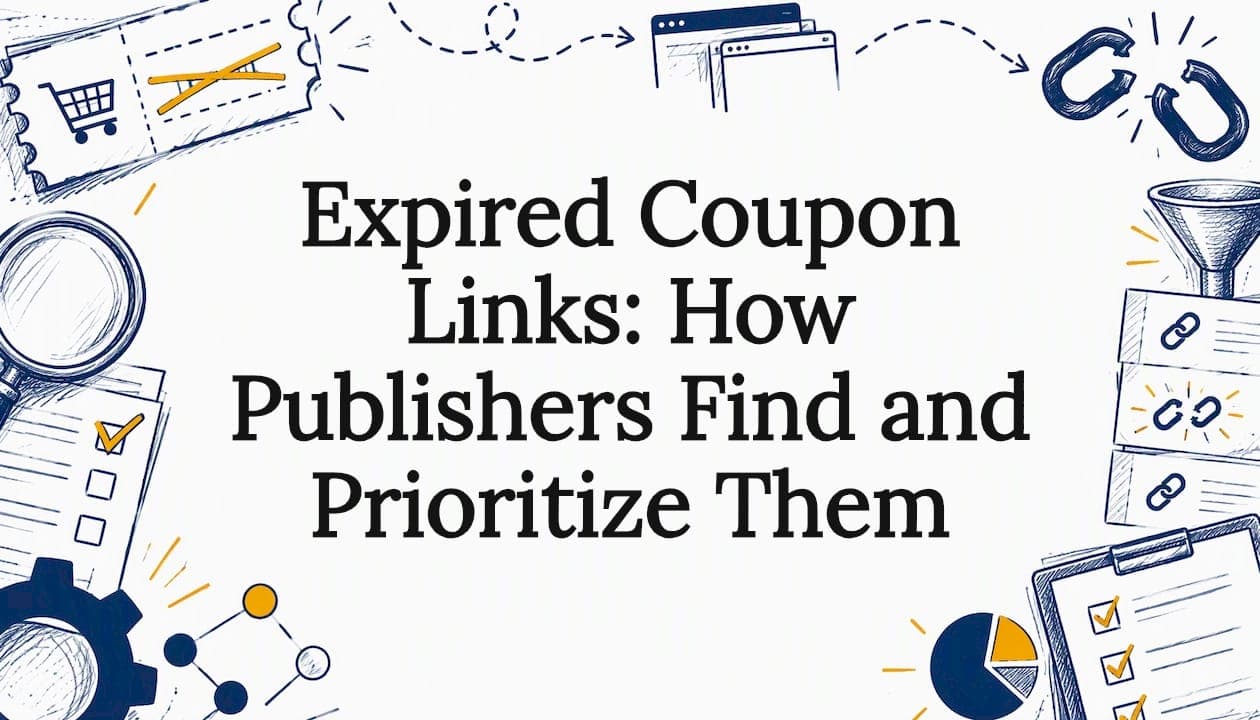
An expired coupon link is a monetized anchor, usually in an older post, that still promises a discount the merchant no longer honors. The link may return a normal page, so it passes a basic status check, yet the visitor lands on a rejected code, a generic homepage or a discontinued product. The reliable way to handle them is to test each link past the HTTP response, classify it as Broken, Needs Attention or Healthy, and work through the list in order of traffic and commercial exposure.
This article sets out what qualifies as an expired coupon link, how to detect one, how to decide between removal, replacement and manual review, and how to keep the problem from returning.
- ✓Identify broken affiliate links
- ✓Evaluate links that still load
- ✓Separate clear fixes from manual reviews
- ✓Prioritize what to fix first
TL;DR
- An expired coupon link is any coupon or offer anchor whose code, offer or tracking path no longer works as the page promises, whether or not the URL still loads.
- Studies of U.S. affiliate programs have found that 3% to 10% of affiliate links point to an incorrect page, show out-of-stock or incorrect information, or do not work.
- A status-code checker finds only part of the problem. Tests should also cover the destination content, the redirect path and the tracking parameters.
- Classify each finding as Broken, Needs Attention or Healthy, and give priority to high-traffic pages with several coupon anchors.
- When a code has expired but the merchant is still active, update the copy and the offer language rather than deleting the link by default.
Table of Contents
- What counts as an expired coupon link
- Why a 200 OK does not mean a coupon link is healthy
- How much old content is affected
- How to check whether a coupon link is still valid
- A three-label classification for coupon links
- What to do when the code has expired but the merchant is still active
- How to prioritize expired coupon links across a site
- Monitoring so the problem does not return
- Disclosure and accuracy obligations for U.S. publishers
- Audit option for publishers with large archives
- Our perspective on expired coupon links
- Frequently asked questions
- Sources
What counts as an expired coupon link
The term covers more than a code that has passed its end date. Affiliate networks already define the obligation in narrow terms: Commission Factory's code of conduct for coupon and offer affiliates treats an expired code as one that the affiliate must remove from the website or explicitly mark as expired. For a publisher with several hundred posts, a practical definition needs to be broader, because the failure takes several forms:
- Lapsed code with a live page. The merchant page loads, but the code is rejected at checkout or no longer appears in the offer terms.
- Redirect to a generic destination. The coupon URL used to open a campaign page and now sends visitors to the merchant homepage or a category page, with no trace of the offer.
- Discontinued product or campaign. The deep link resolves, but the product is unavailable or the seasonal promotion has ended.
- Unverifiable tracking path. The link loads and appears to function, but the affiliate parameters are missing, altered or routed through a network path that may no longer be attributed to the publisher.
- Stale on-page claims. The link itself is acceptable, yet the surrounding copy still states a percentage, a price or a deadline that no longer applies.
The first three are visible to a visitor. The fourth is largely invisible without inspecting the redirect chain, which is why it tends to persist for months. The fifth is an editorial issue that a link tool never reports.
Why a 200 OK does not mean a coupon link is healthy
Most link checkers report the HTTP status of each URL. A 404 or a server error is flagged, and everything returning 200 is treated as fine. For coupon links, that logic fails in a predictable way: merchants often keep expired campaign URLs resolving, redirect them to a default page, or return a branded error page with a success status. Each of these returns a normal response while the commercial purpose of the link is gone.
The broader pattern is described in our analysis of affiliate link rot, where a 200 OK can hide revenue risk. The consequence for coupon content is specific. A visitor who follows a monetized anchor expecting a discount and meets a rejected code has little reason to continue the purchase, and the click, which the publisher earned through ranking and content effort, is spent without a result.
The visitor-trust effect is a second cost. Coupon posts are written as promises with a date attached. When the promise fails, the page reads as outdated, and the reader is less inclined to follow other anchors on it, including ones that remain Healthy.
How much old content is affected
The most cited U.S. figure comes from a retail trade publication summarizing a study of link rot: between 3% and 10% of all affiliate links in the United States pointed to an incorrect page, carried out-of-stock or incorrect information, or did not work. The figure dates from 2019 and covers affiliate links in general, not coupons alone, so it should be read as a baseline rather than a measure of any single site.
Coupon links plausibly sit at the upper end of any such range, for a structural reason: they carry a built-in end date, whereas an evergreen product link may remain valid for years. A site with 400 posts and an average of six affiliate anchors each holds roughly 2,400 links. At a 3% rate that is 72 links needing attention, and at 10% it is 240. The arithmetic matters because manual checking at that scale is not realistic, and without a sorted list most publishers either check nothing or check only the most recent posts.
The pattern in our own research on link health across publisher populations is available in the Affiliate Link Health Benchmark 2026, which documents the methodology and the denominator used for each finding.

How to check whether a coupon link is still valid
A complete check combines automated collection with manual confirmation. The sequence below applies to a single post or an entire domain.
Step 1: Inventory every monetized anchor
Extract all outbound links from the site, then separate affiliate links from editorial links by their network domains, tracking parameters or redirect paths. Record the source URL, the anchor text, the destination and the date of the last edit to the page. Pages untouched for more than a year deserve earlier attention, since coupon terms rarely survive that long.
Step 2: Follow the full redirect chain
Record every hop from the original anchor to the final landing page, not only the final status code. Note whether the affiliate identifier is still present in the chain, whether the final domain matches the intended merchant and whether the destination path matches the original product or campaign.
Step 3: Compare destination content with the promise
Read the landing page against the anchor and surrounding copy. Look for expiry language, out-of-stock indicators, a generic homepage in place of a campaign page, and the absence of the discount named in the post. This comparison is the step that automated status checks omit, and it is where most commercially unhealthy links are found.
Step 4: Test the code where the merchant allows it
Where the offer can be tested without a purchase, such as a visible promo field on a cart page, confirm whether the code is accepted. Where it cannot, mark the link for manual review rather than assuming either outcome. Confirming that commission is actually credited requires access to the publisher's network reporting, which is outside the reach of an external audit and should be reconciled by the publisher against its own dashboards.
Step 5: Classify and record the evidence
Assign each link one of three classifications and retain the evidence (redirect log, landing page capture, date checked). The classification framework is below.
A three-label classification for coupon links
Sorting findings into consistent categories prevents the common failure of treating every flagged link as equally urgent.
| Classification | What the evidence shows | Typical coupon example | Recommended publisher action |
|---|---|---|---|
| Broken | The link fails outright, or the destination clearly cannot deliver the offer | 404 or error page, discontinued product, merchant closed, explicit "offer ended" message | Remove the anchor or replace it with a current offer from the same or an alternative merchant |
| Needs Attention | The link loads, but the evidence is ambiguous or commercially weak | Redirect to a generic homepage, code not shown on the landing page, missing affiliate parameters, stale price in copy | Review manually, then update, replace or retain with revised copy |
| Healthy | The destination matches the promise and the tracking path appears intact | Active campaign page with the offer visible, affiliate identifier present throughout the chain | Leave in place and recheck on the next cycle |
The middle category is the most useful and the most often missing. Forcing every uncertain link into either pass or fail produces false deletions, which remove links that may still earn, or false reassurance, which leaves unhealthy links live. Our guide on testing, classifying and prioritizing affiliate links that stop earning covers the criteria for the Needs Attention group in more detail.
What to do when the code has expired but the merchant is still active
This is the most frequent situation, and deletion is rarely the best response. The merchant relationship, the product page and the tracking path may all be intact. Only the discount has lapsed. The options, in order of preference:
- Check the merchant's current offers. Affiliate network dashboards and merchant partner pages usually list active codes and creative. Replace the expired code with a current one only if the merchant has published it for affiliates.
- Rewrite the anchor and copy as a standard product link. If no active code exists, remove the discount language and keep the link as a plain merchant reference. The anchor continues to serve the reader without promising a saving that does not exist.
- Mark the offer as expired. This is consistent with the obligation the network code of conduct places on coupon affiliates, and it is suitable where a historical offer has informational value or recurs seasonally.
- Remove the link only when the merchant no longer offers the product, the program has closed or the link cannot be verified in any form.
In every case, update the visible date on the post if the changes are substantive, and avoid inserting fresh-sounding claims such as "working today" that the publisher cannot sustain. If the merchant program itself has ended, the replacement decision is a different problem, addressed in our piece on replacing dead affiliate programs with intent first.
How to prioritize expired coupon links across a site
A flat list of 200 flagged links is not actionable. Ranking by exposure converts it into a work queue.
- Traffic to the host page. A Broken link on a post receiving steady organic traffic costs more qualified clicks than the same link on a post that receives none.
- Position and prominence. Anchors in the first screen, in comparison tables and in call-to-action buttons draw more clicks than links in the final paragraphs.
- Concentration per page. A page with five Needs Attention coupon anchors is a better candidate for a full rewrite than five pages with one each.
- Merchant importance. Where one merchant accounts for a large share of a site's affiliate exposure, a program change at that merchant affects many pages simultaneously.
- Evidence strength. Confirmed Broken findings go first because the action is unambiguous. Needs Attention items follow, since they require a judgment.
The approach is developed further in prioritizing broken affiliate links to stop revenue leaks, which includes a method for weighting these factors.
Monitoring so the problem does not return
Coupon links decay continuously, so a single cleanup restores health only temporarily. A sustainable routine has three components:
- A recurring check cycle. High-traffic coupon pages are checked more often than the long tail, for instance monthly versus quarterly. The rationale for a frequent cadence is laid out in auditing affiliate links weekly.
- An expiry field in the editorial workflow. Every coupon anchor is logged with the offer end date or a review date, so the next check is scheduled when the link is first published.
- Program-terms review. Merchants change commission structures, cookie windows and permitted coupon use. Periodic testing against current terms, as described in the guide to auditing affiliate program terms with link tests, catches changes that no status check detects.
Disclosure and accuracy obligations for U.S. publishers
Coupon content carries a compliance dimension in the United States. The FTC has long held that advertisers are responsible for the claims their affiliates make and has encouraged companies to monitor affiliates and issue specific guidelines on prohibited misleading claims. In the same statement, the agency expressed concern about affiliates using false claims and misleading advertising. A coupon post that continues to advertise a discount the merchant no longer honors is, at minimum, an accuracy risk for the merchant relationship and for the publisher's standing in the program.
Disclosure is a separate requirement. The FTC has stated that a reviewer connected to a seller, or paid to review a product, should disclose that material connection. When old coupon posts are revised, the update is a convenient point to confirm that disclosures are present and clearly placed. A structured method is provided in our six-step FTC affiliate disclosure audit. This section describes general practice and is not legal advice; publishers with specific questions should consult counsel.
Audit option for publishers with large archives
For archives too large to review manually, Affiliate Link Audit performs manual and semi-automated audits that detect and prioritize broken, outdated or non-earning affiliate links. Each finding is classified as Broken, Needs Attention or Healthy, and the report separates clear fixes from items that require manual review, with suggested replacements where applicable. The audit identifies and documents issues; it does not alter links, and the publisher decides what to change. It also does not verify commission crediting or quantify lost income.
Every engagement begins with a free sample report, priced at $0, so the evidence format can be examined before purchase. The full audit is a one-off $97. The sample report shows the structure of the findings, and the Full Audit page describes the scope of the complete scan.
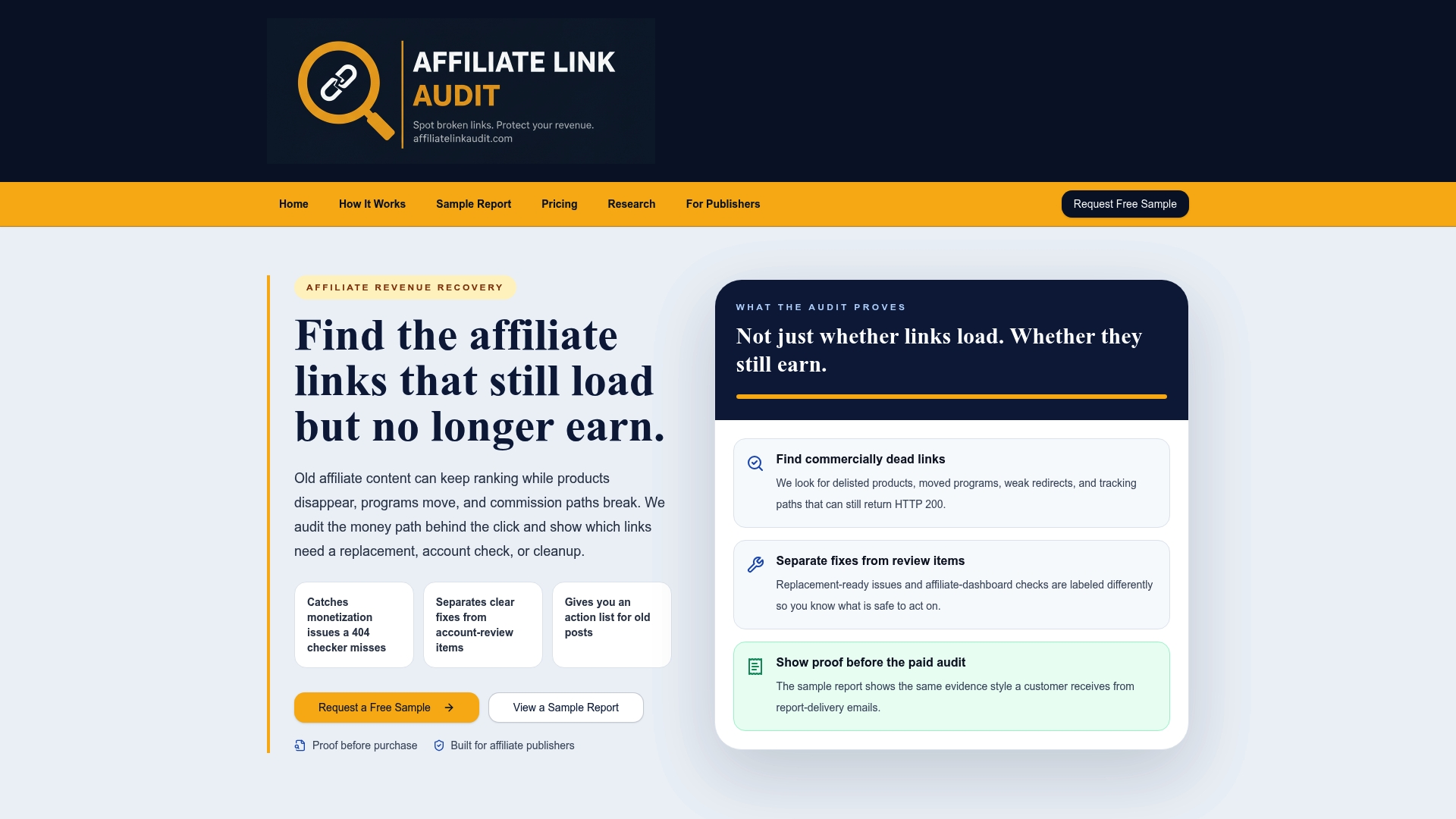
Publishers can also review the publisher audit overview to see how the service applies to content sites with large coupon and deal archives.
Our perspective on expired coupon links
The central limitation of conventional link checking is its unit of measurement. A status code answers whether a URL responds, while the publisher's question is whether the anchor still does what the page says it does. Those are different questions, and expired coupon links sit in the gap between them.

We approach the problem as an evidence exercise. Each link is tested for the failure modes described above: unavailable products, redirects to generic homepages and tracking paths that may no longer attribute clicks to the publisher. Findings are then separated into confirmed Broken links and items that need review, because the cost of a wrong deletion is real and the cost of an unflagged dead end is also real. A report that merges the two categories forces the publisher either to trust it blindly or to redo the work.
We also limit what an audit claims. We detect links that are commercially unhealthy and supply the evidence; we do not assert confirmed lost income, because that figure depends on network reporting that only the publisher can see. The publisher decides what to fix, and the report is designed so that the decision is quick and defensible. For archives with hundreds of coupon anchors, a prioritized list replaces guesswork about where to begin, which is the practical value of the work.
— Michael N.
Frequently asked questions
What is an expired coupon link?
It is a monetized anchor that promotes a coupon or discount the merchant no longer honors. The URL may still load, so the failure is often visible only on the landing page or at checkout. Network rules, such as Commission Factory's code of conduct, expect affiliates to remove expired codes or label them as expired.
How can I tell whether a coupon link still works?
Follow the redirect chain, compare the landing page with the offer described in your post, and test the code at checkout where the merchant permits. A link that loads but lands on a generic homepage should be treated as Needs Attention. Commission crediting can only be confirmed in your own network reporting.
Should I delete every expired coupon link?
Not necessarily. If the merchant and product remain active, you can replace the code with a current one, convert the anchor to a plain product link or label the offer as expired. Deletion is appropriate when the product, program or merchant is gone and no valid destination exists.
How often should coupon links be checked?
Coupon links carry end dates, so they warrant more frequent checks than evergreen product links. A common approach is monthly for high-traffic coupon pages and quarterly for the long tail. Logging a review date for each coupon anchor when it is published makes the schedule automatic.
Can an audit repair the links for me?
No. An audit identifies and classifies the problem links, provides evidence and suggests replacements, but the publisher makes and applies the changes. This keeps editorial and compliance decisions with the site owner.
Sources
- 4 Tips for Combating Link Rot in Affiliate Marketing
- Code of Conduct for Coupon and Offer Affiliates, Commission Factory
- Federal Trade Commission, 2010 public statement on advertising and marketing enforcement
- FTC press release: Firm to Pay FTC $250,000 to Settle Charges
Recommended
- Stop Revenue Leaks for Publishers: Prioritize Broken Affiliate Links
- Publishers, Replace Dead Affiliate Programs: 3 Labels, Intent First
- Audit Affiliate Links Weekly to Stop Hidden Commission Losses for Publishers
- Affiliate Fixes: Publishers Should Rank Revenue Risk, Not Errors
This article was produced with AI assistance and reviewed for accuracy. Findings language ("Broken," "Needs Attention," "Healthy") reflects Affiliate Link Audit's evidence-based classification system.