
Fix the links that put the most revenue at risk first, not the links with the most errors. The key checks are top-earning pages with aging affiliate links and links that return a successful response while being commercially broken. We classify every finding as Broken, Needs Attention, or Healthy, which keeps triage decisions grounded in evidence rather than guesswork.
TL;DR:
- Score each repair by dividing Affected Traffic Value multiplied by Fix Confidence by Implementation Cost; prioritize high scoring, low cost work.
- Treat links returning a 200 status as Needs Attention when they redirect to homepages, show unavailable products, or lose affiliate tracking IDs.
- Compare equal length periods before and after repairs, then check site analytics against affiliate network reports; pages with little traffic need longer measurement windows.
- Monthly audits catch an average of 12.5% broken or outdated links, while weekly top page checks and quarterly site reviews extend coverage.
- Place clear affiliate disclosures near the top of monetized pages, before the first affiliate link, and correct older posts where disclosures are buried.
Table of Contents
- A Revenue-at-Risk Formula for Scoring Repairs
- Common Affiliate Link Failures and How We Fix Them
- A 30 to 90 Minute Triage for Fast Wins
- Confirming a Fix Actually Restored Revenue
- The Technical Checks a Developer Should Run
- Updating Content So Links Convert Again
- Checking Disclosures While You Fix Links
- Setting a Recurring Audit Schedule
- What Publisher Audits Keep Revealing
- See the Evidence Before You Commit to a Full Repair Plan
- FAQ
- Sources
A Revenue-at-Risk Formula for Scoring Repairs
Error counts tell us how many links failed, not which failures matter. A dead link on a page with negligible traffic carries a different weight than a tracking parameter stripped from a buying guide generating substantial traffic. The scoring method documented by Search Engine Journal addresses this directly: Revenue-at-Risk equals Affected Traffic Value multiplied by Fix Confidence, divided by Implementation Cost.

Affected Traffic Value starts with page traffic over a defined period, multiplied by an expected conversion rate and the average commission or value per conversion. A page drawing meaningful monthly sessions with a historically solid conversion rate and a reasonable average commission produces a traffic value figure that anchors the rest of the score.
Fix Confidence reflects how certain we are that a repair restores revenue. A not-found error carries high confidence because replacing a dead URL is a known fix. A homepage redirect or a missing affiliate ID carries moderate confidence until we verify the destination page still sells the product. Network reporting discrepancies (clicks logged but no corresponding conversions) carry lower confidence until a test purchase or debug trace confirms the cause.
Implementation Cost accounts for editor time to rewrite anchor text, developer time for template or redirect changes, and testing time to confirm the fix worked.
- Score every flagged link using Affected Traffic Value, Fix Confidence, and Implementation Cost.
- Rank the resulting list from highest to lowest score before assigning any work.
- Set a prompt service-level target for high-score items and a longer window for low-score items.
Pro Tip: Recalculate Fix Confidence after the first round of repairs; early fixes often reveal whether a whole category of links shares the same root cause.
Common Affiliate Link Failures and How We Fix Them
Most audits surface the same handful of failure patterns, and each has a distinct repair path.
Dead or discontinued program links. A not-found page or a landing page confirming the program ended calls for review: find a comparable merchant or product, update the destination URL, and rewrite the anchor text to match the new offer rather than leaving stale phrasing pointing at a retired product.
Links that load but no longer earn. A link returning a successful response can still fail commercially when it redirects to a generic homepage, lands on an out-of-stock SKU, or points to a discontinued program page dressed up as a normal page. We classify these as Needs Attention rather than Broken, since they require manual review to confirm whether the merchant relationship or the specific product still exists.
Missing or stripped affiliate IDs. Template changes, redirect chains, and some caching plugins strip tracking parameters without throwing any visible error. Checking the final destination URL for the expected affiliate ID, and testing with a sandbox click or a small test purchase where feasible, is the only reliable way to catch this category.
Overlinking and poor placement. Pages with affiliate links stacked densely in low-context positions may produce weaker click-through and conversion rates than pages with better-placed links tied directly to the surrounding recommendation.
- Pull a list of all affiliate links per page and flag pages with link density far above the site average.
- Remove or consolidate redundant links pointing at the same offer within one article.
- Reposition remaining links next to the specific claim or recommendation they support.
Mobile and device-specific breakage. A link that resolves correctly on desktop can fail differently on mobile due to app-redirect behavior or responsive template bugs, so testing on both device types matters whenever analytics show meaningful mobile traffic share.
Monthly affiliate link audits catch an average of 12.5% broken or outdated links across publisher sites, according to Affiliate Link Audit's research, which underlines why a recurring check matters more than a one-time cleanup.
A 30 to 90 Minute Triage for Fast Wins
Before scheduling a full audit, a short triage pass captures the fixes with the clearest payoff.
- Pull your highest-traffic pages from analytics for a recent reporting period.
- Run a quick link health scan across those pages only.
- Sample links returning successful responses for commercial health: check that the destination still sells the product at a visible price.
- Confirm affiliate IDs appear correctly in the final destination URL for each sampled link.
- Flag obvious not-found pages for review and identify a suitable replacement link.
- Export every finding into a tracking spreadsheet scored with the Revenue-at-Risk formula.
- Fix anything scoring high on revenue impact and low on implementation cost before moving to anything else.
This short pass rarely catches everything a full audit would, but it reliably surfaces the highest-value repairs sitting on the pages that already carry the most traffic.
Confirming a Fix Actually Restored Revenue
A fix is only as good as our ability to measure its effect. The core KPIs are revenue per visit, click volume on the affected link, click-through rate, conversion rate, and network-reported conversions where the merchant provides them.
Compare a pre-fix window against a post-fix window of equal length, long enough to capture a representative sample of traffic rather than a single unusually quiet or busy day. A comparison over successive periods may work for high-traffic pages; lower-traffic pages need a longer window before the numbers mean anything.
Triangulate using site analytics for clicks and CTR, the affiliate network's own reporting for conversions, and a manual test click-through to check whether the tracking parameter survives the full redirect chain. We detect commercially unhealthy links and surface that evidence, but confirming that a specific click actually credited a commission is the publisher's or network's call, not something an audit can verify independently.
- Set pre- and post-fix windows of equal length before comparing any metric.
- Cross-check analytics data against the affiliate network's own dashboard.
Pro Tip: Run a manual test click-through immediately after any template or redirect change, before waiting on analytics to confirm whether tracking survived.
The Technical Checks a Developer Should Run
Several checks require more than a visual page review and belong on a developer's checklist.
- Check the HTTP status code for every link and follow the full redirect chain to the final landing page, not just the first hop.
- Sample pages returning successful responses for commercial health, flagging homepage redirects or out-of-stock pages as Needs Attention.
- Verify the affiliate ID and tracking parameters survive the redirect chain intact, since some server configurations or scripts strip them silently.
- Apply the rel attribute guidance from Google Search Central: rel="sponsored" for paid or affiliate links, rel="ugc" for user-generated content, and rel="nofollow" where neither applies.
- Test tracking end-to-end with a click simulation or browser network debug tools, confirming the expected parameters appear in the outbound request.
Updating Content So Links Convert Again
Technical repairs only work if the surrounding content still matches reader intent. Buying guides and comparison pages built around evergreen search queries deserve refresh priority, since they tend to carry the longest traffic tail.
- Rewrite anchor text to reflect the current offer, not a product that has since changed or disappeared.
- Add a price or availability note where that information changes often enough to go stale quickly.
- Remove claims tied to discontinued features, pricing, or promotions that no longer apply.
- Redirect or merge thin, overlapping posts into one stronger page rather than maintaining duplicates.
- Unpublish content built entirely around a program or product that no longer exists when no reasonable replacement fits.
Our guidance on outdated Amazon links walks through this replacement process in more detail for publishers working through a large backlog of product mentions.
Checking Disclosures While You Fix Links
A repaired link that sits next to a missing or buried disclosure trades one problem for another. FTC Endorsement Guides require that material connections, including affiliate relationships, be disclosed clearly and conspicuously, meaning a reader sees the disclosure and the link at the same time rather than buried in a footer or a separate page.
- Place the disclosure near the top of the content, before the first affiliate link appears.
- Use plain language rather than legal phrasing a casual reader might skim past.
- Scan high-traffic monetized pages specifically, since older posts are the most likely to predate current disclosure habits.
- Correct any page where the disclosure exists but sits far from the links it covers.
Our FTC affiliate disclosure audit checklist covers this process step by step for publishers working through a backlog of older posts.
Setting a Recurring Audit Schedule
A one-time cleanup fades in value within months as programs change and products go out of stock. A workable cadence runs a quick top-page check weekly, a batch audit across a wider page set monthly, and a full site audit quarterly.
- Assign ownership to a single editor or monetization lead rather than leaving link health as an unowned task.
- Log every finding in a ticketing system so fixes get tracked to completion instead of sitting in a spreadsheet.
- Reapply the Revenue-at-Risk score at each cycle so the highest-impact pages stay at the top of the queue.
Our weekly audit best practices outline how to build this cadence into a regular editorial workflow, and the staged operational approach described in Strategic Concierge's guidance on digital foundations offers a useful model for embedding recurring checks into a broader business process.
What Publisher Audits Keep Revealing
Across publisher audits, the same pattern recurs: the pages driving the most traffic are also the ones most likely to carry stale links, because they were written first and touched least often. A meaningful share of flagged links return 200 OK while pointing at a homepage redirect or a page with no purchase path, which raw link checkers miss entirely. The classification system, Broken, Needs Attention, and Healthy, exists because treating those two categories as identical wastes editorial time on the wrong fixes. Evidence-first triage, scored and ranked, consistently outperforms working through links in whatever order they happen to appear on a page.
— Michael N.
See the Evidence Before You Commit to a Full Repair Plan
We built our audit process around the same Revenue-at-Risk thinking laid out above: manual and semi-automated checks that detect broken or non-earning affiliate links, evaluate whether 200 OK links still function commercially, and classify every finding as Broken, Needs Attention, or Healthy. The output is a prioritized repair action plan, not a raw error list, so the fixes with the most revenue at stake surface first.
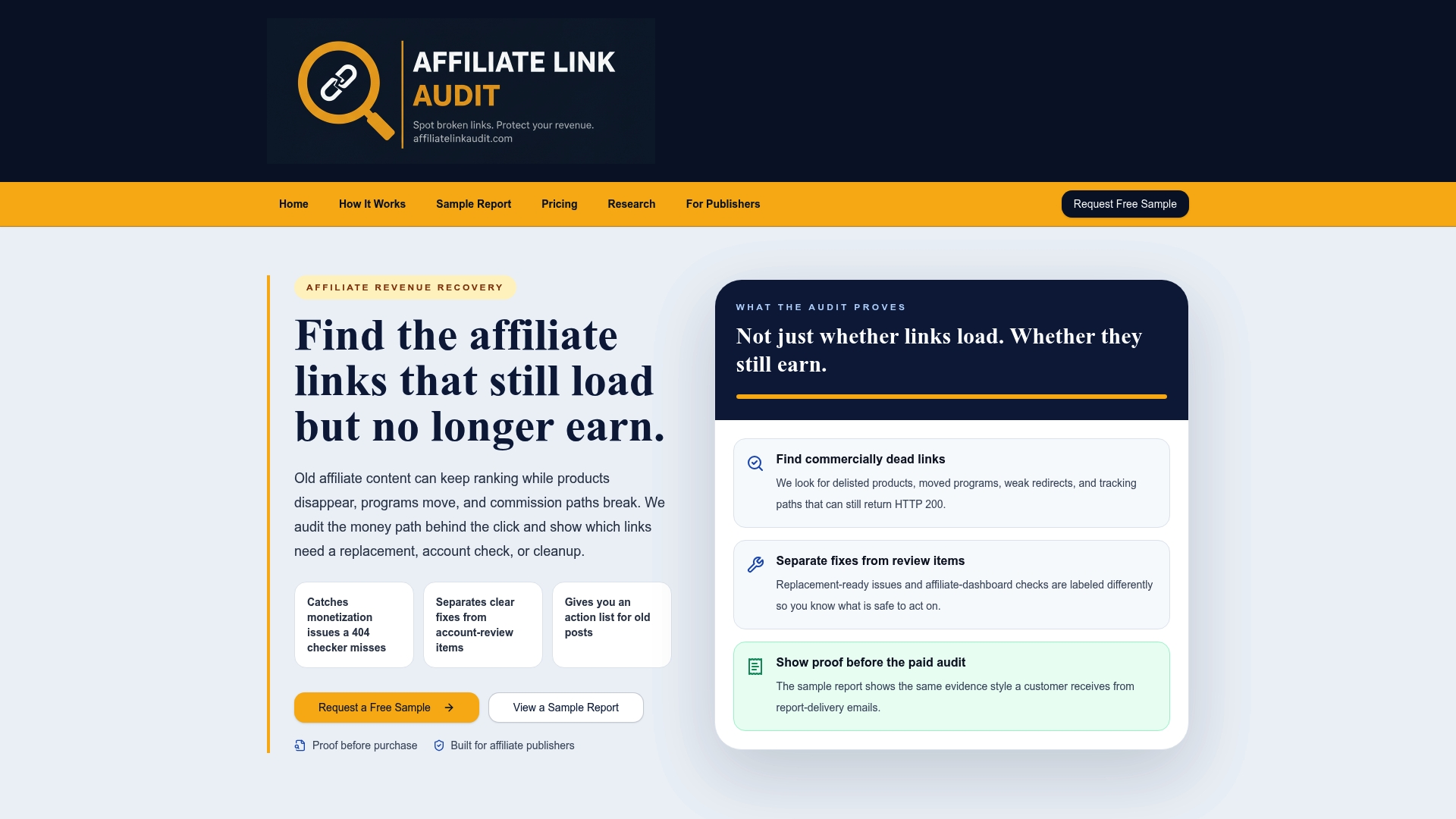
- Start with a free sample report to see real classified findings before paying for anything.
- Move to a Full Audit for $97 one-off when you want the complete prioritized plan across your site.
We identify the issues and provide the evidence; the repair decisions and the work of implementing them stay with you. Publishers can also review our audit services built for publishers to see how the full process maps to an existing content library.
FAQ
What is the 80/20 rule in affiliate marketing?
Applied to link audits, it means prioritizing pages that appear to carry greater revenue risk, such as older, high-traffic buying guides. Prioritizing those pages first, using a scoring method like Revenue-at-Risk, captures most of the available upside before touching lower-traffic pages.
What is the biggest problem in affiliate marketing?
Links that still load but no longer earn are a bigger practical problem than outright dead links, since a 200 OK status gives no visible warning that a redirect, an out-of-stock page, or a stripped tracking parameter is quietly cutting off commissions. We classify these as Needs Attention because confirming the cause requires manual review rather than an automated scan.
Is affiliate marketing still a viable strategy going into 2026?
Affiliate marketing remains a viable revenue channel for publishers, provided existing content gets maintained rather than left to decay after publication. The recurring issue is not the model itself but aging links and outdated program references that quietly stop converting on older, still-popular pages.
Can I use ChatGPT for affiliate marketing?
A language model can help draft replacement anchor text, summarize product changes, or outline a disclosure statement, but it cannot verify whether a specific affiliate link is commercially healthy or confirm that a tracking parameter survived a redirect. Those checks still require an actual link scan and manual review of the destination page.
Sources
- Searchenginejournal
- Ftc
- Qualify Outbound Links for SEO | Google Search Central | Documentation | Google for Developers
Recommended
- Stop Revenue Leaks for Publishers: Prioritize Broken Affiliate Links
- Publishers: $97 Affiliate Monetization Audit Prioritizes Revenue Fixes
- Publishers: 5 Tests to Find, Classify, and Fix Missing Affiliate IDs
- Stop Losing Commissions: Evidence First Affiliate Link Testing for Publishers
This article was produced with AI assistance and reviewed for accuracy. Findings language ("Broken," "Needs Attention," "Healthy") reflects Affiliate Link Audit's evidence-based classification system.