
The fastest way to confirm an affiliate link is trackable is to run a redirect-and-parameter check, then, where the program permits, execute an approved test action and verify it in the partner report. This two-step sequence lets us classify each link as Broken, Needs Attention, or Healthy. Every test should produce concrete evidence, a redirect chain, a screenshot, an Order ID, so reconciliation with the brand or network does not rely on memory or assumption.
TL;DR:
- Trace every redirect and confirm tracking parameters survive; a 200 OK can still need attention if the page loses the product or offer.
- Run an approved test action only when the partner permits it, record the Order ID, reverse the transaction, and wait up to 48 hours for reporting.
- Bulk scanners can mislabel links when bot detection or location rules alter results, so manually check flagged pages that drive meaningful traffic.
- Prioritize revenue generating pages, check high traffic links weekly, scan the rest monthly, and audit quarterly or after migrations or template changes.
- For attribution disputes, match raw click logs and network reports using the click ID and Order ID; working redirects alone do not prove commission credit.
Table of Contents
- What to check on every affiliate link
- Step-by-step testing workflow: quick test, test action, verify
- Tools and quick checks for one-off and bulk validation
- Interpreting results and reconciling reporting differences
- Audit checklist and monitoring plan for publishers
- How Affiliate Link Audit approaches link testing
- Author perspective: practical priorities for busy publishers
- How Affiliate Link Audit can help
- FAQ
- Sources
What to check on every affiliate link
A link that loads is not the same as a link that earns. Affiliate link testing starts with the full redirect chain and its HTTP status codes: a 4xx or 5xx response at any hop means the link is Broken, not merely slow.
From there, the check moves to the tracking parameters themselves, things like ref, aff, affiliate_id, click_id, and common UTM tags, confirming they appear once, intact, and unmangled by the redirect path. A 200 OK response at the final URL still needs a human look: does the landing page show the intended product, the expected price, and a working call to action, or has the merchant quietly swapped in a homepage?
- Trace every redirect hop and flag any 4xx or 5xx status code as Broken.
- Confirm tracking parameters survive the redirect chain without duplication or truncation.
- Verify the final landing page matches the promoted product, price, and offer.
- Test whether cookies and click IDs persist across domain changes during the redirect.
- Check for device and geo variance, since some merchants serve different pages by user agent or location.
- Confirm disclosure language sits close to the link, consistent with FTC endorsement guidance.
Step-by-step testing workflow: quick test, test action, verify
A reliable affiliate link test follows three stages: a quick reachability check, an approved test action where the partner allows one, and verification in the partner's own reporting.
- Open the link in an incognito or private browser window to avoid cached cookies, note the redirect chain and final URL, and capture status codes and response times from the browser's network tab.
- If the affiliate program supports test actions, generate the approved tracking link through the partner's process and complete the conversion exactly as instructed.
- Record the Order ID or transaction identifier immediately after the test purchase or lead submission.
- Wait up to 48 hours before concluding a conversion is missing, since impact.com's guidance on creating test actions notes that reporting delays and referral-window rules commonly apply.
- If the test registers correctly, reverse the transaction or coordinate with the brand to cancel it, so the test does not become a real payable order.
- Archive the evidence: redirect-chain screenshots, network-tab logs, timestamps, and the Order ID, all of which matter if the discrepancy needs to be escalated to the brand or network.
Isolating test actions from production traffic matters here. impact.com's own documentation emphasizes keeping test conversions separate from live revenue data, which is also why recording the Order ID at the moment of the test, rather than reconstructing it later from memory, saves time during escalation.
Pro Tip: Run the quick reachability test first on every link in a batch, then reserve the test-action step for links where the quick test already looks suspicious, since test actions take more time and sometimes real money.
Tools and quick checks for one-off and bulk validation
Single-link validators show the redirect chain, HTTP status codes, the final resolved URL, and response time, enough to catch a dead link in seconds. Bulk scanners trade precision for scale: they move fast across hundreds of URLs but tend toward false positives on links that use bot-detection or geo-gating, so high-value pages still need a manual follow-up.
- Use a single-link checker for spot audits on individual posts before publishing.
- Run bulk scanners for site-wide sweeps, then manually verify anything flagged on top-traffic pages.
- Open browser developer tools and inspect the network tab to confirm cookies and click IDs persist past the redirect, since automated scanners often miss landing-page business logic.
- Set monitoring alerts for 4xx and 5xx responses, unusually long redirect chains, or landing pages that have lost product detail, and tune the check frequency to how much traffic a page gets.
- Hand a link over to a dedicated audit service when the page carries heavy traffic, the redirect path crosses multiple domains, or misattribution keeps recurring despite repeated fixes.
Google's own post-launch monitoring guidance notes that verification crawlers can mark action links as broken if a site's WAF or CDN blocks the crawler's user agent, which is worth ruling out before assuming a link itself has failed.
Interpreting results and reconciling reporting differences
Three categories cover almost every outcome: Broken means the link or its landing page is unreachable or no longer relevant to the offer; Needs Attention means the page loads but is unlikely to earn, commonly a homepage redirect or a missing product; Healthy means the redirect completes, tracking parameters persist, and the landing page matches the original intent. A 200 OK response can still sit in Needs Attention territory, since the server responded fine while the product was discontinued or the content changed underneath the link.
Timing complicates verification further. impact.com's Amazon Seller testing documentation describes a reporting delay of up to 48 hours, alongside program-specific thresholds like a minimum click count before data appears, a reminder that a missing conversion at the one-hour mark is not yet evidence of a broken link.
- Pull raw click logs and confirm the click ID made it through to the conversion page.
- Search the network's reporting dashboard for the recorded Order ID.
- Gather screenshots and timestamps before opening a ticket with the brand.
- Include the Order ID in any escalation, since it is the fastest way for a brand to locate the transaction.
Reachability is a technical fact; commission attribution is a business policy question, and the two can diverge even when the link itself works exactly as built.
Audit checklist and monitoring plan for publishers
A testing plan without prioritization turns into busywork. The links worth checking first are the ones on pages that already carry traffic and revenue, since a fix there pays off immediately while a fix on a dormant post barely matters.
- Rank pages by traffic and estimated affiliate revenue, then test the top tier first.
- Run weekly spot checks on high-traffic pages, monthly scans across the rest of the site, and a full audit quarterly or immediately after any site migration or template change.
- Triage findings into three lanes: immediate fixes like 404s and server errors, replacement or re-linking for discontinued products, and brand coordination for parameter failures that originate server-side.
- Set alert thresholds: flag any 4xx or 5xx response immediately, flag redirect chains longer than three hops, and flag landing pages missing a product identifier or price.
- Keep a repair log recording the date, URL, issue type, evidence collected, the action taken, and the verification result once retested.
How Affiliate Link Audit approaches link testing
We separate confirmed Broken links from those that merely Need Attention, then provide a prioritized repair action plan rather than a flat list of URLs. A sample audit report typically includes redirect-chain evidence, flagged parameter failures, Order ID checks against network reporting, and suggested replacement links for discontinued products. Our Affiliate Link Health Benchmark 2026 research is available for publishers who want context on how common these issues tend to be. We identify commercially unhealthy links and provide evidence; we do not verify actual commission crediting or guarantee revenue recovery, and we do not repair links ourselves.

Author perspective: practical priorities for busy publishers
The evidence trail matters more than the tool. A screenshot, a status code, and an Order ID settle an escalation far faster than a vague claim that "the link seems off." Testing belongs on a calendar, not on a someday list, since content ages and merchants change their pages without notice. Disclosure rules and tracking verification are separate tasks, but both deserve the same routine attention.
— Michael N.
How Affiliate Link Audit can help
We built the Free Sample around the same question every publisher asks before paying for anything: does this actually find real problems on my site? The sample report shows redirect-chain evidence and flagged parameter issues on a portion of your links at no cost, so you can judge the method before committing to a full scan.
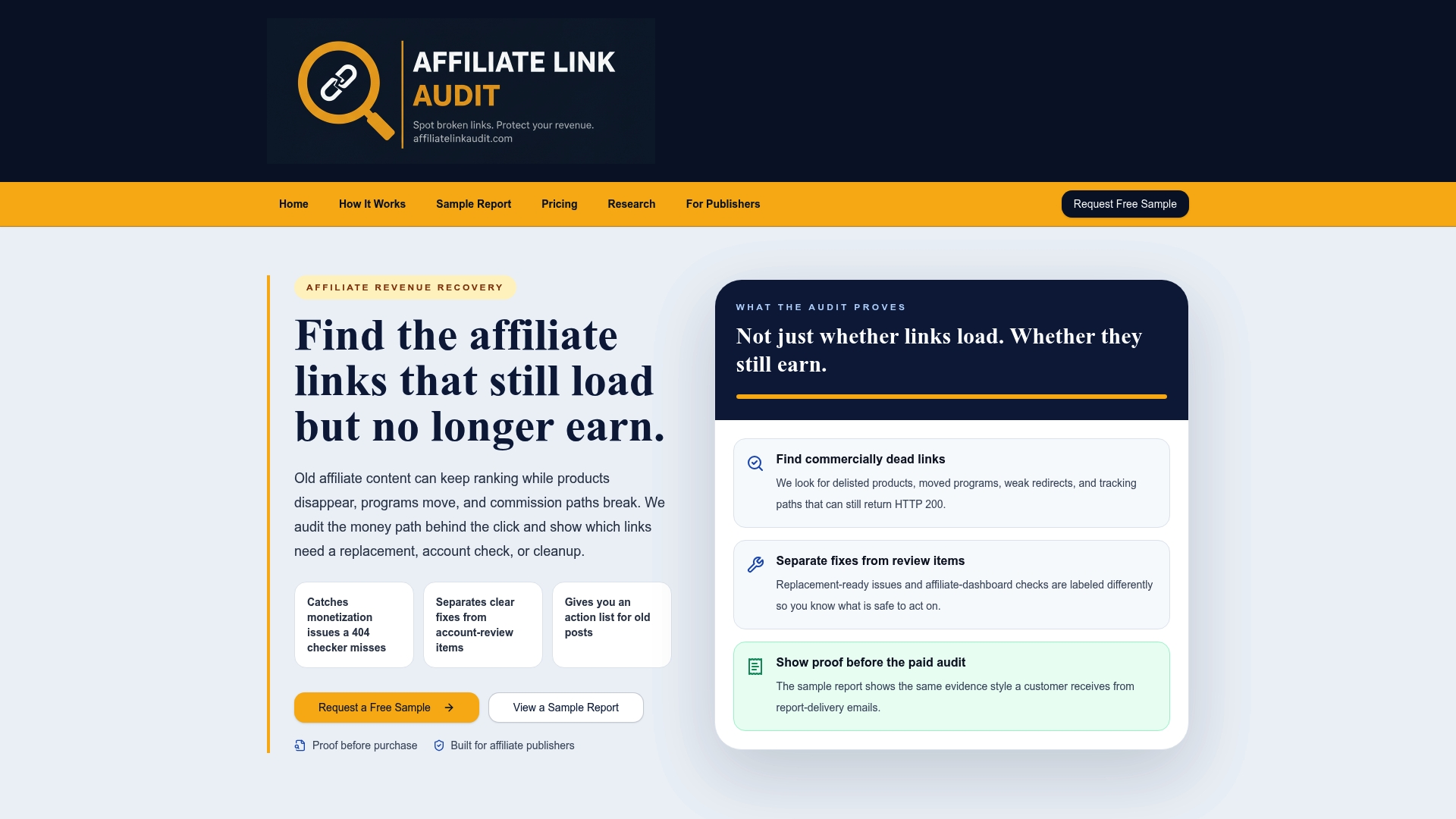
A paid Full Audit extends that same evidence-based review across the whole site and adds a prioritized repair plan with suggested replacements for discontinued products.
- The Free Sample costs nothing and shows a slice of what a full scan finds.
- Pricing and details for a full audit are available on our website.
- A paid audit makes the most sense for large sites, archives full of legacy posts, or publishers who keep hitting the same attribution gaps during manual reconciliation.
Review a sample report or start with the Full Audit landing page to see what's included.
FAQ
Do affiliate links actually make money?
Affiliate links generate commission only when the full chain, redirect, tracking parameters, and landing page, stays intact from click to conversion. A link that returns a normal page but has lost its tracking parameters or now points to a discontinued product will not earn, even though it looks fine to a visitor.
How to check if something is an affiliate link?
Hover over or inspect the link's URL for tracking parameters like ref, aff, affiliate_id, or a click_id string, which typically signal an affiliate or partner tag. Many publishers also disclose affiliate relationships near the link itself, as FTC guidance recommends.
How much does an affiliate link pay?
Payout depends entirely on the merchant's commission structure and the product sold, so there is no single rate across affiliate links. Checking the specific program's terms or the network dashboard tied to that link is the only reliable way to confirm its payout.
How to make $100 a day affiliate marketing?
There is no fixed formula, since earnings depend on traffic volume, niche, and commission rates, which vary widely by program. A more reliable near-term lever is making sure existing links actually track and convert, since a healthy, well-placed link outperforms a broken one regardless of traffic volume.
Sources
For platform-specific testing procedures, see impact.com's test action guidance and its Amazon Seller testing documentation. Disclosure requirements are covered in the FTC's endorsement guides. Google's post-launch monitoring guidance covers crawler-based link verification. For hiring help on large-scale audits, the Agency Review Guide offers vendor-selection research.
- Create test actions for partners | impact.com Help
- FTC's endorsement guides: what people are asking | FTC
- Post-launch monitoring | Google Actions Center
Recommended
- Affiliate Link Audit for Publishers
- Affiliate Link Health Benchmark 2026
- Travel Publisher Link Health Research
This article was produced with AI assistance and reviewed for accuracy. Findings language ("Broken," "Needs Attention," "Healthy") reflects Affiliate Link Audit's evidence-based classification system.