
Low converting affiliate links usually fail after the click, where the creator's context collapses into a generic or degraded merchant page. The fastest first move is a small evidence-first test: click each link as a visitor would, capture the redirect chain and final landing page, and classify every link as Broken, Needs Attention, or Healthy before changing anything else.
TL;DR:
- A normal 200 OK response does not prove a link can sell: inspect the landing page for unavailable products, homepage redirects, and intact tracking.
- Prioritize high traffic pages, ranking Broken and Needs Attention links by traffic and past earnings so repairs target the most valuable destinations first.
- Place a plain language disclosure that says you earn commissions close to affiliate links, including above the first link in a post.
- Test one change at a time after confirming links are Healthy, then judge results by earnings per click or sales per visit, not clicks alone.
Table of Contents
- Why clicks don't become sales: context collapse, trust gaps, and discovery friction
- Technical failure modes that kill attribution and sales
- FTC disclosure and trust: what the rules require
- A step-by-step diagnostic workflow: evidence-first testing and classification
- Prioritized fixes and optimizations you can implement now
- Ongoing monitoring and automatic alerts for affiliate link performance
- How to use A/B testing to improve affiliate link effectiveness
- Integration of affiliate link audits with broader SEO and content strategy
- Common reasons for affiliate link underperformance beyond breakage
- Best practices for optimizing anchor text and call-to-actions
- Impact of low converting affiliate links on overall affiliate marketing revenue
- When DIY testing is enough and when a paid audit makes sense
- Affiliate Link Audit: a free sample and a full audit for your links
- FAQ
- Sources
Why clicks don't become sales: context collapse, trust gaps, and discovery friction
Context collapse is what happens when the post-click experience strips away the framing that made the click happen. Your article explained why a specific product fits a specific need. The merchant page, however, may show a generic homepage, a different variant, or a category grid with no hint of what the reader came for. Intent that was high at the moment of the click drains away within seconds.
The behavioral signals are usually visible if you know where to look. Readers who click and immediately return to your page, or who never reach a product page at all, are telling you the landing experience broke the promise your content made.
Common trust and discovery gaps include:
- A homepage or category page where the recommended product is not visible without searching.
- Pricing, size, or variant details that differ from what your content described.
- Missing reviews, ratings, or other social proof on the destination page.
- Navigation that forces several clicks before the reader can add anything to a cart.
- A product that is out of stock or discontinued, so the visitor reaches a dead end that still loads normally.
That last item matters most for our work. A page can return a normal 200 OK status and still be commercially unhealthy. A standard link checker reports it as fine, while the reader sees an unavailable product and leaves.
Pro Tip: Open some of your affiliate links in a private browser window on your phone, not your desktop. Mobile landing pages can break context, and you will see what a reader sees.
Technical failure modes that kill attribution and sales
Even when a reader wants to buy, the click has to survive the trip to checkout with its tracking intact. Several technical conditions can interrupt that trip, and none of them announce themselves in your analytics.
Run these checks in order:
- Redirect chain length. Long chains of hops, especially ones ending at a homepage, can disrupt session context or the affiliate token that ties the visit to you.
- Homepage redirects. A link that once pointed to a product and now resolves to the merchant's front page is a classic commercially degraded destination.
- Shortened or cloaked links. Link shorteners and cloaking plugins add a layer that can fail silently or be blocked by the browser.
- Script blockers and cookie limits. Privacy tools and browser restrictions can prevent the tracking cookie from being set, so a sale may not be credited even when it happens.
- Program rules. Placement or behavior that violates a program's terms can affect your standing. The Amazon Associates participation requirements, for example, restrict offline promotion and incentives for using special links, among other behaviors.
Program terms do not directly cause low conversion, but a violation can quietly change what a program credits or pays. Reading them once per program is cheap insurance.
We are careful about what any of these checks prove. Testing shows whether a link looks healthy, degraded, or broken at the moment you click. It does not confirm that a given sale was credited, and no outside party can confirm that for you from a click test alone. The publisher decides what to fix based on the evidence.
For a deeper walkthrough of tracking problems, see our guide on what to do when affiliate tracking is not working.
FTC disclosure and trust: what the rules require
Clear disclosure is both a legal expectation and a trust signal. The FTC's guidance says affiliate relationships should be disclosed clearly and conspicuously, in close proximity to the links. When a disclosure sits far from the link it relates to, readers may not connect the two, and that gap can undermine trust.
Wording matters as much as placement. The FTC's Q&A notes that consumers may not understand the phrase "affiliate link" alone as an adequate disclosure, and recommends plain language such as "I get commissions for purchases through links in this post."
Practical placement habits:
- Put a plain-language disclosure above the first affiliate link in a post, not only in the footer.
- Repeat a short note near link lists and product roundups.
- In videos, say it aloud early and include it in the description near the links.
- Avoid vague terms and state that you earn a commission.
Readers who understand the relationship tend to trust the recommendation more, which supports the click you worked to earn. For a step-by-step review, our FTC affiliate disclosure audit checklist covers placement in detail.
A step-by-step diagnostic workflow: evidence-first testing and classification
Evidence-first testing means every conclusion about a link rests on something you captured, not something you assumed. This workflow keeps the effort small and the results reproducible.
- Pick your sample. Choose high-traffic pages and the links on them that draw the most clicks. Start with the pages that matter most to revenue, not the oldest ones.
- Run controlled clicks. Click each link as a visitor would. Record the full redirect chain, the final landing URL, the HTTP status codes, and a screenshot of what loads.
- Compare with analytics. Check landing-page behavior and UTM attribution where you can, then compare what you expected to happen against what you observed.
- Classify each link. Assign one of three labels: Broken (clearly failing, such as an error page or a dead product), Needs Attention (it loads, but the destination is a homepage, an unavailable product, or an unverifiable tracking path), or Healthy (the destination matches the recommendation and the path looks intact).
- Prioritize. Rank the Broken and Needs Attention links by traffic and historical earnings so the highest-impact repairs come first.
The Needs Attention label is easy to skip, because a 200 OK status feels reassuring. Commercially unhealthy links can still hide behind that status.
Pro Tip: Save your screenshots and redirect logs in a dated folder. When you recheck later, you can show what changed instead of relying on memory.
You can see this method laid out further in our article on evidence-first affiliate link testing and our guide to testing, classifying, and prioritizing non-earning links.
Prioritized fixes and optimizations you can implement now
Once links are classified, repairs fall into quick wins and longer-term work. Handle the quick wins first, because they recover the most intent for the least effort.
Quick wins:
- Replace links that resolve to homepages with a deep link to the specific product page.
- Swap out or remove links to discontinued or out-of-stock items, and choose a current equivalent.
- Add a clear disclosure near each recommendation.
- Fix links that return errors or loop through long redirect chains.
Mid-term improvements:
- Deep-link to product pages rather than category or brand pages wherever the program allows it.
- Add UTM parameters where the program permits them, so you can see which placements perform.
- Build or curate a landing page that restores the context your content created. A conversion-first page can bridge the gap between your recommendation and the merchant's store; this landing page design guide from All City Graphix walks through building one.
- Where merchants offer co-branded or curated pages, use them.
Escalation rule: a high-traffic link classified as Needs Attention is a strong candidate for a full evidence-first audit rather than a manual fix. High traffic multiplies the cost of leaving a degraded destination in place, and these are exactly the links where a second, deeper look pays for itself.
One boundary worth stating plainly. Identifying a problem is separate from repairing it. We find and document links that are commercially unhealthy, and you or your team make the change. Nothing in a test or an audit fixes a link on its own.
For help locating the worst offenders, our guide to finding and prioritizing broken affiliate links is a practical companion.
Ongoing monitoring and automatic alerts for affiliate link performance
A one-time cleanup decays. Merchants retire products, restructure URLs, and change redirect behavior without notice, so a link classified Healthy today can slide into Needs Attention next quarter. Monitoring turns a single repair into a habit.
Build a lightweight routine around three layers:
- Scheduled rechecks. Re-run your controlled clicks on your highest-traffic pages on a regular cadence. Compare the new redirect chains and landing URLs against your saved evidence from the last round.
- Analytics tripwires. Set alerts for sudden shifts in click-through behavior or landing-page engagement on pages with affiliate links. A sharp change in outbound clicks that is not matched by a change in earnings is a prompt to retest, not proof of failure.
- Status checks with limits in mind. Automated link checkers are good at catching hard failures like 404s. They are much weaker at the commercially broken cases, such as a product page that loads but shows an unavailable item, or a redirect to a generic homepage. Treat automated alerts as a first filter and keep a manual or semi-manual review for anything that loads.
Pair the routine with event triggers. When a merchant announces a program change, a site migration, or a rebrand, recheck the affected links straight away instead of waiting for the next scheduled pass.
Keep the output simple: a dated list of links, their current classification, and what changed since last time. That record is what lets you spot recurring problem merchants and decide where to spend repair effort first.
How to use A/B testing to improve affiliate link effectiveness
A/B testing replaces opinion with evidence about what makes readers click and buy. The principle is to change a variable at a time, split your traffic between the versions, and let the results decide.
Choose variables that affect the click and the post-click experience:
- Anchor text and call to action. Test a specific, benefit-led phrase against a generic one such as "click here."
- Placement. Compare a link near the top of a section against one placed after the supporting detail.
- Destination. Send half of your readers to a product page and half to a curated landing page to see which preserves intent.
- Format. Test a text link against a button or a product box.
Run each test long enough to collect a meaningful volume of clicks, and change only one element per test so you know what caused any difference. If a page gets little traffic, a result may be noise rather than a real effect, so favor your busiest pages for testing.
Measure the right outcome. Clicks alone can mislead, because a more aggressive call to action may lift clicks while sending less qualified readers to the merchant. Where your program reporting allows, look at earnings per click or sales per visit rather than click volume alone.
Before testing copy or layout, confirm the links themselves are Healthy. An A/B test run on a link that redirects to a homepage will teach you nothing about wording, because the destination is the real constraint. Fix the path first, then optimize the page around it.
Integration of affiliate link audits with broader SEO and content strategy
An affiliate link audit works best as part of your regular content maintenance, not as a separate chore. The pages that earn organic traffic are the same pages most worth protecting, because a ranking page sending readers to a dead end wastes the effort that earned the ranking.
Fold link checks into the workflows you already run:
- Content refreshes. When you update an older post for accuracy, retest its affiliate links in the same pass. Outdated recommendations and outdated destinations tend to travel together.
- Prioritization by traffic. Use your search analytics to rank pages, then audit the highest-traffic, highest-click pages first. This ties repair effort directly to where readers actually arrive.
- Editorial standards. Add link classification to your publishing checklist so new content launches with Healthy links and a visible disclosure.
- Consolidation decisions. If a page keeps attracting traffic but its main recommendations no longer have a viable destination, you can decide to rewrite the recommendation, replace the product, or retire the page.
There is a quality dimension too. Search engines and readers both reward pages that deliver what they promise. A recommendation that leads to a current, relevant product page supports the reader's experience, while a trail of dead or redirected links erodes it over time.
Treat the audit as feedback for your content plan as well. If the same merchant or product category keeps producing degraded links, that pattern tells you where to diversify programs or shift the topics you cover.
Common reasons for affiliate link underperformance beyond breakage
A link can be technically perfect and still underperform. Once the path is Healthy, look at the reasons that live in the content itself.
- Poor placement. Links buried below the point of decision, or crowded into a paragraph with several others, compete for attention and lose. A link should appear where the reader has just been persuaded.
- Outdated offers. A recommendation tied to a discontinued model, an expired promotion, or last year's pricing sends readers to something that no longer matches your words. Content that was accurate when written can drift out of date without any link breaking.
- Weak match between content and product. If the article attracts readers researching a problem but the product suits readers ready to buy, the traffic is real but the intent does not line up.
- Too many choices. A long list of equally weighted options can stall a decision. A clear primary recommendation usually outperforms an undifferentiated roundup.
- Missing proof. Readers want a reason to trust a recommendation: specific use, honest drawbacks, comparison against alternatives. Thin endorsements convert poorly even with a perfect link.
- Program mismatch. A merchant with a short tracking window, low brand recognition, or an awkward checkout can suppress sales regardless of how well your content performs.
The diagnostic habit is the same as before: gather evidence, then change one thing. Compare a low performer to a high performer on the same site and look at placement, freshness, and how directly the content leads to the product. The differences usually point to the fix.
Best practices for optimizing anchor text and call-to-actions
Anchor text and calls to action set the reader's expectation for the destination, so they should describe it honestly. When the words promise something specific and the page delivers it, the click converts. When they overpromise, the reader bounces.
Practical guidelines:
- Be specific. Name the product or the benefit ("see the current price of the 12-cup model") instead of "click here" or "learn more."
- Match the destination. If the anchor names a particular model, the link should land on that model's page, not a category grid.
- Place the call to action after the persuasion. Put the link where your argument concludes, so the reader clicks while the reasoning is fresh.
- Use one clear action per block. A single, well-placed call to action usually serves the reader better than several competing ones.
- State the commercial relationship. Pair links with a plain-language disclosure nearby, consistent with the FTC's guidance on disclosures placed close to the link.
- Avoid pressure language. Urgency that the offer does not support can damage trust and may conflict with how programs and regulators view endorsements. The FTC's questions and answers on consumer reviews and testimonials is a useful reminder that misleading representations draw scrutiny.
Revisit these elements whenever a link fails a retest or underperforms. Rewriting a vague anchor to name the exact product, and confirming the link now lands on that product, often does more than any layout change.
Impact of low converting affiliate links on overall affiliate marketing revenue
Low converting links rarely announce themselves as a single large loss. They show up as a gradual gap between the traffic your content earns and the revenue it returns, and that gap compounds across a site.
Consider how it plays out. A page that ranks well sends a steady stream of qualified readers to links that dead-end, redirect to a homepage, or point to an unavailable product. Each of those visits was costly to earn through research, writing, and ranking, and each one produces nothing. Across your older, higher-traffic pages, the effect can be substantial even though no individual link looks alarming.

The damage is not limited to lost sales. Readers who hit a dead end may trust your recommendations less on their next visit, which weakens every other link on the site. Time spent on content that points to degraded destinations also crowds out time spent on pages that could earn more.
Because older content often carries the most traffic and the most stale links, the largest recoverable opportunity usually sits in pages you published long ago and have not rechecked since.
We cannot tell you a number for your own site, and we do not claim that fixing links guarantees a revenue gain or confirms what you have lost. What an audit gives you is evidence: which links are Broken, which Need Attention, and which are Healthy. With that list, you decide where repair effort is worth spending.
When DIY testing is enough and when a paid audit makes sense
Simple tests catch the obvious cases: error pages, dead redirects, and links that visibly fail. The harder problem is the link that returns 200 OK and still sends readers somewhere that cannot convert, such as a homepage, an unavailable product, or a tracking path that cannot be verified. Standard link checkers do not flag those, and finding them takes manual review of the landing page itself.
My rule of thumb is to let traffic and history decide. A small site can run the workflow above on its own. A site with many monetized pages, or with high-traffic posts that used to earn and no longer do, may benefit from a paid evidence-first audit when the links outgrow what anyone will check by hand. Prioritize by what each page carries, not by how long it has been since you looked.
— Michael N.
Affiliate Link Audit: a free sample and a full audit for your links
Every audit we run starts with a free sample report, so you can see our evidence-first findings on your own content before you spend anything. The sample shows how we separate links into Broken, Needs Attention, and Healthy, and the evidence behind each classification.
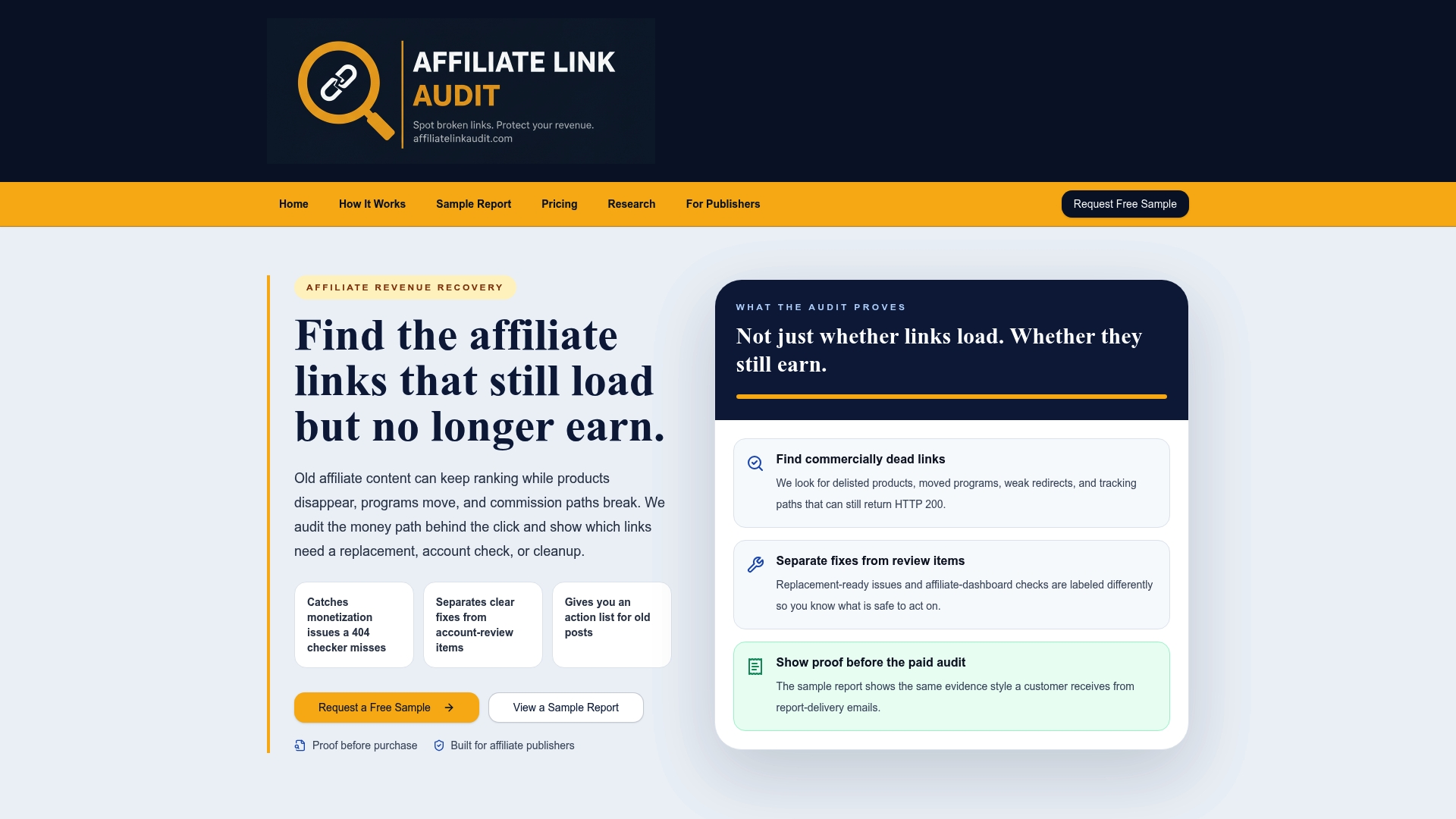
Our Full Audit costs $97 one-off and delivers a prioritized list of links, each classified as Broken, Needs Attention, or Healthy, with evidence and next steps, separating clear issues from items that need manual review. We identify and document the problems. You decide what to change. See the free sample report and find out which of your high-intent clicks are going nowhere.
FAQ
What is the 80/20 rule in affiliate marketing?
The 80/20 rule suggests that a small share of your content and links, roughly a fifth, produces most of your results. In practice, this means focusing testing and repair on your highest-traffic pages and best-clicked links first. It is a prioritization guide, not a fixed law.
Why do my affiliate links get clicks but few sales?
The most common cause is a post-click mismatch: the link lands on a homepage, an unavailable product, or a page that does not match your recommendation. Tracking problems and weak trust signals can also contribute. Test each link as a visitor would and classify it as Broken, Needs Attention, or Healthy.
Do I need to disclose affiliate links?
Yes. The FTC says affiliate relationships should be disclosed clearly and conspicuously, close to the links. Plain wording that mentions commissions is better than the bare phrase "affiliate link."
How can I find affiliate links that load but don't earn?
Click each link manually, record the redirect chain and final landing page, and check whether the destination matches your recommendation. A page that returns 200 OK but shows a homepage or unavailable product is commercially unhealthy. A free sample report from us shows how we evidence these cases.
Sources
- FTC's Endorsement Guides: What People Are Asking | Federal Trade Commission
- FTC's Endorsement Guides: What People Are Asking | Consumer Advice
- Amazon.com Associates Central - Associates Program Participation Requirements
Recommended
- Publishers, Replace Dead Affiliate Programs: 3 Labels, Intent First
- Affiliate Links That Stop Earning: Test, Classify, Prioritize
- Stop Losing Commissions: Evidence First Affiliate Link Testing for Publishers
- Stop Revenue Leaks for Publishers: Prioritize Broken Affiliate Links
This article was produced with AI assistance and reviewed for accuracy. Findings language ("Broken," "Needs Attention," "Healthy") reflects Affiliate Link Audit's evidence-based classification system.