
Affiliate link cleanup means finding every monetized link across your published content, testing where each one actually leads, and fixing or flagging the ones that no longer earn. The single highest-value first move is to inventory every surface that publishes your links and run a full redirect-path test on each one, since that sweep surfaces the largest, easiest-to-fix leaks. This guide covers tool categories, a repeatable audit workflow, technical cleanup steps, FTC disclosure requirements, and how an evidence-first audit service fits into the process.
TL;DR:
- Inventory every surface, including posts, tables, videos, newsletters, PDFs, and bio pages, then test every redirect hop rather than checking only the final destination.
- Check your ten highest traffic posts weekly, while lower traffic archive pages can follow a monthly or quarterly schedule based on revenue at risk.
- Classify links as Broken, Needs Attention, or Healthy; homepage redirects, discontinued products, and unverifiable tracking need review even when pages load normally.
- Keep parameters required by the affiliate program, remove only proven nonessential tags, and compare the full redirect chain before and after each URL change.
- Place plain language commission disclosures near each recommendation, include them in videos, and repeat them periodically during livestreams.
Table of Contents
- Tools and browser extensions for link discovery, cloaking, and monitoring
- A repeatable workflow to inventory, test, and prioritize fixes
- How to clean up URLs without losing tracking or attribution
- FTC disclosure rules you need to follow during cleanup
- Matching the right tool to the leak you actually have
- Why evidence-first classification changes what you fix first
- The discipline that separates a clean link library from a leaking one
- Get a free sample audit before you commit to a full cleanup
- FAQ
- Sources
Tools and browser extensions for link discovery, cloaking, and monitoring
Affiliate link maintenance breaks into four distinct jobs, and conflating them is the most common reason publishers buy the wrong tool. Discovery tools find where links live across a site. Cloaking and shortening tools make long, parameter-heavy URLs presentable and easier to manage in bulk. Click trackers record how traffic moves through a link before it reaches the merchant. Health monitors periodically check whether a link still resolves to a working, relevant destination.
Discovery starts with a crawl of your own site, since affiliate links hide in more places than most publishers expect: body paragraphs, comparison tables, video descriptions, email newsletters, PDF downloads, and link-in-bio pages all carry monetized URLs that a simple site search will miss, as explained in detail in Ai content op website: dit moet je technisch regelen. A sitemap crawler combined with a spreadsheet export of every outbound URL is often the fastest way to build a starting inventory.
Cloaking and shortening tools rewrite long affiliate URLs into branded, memorable paths. Pretty Link is a widely used WordPress plugin for this job, documenting cloaking, redirect management, and basic click reporting directly on its plugin page. ThirstyAffiliates performs a similar function for publishers who want centralized link management inside the WordPress dashboard rather than editing raw URLs in every post.
Click trackers sit a layer below cloaking: they record the click event itself, which matters when a merchant's own analytics disagree with your reporting. Health monitors are the newest category and the one most publishers skip, because a link can return a normal page load while still failing to earn, something a basic uptime checker will never catch.
Each category fits a different stage of the workflow:
- Discovery scanners build the master inventory before any testing begins.
- Cloaking and shortening plugins standardize how links are presented and stored across a site.
- Click trackers confirm that traffic is actually reaching the merchant through the intended path.
- Health monitors flag links that have gone dead or changed destination since they were last checked.
Deployment is usually additive rather than exclusive: a publisher running Pretty Link for cloaking still needs a separate health check, since cloaking tools rewrite the display URL but rarely verify the final destination on a recurring schedule. That gap, between a link that loads and a link that still earns, is where most hidden revenue loss happens, as outlined in guidance on auditing affiliate links weekly.
A repeatable workflow to inventory, test, and prioritize fixes
A disciplined audit workflow has five stages: inventory, test, classify, prioritize, and fix. Skipping the inventory stage is the most common failure point, since publishers who jump straight to spot-checking a handful of pages miss the legacy content carrying the bulk of dead links.
- Compile a comprehensive inventory. List every surface that might contain affiliate links: blog posts, comparison tables, resource pages, video descriptions, email sequences, PDFs, and link-in-bio tools. Export outbound links from each surface into a single spreadsheet with the source page, anchor text, and destination URL.
- Test the full redirect path. For each link, follow every hop from the published URL to the final merchant page, recording each intermediate redirect rather than just the end result. A link that passes through three redirects and lands on a generic homepage is a different problem than one that fails outright.
- Classify each link. Sort every tested link into one of three categories: Broken (the destination returns an error or no longer exists), Needs Attention (the page loads but the product is gone, the redirect lands on a homepage, or tracking cannot be verified), or Healthy (the link resolves correctly and tracking appears intact).
- Prioritize by traffic and certainty of fix. Rank flagged links by the traffic volume of the page they sit on, the apparent revenue potential of the product, and how straightforward the fix is. A broken link on a high-traffic page with an easy replacement product should always outrank a low-traffic, ambiguous case.
- Plan and schedule fixes. Separate the list into clear fixes you can action immediately and items that need manual review, such as verifying whether a merchant discontinued a program entirely.
Pro Tip: Record every redirect hop in your spreadsheet, not just the final URL, since a tracking parameter that disappears mid-chain is often the real reason a link stopped earning.
Recording redirect hops matters because a destination page loading normally tells you nothing about whether the affiliate tag survived the trip. The FTC's endorsement guidance does not speak to commission tracking directly, but the underlying principle for publishers is the same one practitioner guidance recommends: preserve the original URL and document each redirect hop so you can determine the actual final destination versus the intended offer. When attribution cannot be verified from the publisher side, the honest classification is Needs Attention rather than Healthy, since a link that appears to work and a link that reliably pays are not the same thing.

Cadence matters as much as method. Pages that drive the most traffic deserve a weekly check, since a merchant can discontinue a product or restructure its URL scheme without any notice to affiliates, and a once-a-year audit leaves months of silent revenue loss on your highest performing content, a pattern discussed in guidance on stopping hidden commission losses. Lower-traffic archive content can run on a monthly or quarterly cycle instead, since the revenue at risk is smaller and the audit cost should scale with it.
How to clean up URLs without losing tracking or attribution
Cleaning an affiliate URL means two things happen at once: you remove clutter that serves no purpose, and you preserve every parameter the affiliate program actually requires to credit the click. Conflating these two actions, and stripping a parameter that looked unnecessary but was not, is the fastest way to turn a Healthy link into one that silently stops earning.
The safe rule is to retain any parameter documented by the affiliate program itself, typically the tracking ID, campaign tag, or sub-ID used for attribution, and remove only parameters you can demonstrate are nonessential, such as leftover UTM tags from an old email campaign or session identifiers that have no bearing on commission crediting. When in doubt, test before and after: capture the full redirect chain on the original URL, make the change, then capture the chain again and compare the two side by side.
- Keep any parameter named in the affiliate program's own linking documentation, even if its purpose is not obvious from the string itself.
- Remove generic marketing parameters (UTM tags, session IDs) that duplicate tracking already handled by the affiliate tag.
- Test the full chain before and after any change, comparing hop count and final destination, not just whether the page loads.
- Document the comparison in your audit spreadsheet so a future review does not repeat the same guesswork.
Browser-based redirect checkers let you see each hop without installing anything, which is useful for a quick spot check, while a cloaking plugin like Pretty Link handles the server-side redirect pattern for publishers managing hundreds of links across a WordPress site. The cloaking layer should never replace the disclosure that sits near the link, a point covered in the next section, since cleaning the URL's presentation and meeting disclosure obligations are two separate tasks that both need to happen.
A single redirect hop that strips the tracking parameter is often invisible from the front end: the page loads normally, the product is in stock, and nothing about the user experience signals a problem, which is exactly why a manual spot check of the rendered page is not sufficient and a full hop-by-hop comparison is the only reliable test, as detailed in guidance on detecting tracking failures.
FTC disclosure rules you need to follow during cleanup
Affiliate link cleanup touches compliance as directly as it touches revenue, since a cloaked or shortened URL does nothing to satisfy the disclosure obligations that attach to the endorsement around it. The FTC's endorsement guidance requires disclosures to be clear and conspicuous, placed near the recommendation or link rather than buried in a footer or an "about" page, and the agency offers sample wording such as "I get commissions for purchases made through links in this post" as an example of language that meets that bar.
The influencer-specific guidance goes further on placement and wording: it recommends clear terms like "advertisement," "ad," or "sponsored" over vague shorthand such as "sp" or "spon," and it specifies that disclosures need to appear in the format where the endorsement itself appears, meaning a video needs its own in-video or on-screen disclosure rather than relying on a description box alone, and a livestream needs the disclosure repeated periodically rather than stated once at the start. Shopify's own guidance on affiliate disclosure echoes the same principles for publishers, recommending plain language such as "I may earn a commission for purchases made through these links" placed prominently rather than buried in site-wide terms.
A cleanup project is a natural point to verify disclosure placement, since you are already reviewing every page that carries a monetized link. Before closing out a cleanup pass, confirm:
- The disclosure sits near the link or recommendation itself, not only in a sidebar or footer.
- Wording uses plain terms like "ad," "sponsored," or "commission," never ambiguous shorthand.
- Video and livestream content repeats the disclosure in the format itself, not only in the description.
- Cloaking or shortening a URL has not moved the link away from its original disclosure context.
A step-by-step FTC disclosure audit is a useful companion checklist for publishers running this review alongside a technical link cleanup.
Matching the right tool to the leak you actually have
Buying a tool before diagnosing the problem is how publishers end up paying for overlapping features or missing coverage entirely. The fix depends on what kind of leak you are dealing with: a handful of broken links on recent posts usually calls for a manual fix list, dozens of legacy links scattered across years of archive content call for a bulk audit, and a site with hundreds of monetized pages and no prior review history is a strong candidate for a professional, done-for-you audit rather than a self-service tool.
A short evaluation checklist applies regardless of which category fits:
- Does it preserve affiliate parameters by default, or does it strip query strings without checking which ones are required?
- Does the reporting distinguish Broken from Needs Attention, or does it only flag hard 404 errors and miss homepage redirects and discontinued products?
- How much setup does it require relative to the size of your link inventory?
- What does it cost relative to the revenue at risk on the pages it covers?
- Is there a way to see sample output before committing, such as a trial run or a sample report, so you can judge accuracy on your own content first?
Running a small test batch, a handful of known links including at least one you suspect is already broken, before adopting any tool at scale is the fastest way to confirm its classification logic matches reality rather than taking a vendor's claims at face value.
Why evidence-first classification changes what you fix first
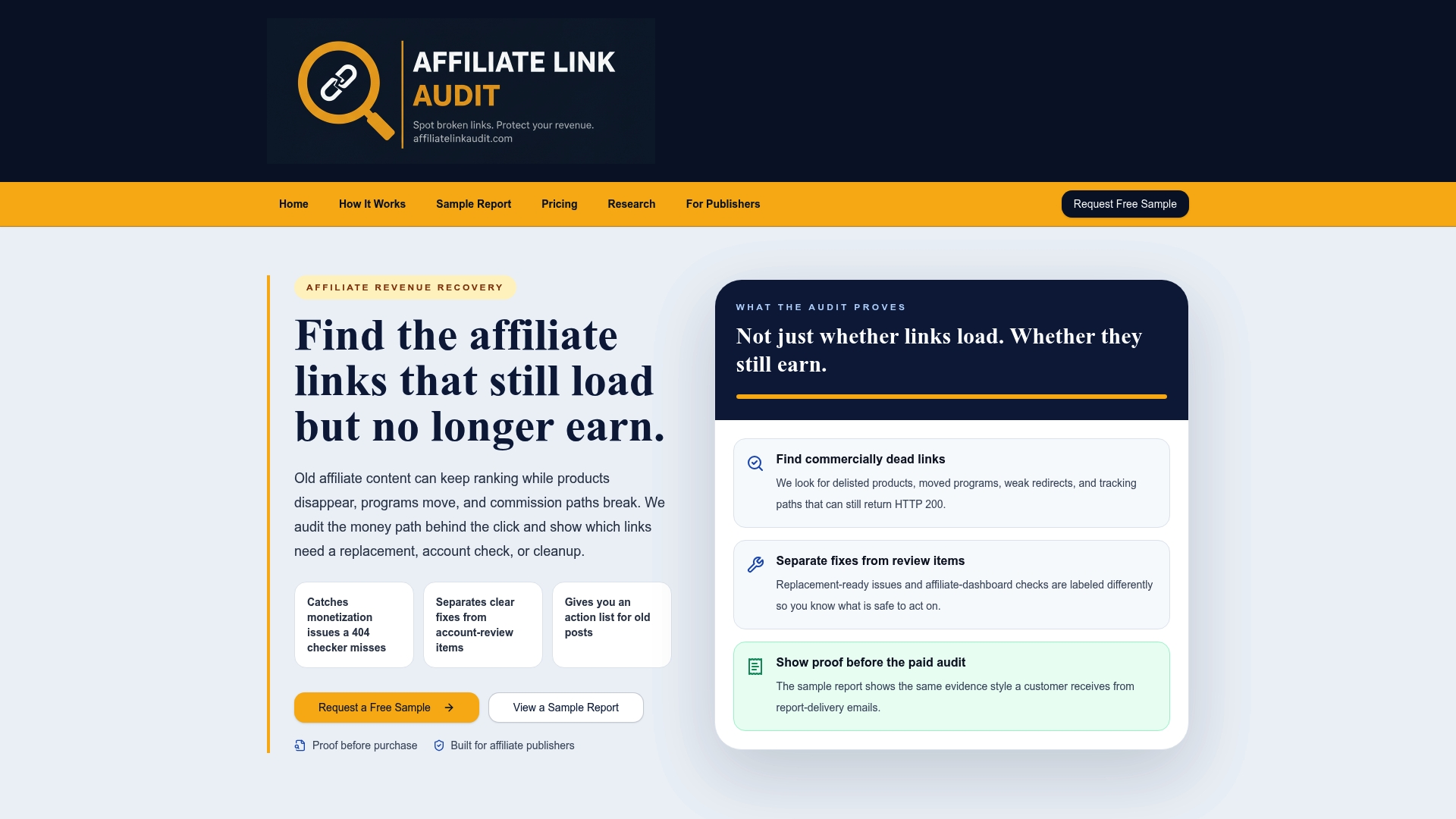
Our audits classify every tested link as Broken, Needs Attention, or Healthy, and that distinction is the difference between a report that tells you something is wrong and one that tells you what to do about it. A link returning a standard error is marked Broken. A link that loads normally but redirects to a generic homepage, points to a discontinued product, or cannot have its tracking parameters verified through the full redirect chain is marked Needs Attention. A link that resolves correctly with intact tracking is marked Healthy.
We detect links that are commercially unhealthy, discontinued products, homepage redirects, unverifiable tracking, and provide evidence for each finding; the publisher decides which issues to address. Every audit includes a free sample report, allowing you to review findings on a subset of your content before deciding on the full audit.
A link that returns a 200 OK response is not proof that a commission will be paid. The gap between "loads" and "earns" is exactly where Needs Attention findings live.
A prioritized finding might read: a top-traffic post links to a product page that now redirects to the retailer's homepage, classified Needs Attention, with a suggested replacement link flagged for manual confirmation before publishing the fix.
The discipline that separates a clean link library from a leaking one
The most consistent pattern across affiliate content is not a single catastrophic failure but a slow accumulation of small ones: a product gets discontinued, a merchant restructures its URL scheme, a tracking parameter quietly drops during a site migration, and each event individually looks minor. Treating cleanup as a one-time project rather than a recurring habit is the error that compounds. A publisher who prioritizes the ten highest-traffic posts for a weekly check captures most of the available benefit with a fraction of the effort a full-site audit demands, simply because traffic concentration means a small number of pages carry most of the exposure.
— Michael N.
Get a free sample audit before you commit to a full cleanup
We offer two ways to start: a Free Sample audit at no cost, which applies the classification to a portion of your content so you can review findings before spending anything, and a Full Audit that covers a complete review of your published affiliate links with a prioritized action plan.
- Publishers with years of legacy content and no prior review history see the most value, since that is where Needs Attention findings tend to concentrate.
- High-traffic sites benefit from the prioritization built into the report, since fixing the top few pages first captures most of the available upside.
- Smaller or newer sites can still use the Free Sample to confirm their current link library is in good shape before scaling content.
Start with the free sample report to see real classifications on your own content, or go directly to the Full Audit for a complete prioritized review.
FAQ
How can I clean up a URL?
Cleaning a URL means keeping every parameter your affiliate program requires for tracking while removing parameters that serve no purpose, such as leftover UTM tags. Test the full redirect chain before and after the change to confirm the final destination and tracking tag both survive the edit.
What is my affiliate link?
Your affiliate link is the specific URL containing your unique tracking identifier, usually a sub-ID, affiliate tag, or campaign parameter, that credits a sale or click back to your account. You can typically find it inside your affiliate program's dashboard under a link generator or reporting tool, rather than by guessing at the merchant's public URL.
What are the top 5 affiliate programs?
There is no single authoritative ranking of top affiliate programs, since the best fit depends on your content niche, audience, and the commission structure each merchant offers. Rather than chasing a generic list, evaluate programs on cookie duration, commission rate, and product relevance to your existing content.
How do I remove an Amazon affiliate link?
Locate every instance of the link across your content inventory, including posts, tables, and emails, then either delete the link entirely or replace it with an active alternative if the product is still relevant. Running a full redirect-path test afterward confirms the replacement link resolves correctly and carries valid tracking.
Sources
- FTC's Endorsement Guides: What People Are Asking | Federal Trade Commission
- Disclosures 101 for Social Media Influencers
- Wordpress
Recommended
- Stop Revenue Leaks for Publishers: Prioritize Broken Affiliate Links
- Publishers: $97 Affiliate Monetization Audit Prioritizes Revenue Fixes
- Stop Losing Commissions: Audit Cloaked Affiliate Links for Publishers
This article was produced with AI assistance and reviewed for accuracy. Findings language ("Broken," "Needs Attention," "Healthy") reflects Affiliate Link Audit's evidence-based classification system.