
An affiliate link audit finds links that are Broken, Needs Attention, or Healthy, and returns a prioritized action plan rather than a raw error list. In this context, app affiliate links refers to the affiliate links inside a publisher's own content, the anchors readers click on in blog posts and reviews to reach a merchant, not links built by app developers to drive installs. An audit checks for hard breaks like 404s alongside soft failures where a link loads normally but no longer earns. Publishers with high-traffic or aging content should start with a short check of their top revenue pages this week, or request a free sample audit to see the evidence format before committing to a full scan.
TL;DR:
- High-traffic pages should be checked first, focusing on top revenue links, because a single broken link there causes significant financial loss.
- Many affiliate failures occur silently through soft errors like redirects to generic pages or missing tracking parameters, which standard status checks do not detect.
- Automated tools must be supplemented with manual verification to identify subtle soft failures and ensure tracking parameters survive across redirect chains.
- Links that resolve but no longer lead to valid merchant pages should be repaired or replaced based on offer availability and product status.
- Regular audits should include compliance review of disclosures and rel attributes, as well as technical link health, to prevent regulatory penalties and search ranking issues.
Table of Contents
- What an affiliate link audit inspects and the three-result classification
- A time-boxed audit checklist you can run now
- How to triage and prioritize fixes by revenue impact and effort
- Compliance and SEO: rel attributes, disclosure placement, and thin-affiliate risk
- Automation, monitoring cadence, and alerting to prevent future revenue loss
- How app affiliate links work inside a publisher's content
- Common platforms and networks and their link requirements
- Technical challenges unique to app affiliate links
- Tools and software specialized for auditing app affiliate links
- How to accurately track conversions and revenue from app affiliate links
- Legal considerations beyond FTC disclosures
- Why link health belongs in routine content maintenance
- Affiliate Link Audit: what a sample report and a full audit actually deliver
- Sources
- FAQ
What an affiliate link audit inspects and the three-result classification
A professional audit treats every monetized anchor as a claim that needs verification, not a link that either works or doesn't. The check sequence typically includes HTTP status retrieval, a full redirect chain trace, final destination content verification against the original recommendation, presence of tracking parameters, confirmation that the merchant offer still exists, and a check of disclosure text and rel attributes on the anchor itself.
The three-result system gives publishers a consistent vocabulary for triage:
- Broken: the link returns an error status, redirects to an unrelated or discontinued page, or the destination no longer exists in any usable form.
- Needs Attention: the link resolves with a 200 status but shows signs of commercial failure, such as a redirect to a generic homepage, a soft-404 page dressed as valid content, or tracking parameters missing from the final URL.
- Healthy: the link resolves to the correct merchant page, tracking parameters are intact, and the offer described in the surrounding content still exists.
Soft failures cause a meaningful share of commercial link decay, and industry analyses report link rot affects a significant share of affiliate pages, which is why status-code checks alone understate the problem. A credible report backs each classification with evidence: redirect trace logs, screenshots of the final landing page, and a captured network dashboard view confirming whether a test click registered with the affiliate network.
A time-boxed audit checklist you can run now
Publishers do not need a paid engagement to surface the most damaging failures on their highest-earning pages. A tiered self-check, scaled to available time, catches the obvious problems before they compound.
- 15-minute quick check: open every affiliate link on your single top-earning page, confirm the destination matches what the surrounding text promises, and verify the anchor carries a rel attribute along with a visible disclosure near the link.
- 60-minute deep spot-check: follow each redirect chain in your browser's developer tools, watch your affiliate network's dashboard to confirm the test click registered, and read the landing page content for soft-404 signals such as generic category pages standing in for a specific product.
- Half-day batch pass: export all affiliate links from your content management system, run them through a crawler for HTTP status, manually verify a sample of the top-earning results, and log every fix with a date so the next audit has a baseline.
Standard link checkers that only verify HTTP status miss many affiliate failures; the dangerous cases return 200 while the tracking or the offer itself has quietly failed. That gap is why the 60-minute and half-day passes include manual verification steps that a simple crawler cannot replace.
Pro Tip: Run the 15-minute check on your top three pages by traffic first, since a single Broken link there does more damage than a dozen Broken links on pages nobody visits.
How to triage and prioritize fixes by revenue impact and effort
Not every Broken link deserves the same response speed. A tier system tied to revenue share keeps a publisher from spending an afternoon on a link that earns a few dollars a month while a five-figure page sits broken.
A quick estimate makes the cost of delay concrete. Say a page gets a typical number of monthly visits, a reasonable click and conversion rate, average order value, and commission rate: that page generates a meaningful amount of revenue from that single link, so a week of downtime on a Tier 1 link is a meaningful, calculable loss rather than an abstract inconvenience.
- Repair when the merchant and offer are still valid but the URL or tracking parameter is wrong.
- Replace when the original product is discontinued but a comparable offer exists from the same or a different merchant.
- Remove or schedule a full audit when a page shows multiple Needs Attention results, which usually signals a systemic tracking or template issue rather than an isolated broken link.
Compliance and SEO: rel attributes, disclosure placement, and thin-affiliate risk
An audit that only checks whether a link resolves misses two categories of risk that carry consequences beyond lost commissions: regulatory exposure and search visibility.
- Google recommends marking paid or affiliate links with rel="sponsored", or rel="nofollow" as an acceptable alternative, so search engines understand the commercial relationship rather than treating the link as an organic editorial reference.
- The FTC requires affiliate disclosures to be clear and conspicuous and placed near the endorsement itself, which means a footer-only policy link is generally insufficient regardless of how it is worded.
- Disclosure wording matters as much as placement: plain language near the recommendation performs better for both compliance and reader trust than a vague label buried in a privacy page.
- Thin affiliate content, meaning pages that copy merchant descriptions with little original analysis, raises search quality risk independent of whether the links themselves still work.
Creator communities that cover disclosure practices across video and written formats, such as The Deputie Community, offer a useful outside check on whether a disclosure would actually be noticed by a typical reader before it reaches a regulator's attention.
Automation, monitoring cadence, and alerting to prevent future revenue loss
Manual audits catch what automated tools miss, but neither approach alone is sufficient on its own for a site with more than a handful of monetized pages. A workable cadence pairs continuous automated checks with periodic manual review.
- Top-earning pages warrant near-immediate or daily automated checks, since a broken Tier 1 link accumulates losses fast.
- Steady mid-tier links can be checked daily to weekly without meaningful risk.
- Low-impact legacy links can be batched into a weekly or monthly scan.
- A full manual audit on a quarterly cycle catches soft failures that automated status checks structurally cannot see.
Alert design matters as much as check frequency. Instant alerts belong on Tier 1 links only; everything else routed to instant notification produces alert fatigue and gets ignored. Email digests suit Tier 2, and a weekly summary is enough for Tier 3.
Pro Tip: Trigger a full manual audit after any site migration, CMS change, or major seasonal sale, since these events tend to produce clusters of Needs Attention links that automated crawlers report as technically fine.
How app affiliate links work inside a publisher's content
An app affiliate link, in this context, is the anchor a publisher places inside a blog post or review to send a reader toward a merchant page, tracked through the affiliate network so the publisher earns a commission on the resulting action. The mechanics differ from a plain hyperlink in three ways that matter for an audit.
First, the link usually routes through the affiliate network's own redirect domain before landing on the merchant's page, which means a single click can pass through two or three intermediate hops before the final destination loads. Second, tracking parameters attached at the start of that chain need to survive every hop intact; a redirect that strips them produces a page that looks correct to a human reader while registering no commission at all. Third, many merchant pages change their URL structure or discontinue specific products over time, so a link that was accurate at publication can point to a generic category page or an out-of-stock notice months later without ever returning an error status.
This is why an audit has to trace the full chain rather than check only the final response. A link that resolves to a 200 status tells you almost nothing about whether the commission path survived the trip.

Common platforms and networks and their link requirements
Publishers typically run affiliate links through a small set of networks, and each imposes its own requirements on how links are built and maintained. Large retail affiliate programs generate links tied to specific product identifiers, which break the moment that identifier is retired even if the general product category still exists. Software and subscription affiliate programs often use unique referral codes embedded in the URL, and those codes can expire or get reissued when a vendor changes its billing platform. Travel and hospitality programs frequently route through white-label booking engines, so a broken link there may point to a booking widget that has been redesigned rather than a page that is truly gone.
Each network also has its own rules about link formatting, including whether the affiliate tag must appear as a query parameter or a path segment, and whether direct linking to a specific offer page is permitted versus requiring a landing page provided by the network. An audit needs to account for these differences rather than applying one verification method across every link on a site, since a redirect pattern that signals a break on one network is normal behavior on another.
Technical challenges unique to app affiliate links
The most persistent technical challenge in this space is tracking-path fragility across redirect chains. A link can pass through an affiliate network's tracking domain, a shortener, and finally the merchant's own site, and any one of those hops can silently drop the tracking parameter during a routine merchant-side URL migration. The result is a link that a reader clicks successfully, that lands on a real and relevant page, and that still earns nothing, because affiliate links can return 200 but still fail commercially when tracking is lost or the final content is not the expected product page.
Device and browser variation compounds the problem. A redirect chain that resolves cleanly in a desktop browser can behave differently on mobile, particularly when a merchant serves a different landing experience based on user agent. An audit run only from a single device and browser configuration risks missing failures that a portion of real traffic actually experiences.
Cookie and session handling adds another layer: some networks rely on cookie-based attribution that can be cleared or blocked before the eventual purchase completes, which is a tracking limitation rather than a link problem, but it produces the same symptom, a click with no recorded commission, and an audit needs to distinguish the two causes rather than flag every unattributed click as a broken link.

Tools and software specialized for auditing app affiliate links
Generic link checkers verify HTTP status at scale but stop there, which is exactly the gap that produces false confidence in a site's link health. A crawler that reports "200 OK" for a homepage redirect or a soft-404 page is technically accurate and commercially useless. Purpose-built monitoring tools address this by tracing full redirect chains, capturing the rendered content of the final page, and checking whether a test click registers in the affiliate network's own dashboard rather than relying on the HTTP response alone.
The practical toolkit for a publisher combines a few layers: a crawler for bulk status checks across the entire content library, browser developer tools for manually tracing individual redirect chains on high-value pages, and the affiliate network's own reporting dashboard as the ground truth for whether a click actually converted into a tracked event. No single automated tool replaces manual verification entirely, since distinguishing a Needs Attention soft failure from a Healthy link often requires a human reading the destination page against the original recommendation. This is the layer a paid audit service is built to handle at scale, applying consistent classification criteria across every link on a site rather than sampling a handful manually.
How to accurately track conversions and revenue from app affiliate links
Accurate revenue tracking starts with confirming that the tracking parameter attached to a link at the point of publication survives to the final merchant page, since a parameter dropped anywhere in the redirect chain produces a conversion that never gets attributed to the publisher. The affiliate network's dashboard is the authoritative source for whether a click registered, and a publisher should treat any discrepancy between expected traffic and recorded clicks as a signal to trace that specific link's redirect path.
Revenue estimates built from traffic and assumed conversion rates are useful for prioritization, as shown in the tier example earlier in this piece, but they are estimates, not confirmed figures. Confirming actual commission crediting requires reconciling the network's reported conversions against the publisher's own analytics, a step outside the scope of a link audit itself. An audit can tell a publisher which links are commercially unhealthy, meaning discontinued products, homepage redirects, or unverifiable tracking, and hand over the evidence; deciding how to reconcile that against network-reported earnings and what to fix first remains the publisher's call.
Consistent link tagging conventions across a site make this reconciliation easier over time, since a predictable parameter structure lets a publisher spot anomalies in network reports faster than sifting through inconsistent legacy tagging from years of ad hoc link building.
Legal considerations beyond FTC disclosures
FTC disclosure rules are the most commonly cited compliance concern, but they are not the only policy framework governing affiliate content. Platforms that host the merchants a publisher links to, including Apple and Google, maintain their own terms for how products can be represented and linked to, and those terms exist independently of general advertising law. A publisher whose content links to app store listings or platform-specific purchase flows should treat those platform policies as a separate compliance layer, since a link can be fully FTC-compliant and still violate a platform's own linking or promotional terms.
Google's spam policies warn that affiliate pages that copy merchant text without added value can be flagged as low-quality, which is a search policy risk distinct from any FTC concern and one that an audit's content-quality check is designed to catch. Merchant program terms add a third layer: many affiliate programs prohibit specific promotional tactics, such as bidding on the merchant's own brand terms in paid search, and violating those terms can result in commission forfeiture or account termination regardless of whether the link itself functions correctly.
A thorough audit flags content-quality and platform-policy risks alongside technical link failures, since all three categories can suppress revenue or visibility even when the underlying link resolves without error.
Why link health belongs in routine content maintenance
Link rot is not a rare edge case. Industry analyses report link rot affects a significant share of affiliate pages, and that decay compounds quietly on older, high-traffic content long after the original writer has moved on. A proper audit delivers a classification for every link, evidence behind each finding, and a prioritized plan, not a vague warning. Publishers who treat link checks as routine content maintenance, on the same schedule as updating stale statistics, tend to lose less revenue to drift.
— Michael N.
Affiliate Link Audit: what a sample report and a full audit actually deliver
Publishers who want to see the evidence format before spending anything can request the free sample report, which shows the classification structure, screenshots, and redirect trace logs a full engagement produces. It costs nothing and commits you to nothing.
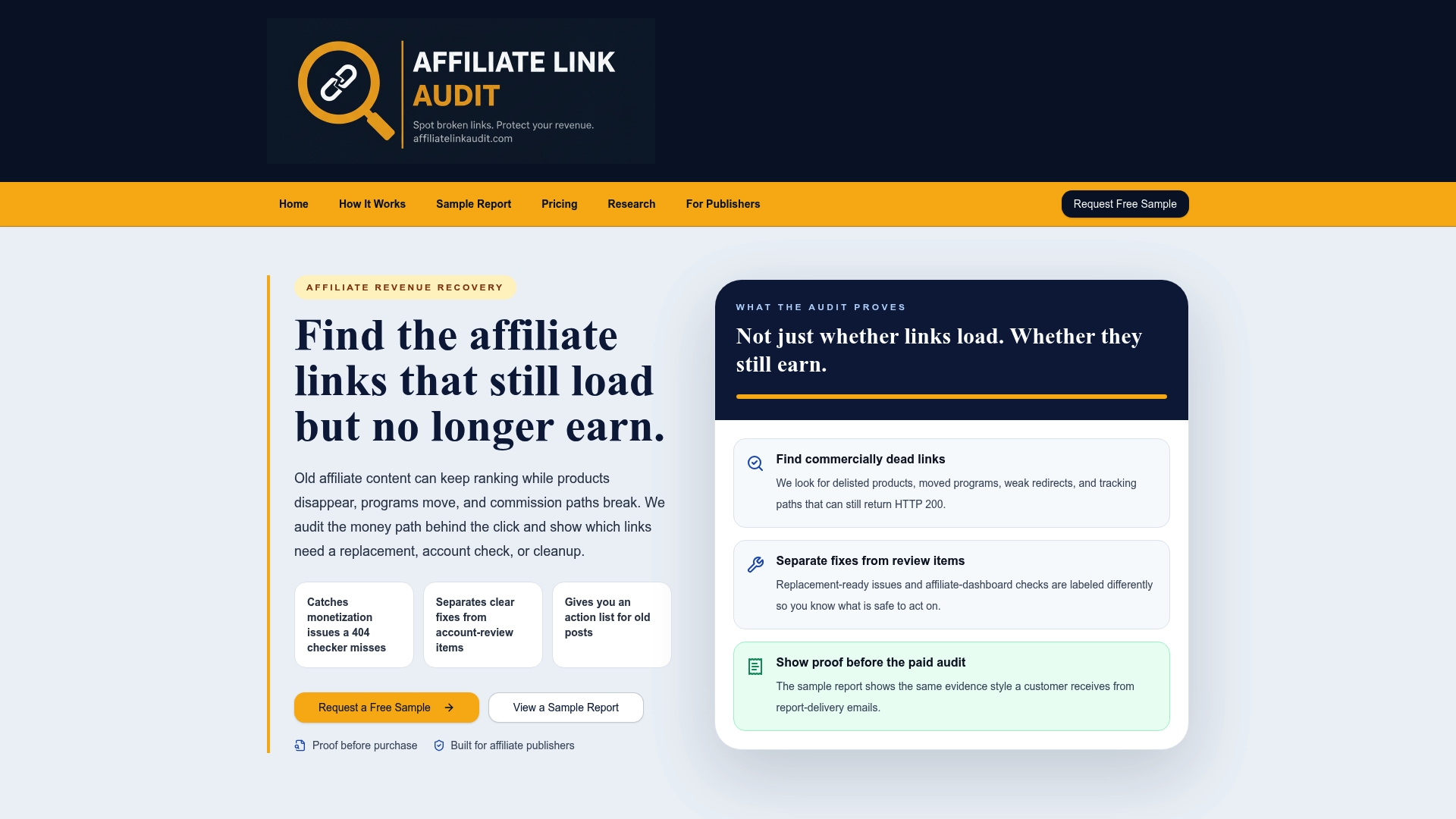
A Full Audit goes further than a status check: it detects Broken and Needs Attention links across a site, evaluates whether links that still load are still commercially functional, and returns a prioritized action plan with suggested replacements for anything discontinued.
- The full report separates confirmed Broken links from items that need manual review, so nothing gets treated as fixed before a human confirms it.
- Every finding comes with evidence, including redirect traces and destination screenshots, rather than a bare pass or fail label.
- The audit does not guarantee recovered commissions and does not automatically fix anything; it identifies commercially unhealthy links and hands the publisher a prioritized list to act on.
For publishers who want the process explained further first, the audit service overview for publishers covers how content quality and disclosure checks fit alongside the technical scan.
Sources
These sources back the audit checks, tiering, and compliance guidance covered above.
- Qualify Outbound Links for SEO | Google Search Central
- FTC's Endorsement Guides: What people are asking
- How to Monitor Affiliate Links and Protect Your Revenue | DeadLinkRadar
FAQ
What counts as a "Needs Attention" affiliate link?
A Needs Attention link loads successfully with a normal status code but shows signs of commercial failure, such as a redirect to a generic homepage instead of the specific product, a soft-404 page, or tracking parameters missing from the final URL. It is distinct from a Broken link, which fails to resolve at all.
How often should I audit my affiliate links?
Top-earning pages benefit from near-continuous automated checks with a manual review layered in whenever content changes; steady mid-tier links can be checked weekly, and a full manual audit on a quarterly basis catches soft failures that automated tools miss. A full audit is also warranted after a site migration or a major seasonal sales event.
Is a footer disclosure enough to meet FTC requirements?
Generally, no. FTC guidance calls for disclosures placed near the endorsement itself, in clear and conspicuous language, and a footer-only policy link typically does not meet that standard.
Can an audit guarantee I'll recover lost commissions?
No audit can guarantee recovered commissions or confirm exact lost income, since actual commission crediting depends on the affiliate network's own attribution systems. An audit identifies links that are commercially unhealthy and provides evidence; the publisher decides what to fix and how.
What does Affiliate Link Audit's free sample show?
The free sample report shows the classification system in action, meaning Broken, Needs Attention, and Healthy labels applied to real links, along with the supporting evidence format such as redirect traces and destination screenshots.
Recommended
This article was produced with AI assistance and reviewed for accuracy. Findings language ("Broken," "Needs Attention," "Healthy") reflects Affiliate Link Audit's evidence-based classification system.