
Amazon's Associates operating agreement changed on April 14, 2026, tightening the 180-day qualifying purchase window, narrowing onsite commission scope to the same ASIN variant, and disqualifying purchases referred through paid or boosted ads. The single action every publisher should take now is auditing existing links and sorting each one into Broken, Needs Attention, or Healthy. Waiting risks discovering the damage only after a payout cycle already reflects it.
TL;DR:
- Purchases must complete within 180 days of the click, which can disadvantage sales from slow-moving carts, subscriptions, or delayed gift purchases.
- Links to specific product variants now only credit if the exact same variant (color, size, edition) is purchased, reducing tracking flexibility.
- Affiliate sales via paid or boosted ads are now generally disqualified, increasing risks for campaigns using sponsored social or search traffic.
- Verifying link tags requires testing URLs for your tracking ID, checking for redirects, and confirming the destination matches the intended product variant.
- Prioritizing high-traffic pages during audits helps identify critical broken or questionable links that could impact earnings most significantly.
- ✓Broken affiliate links identified
- ✓Non-earning links evaluated
- ✓Clear fixes separated from manual review
- ✓Prioritized action plan
Table of Contents
- What Changed in the Amazon Affiliate Links Update
- How the Update Affects Your Earnings and Link Behavior
- How Do You Check if Your Amazon Links Are Tagging Correctly?
- Building Your Broken, Needs Attention, and Healthy Audit Checklist
- What to Do Next: Short-Term Fixes and Medium-Term Strategy
- Why Audit-First Thinking Wins Under This Update
- Get a Free Sample Report Before You Commit to a Full Audit
- Sources
- FAQ
What Changed in the Amazon Affiliate Links Update
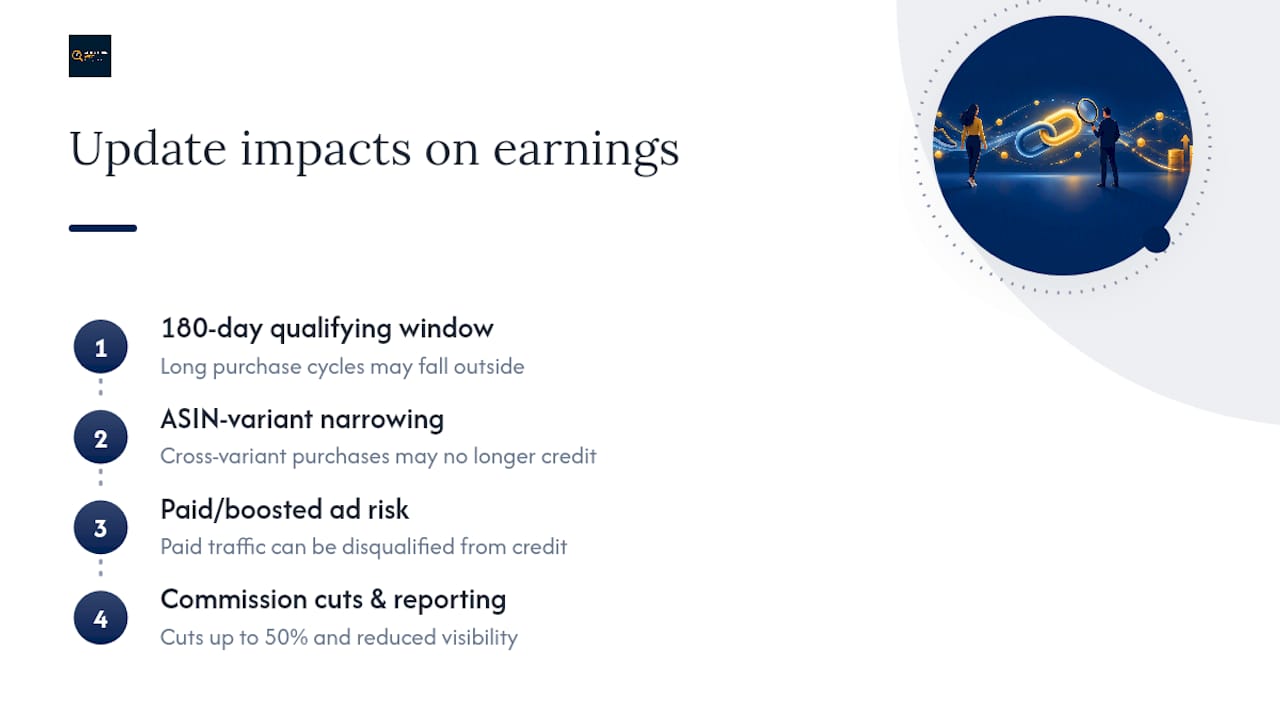
Amazon's operating agreement update, effective April 14, 2026, rewrites several mechanics that determine whether a click actually turns into a paid commission. The edits fall into two categories: some change who qualifies for a payout, others change how tracking and reporting behave behind the scenes.
- The 180-day qualifying window. Purchases must now complete within a tighter time frame after the referral click, which matters for slow-moving carts, subscriptions, or gift purchases delayed past a holiday.
- ASIN-variant scope narrowing. Onsite commissions now apply strictly to Direct Qualifying Purchases of the same ASIN variant the reader clicked. A link that pointed to a specific color or size no longer reliably credits a different variant the shopper ends up buying.
- Paid and boosted ad disqualification. Purchases referred through paid or boosted advertisements linking to Amazon are now excluded from commission eligibility, with limited exceptions, according to the updated program policies.
- Creator Link and storefront registration changes. Unique Creator Links and Storefront setups now carry adjusted registration requirements that affect how attribution gets assigned across a publisher's linked content.
The eligibility changes (the 180-day rule and the paid-ad exclusion) determine whether a sale counts at all. The ASIN-variant and registration changes affect how correctly that sale gets attributed and reported. Confusing the two categories is where most publishers misdiagnose a revenue drop.
How the Update Affects Your Earnings and Link Behavior
The practical effect of the 180-day rule shows up first in categories with long purchase cycles. A reader who clicks a gift guide link in November but buys in late April now falls outside the qualifying window in cases that once would have credited. Digital content and subscription upsells, where a reader browses before committing, face the same exposure.
The ASIN-variant narrowing creates a subtler problem. Publishers who linked to a specific product page and relied on Amazon's broader cross-variant crediting to catch shoppers who bought a different size or color are losing that safety net. If your content links to "wireless mouse, black" and the reader buys "wireless mouse, white," that sale may no longer count as a Direct Qualifying Purchase of the linked ASIN.
The paid and boosted ad language carries the sharpest risk for anyone running Amazon links through sponsored social posts or paid search campaigns. Disqualification under the program policies means traffic you paid to acquire may generate clicks without generating credited revenue.
Industry context: Adweek reported that Amazon had already restructured Associates commission rates, with cuts reaching some publishers by as much as 50%, alongside reporting changes that began affecting visibility into performance data in late 2025 and into 2026. That backdrop makes the April 2026 policy edits land on a program already tightening margins for affiliates.
How Do You Check if Your Amazon Links Are Tagging Correctly?
Verifying tag presence is the fastest diagnostic available, and it takes minutes per link.
- Click the link as a reader would, then look at the resulting URL for your Store ID or a
&tag=parameter carrying your tracking ID, exactly as Amazon's own guidance describes. - Run the official Link Checker on links you built outside Associates Central. It is designed for that use case.
- Skip the Link Checker for SiteStripe or Associates Central links. Amazon's Help Center states plainly that the tool does not work correctly with links copied from Associates Central or SiteStripe, which covers a large share of links generated inside the dashboard.
- Cross-check with server-side click logging where available, so you have independent evidence of click volume against Amazon's reported clicks.
- Document any mismatch before contacting Associates support, including screenshots of the destination URL and the date of the test click.
Watch for two failure patterns during manual checks: a link that redirects to Amazon's generic homepage instead of the product page, and a link that loads a product page but strips the tag parameter somewhere in the redirect chain. Both return a normal page load, which is exactly why they slip past casual review.
Pro Tip: Test links from a logged-out browser or incognito window. Amazon's own session data can mask a tagging failure that a first-time visitor would actually hit.
Building Your Broken, Needs Attention, and Healthy Audit Checklist
Three classifications keep the triage honest. Broken means the link fails outright: a dead redirect, a discontinued product with no replacement, or a confirmed missing tag. Needs Attention covers links that load fine but show a warning sign, a homepage fallback, an ASIN-variant mismatch, or paid-traffic exposure under the new ad disqualification language, without full evidence yet confirming the loss. Healthy means the tag verifies, the destination matches the linked ASIN variant, and no policy exception applies.
- Pull your highest-traffic pages first. A broken link on a page with negligible visits is a low priority no matter how obviously broken it is.
- Scan for redirect and homepage fallbacks, the clearest Broken signal.
- Confirm tag presence using the manual click test on every surviving link.
- Check ASIN-variant sensitivity on product links tied to a specific color, size, or edition.
- Flag any link driven by paid or boosted promotion for separate review under the new disqualification rule.
Prioritize by multiplying traffic against buying intent. A comparison post ranking for a purchase-ready keyword deserves attention before an informational post with the same traffic. Quick replacements (swapping a discontinued ASIN for its current equivalent) can happen same-day; ASIN-variant and paid-ad questions often need manual review before you touch anything.
Pro Tip: Keep a running note of which links needed a suggested replacement versus which ones need a human decision. That separation is what turns an audit into a repair plan instead of a spreadsheet of red flags.
What to Do Next: Short-Term Fixes and Medium-Term Strategy
Start with the audit, then act on what it surfaces. Replace or remove anything classified Broken immediately. Pause any Amazon link running through paid or boosted promotion until you've confirmed it doesn't fall under the new exceptions. Document your evidence (screenshots, timestamps, click logs) before reaching out to Associates support, since unsupported claims rarely move a support ticket forward.
- Diversify merchant links on your highest-earning pages so a single program's policy shift doesn't sink the whole page's revenue.
- Rebuild or refresh content around products still commercially viable rather than patching links to discontinued items indefinitely.
- Set a recurring reminder to re-audit high-traffic content, since Amazon's reporting changes make it easy to miss a slow decline.
- Update affiliate disclosures if your linking structure or Creator Link registration changed under the new rules.
Escalate to Associates support once you have concrete evidence: a documented tag failure, a redirect loop, or a policy question the Help Center pages don't resolve directly.
Why Audit-First Thinking Wins Under This Update
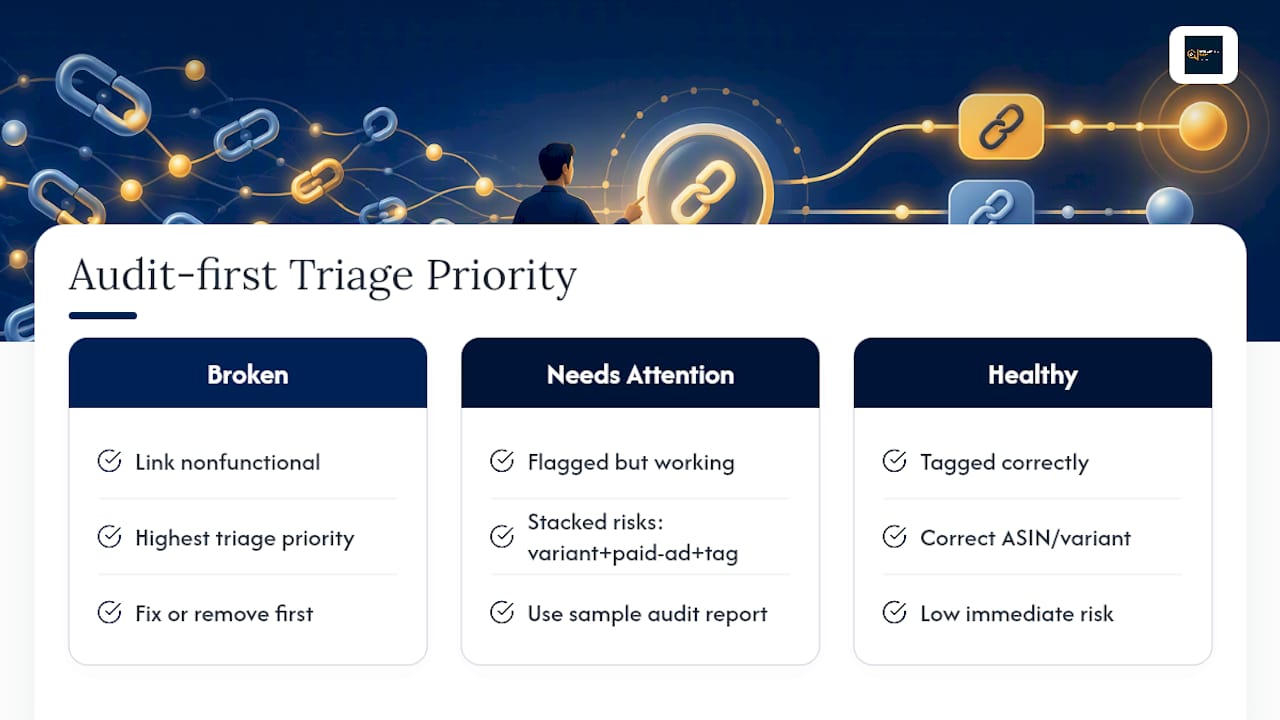
Smaller publishers don't have the staff to chase every policy nuance in real time, which is exactly why triage order matters more than perfection. Sorting links into Broken, Needs Attention, and Healthy forces a decision about where limited hours go first, instead of treating every yellow flag as equally urgent.
The ASIN-variant and paid-ad changes are the ones I'd worry about least in isolation and most in combination: a link that's technically tagged correctly but pointed at the wrong variant, running through a boosted post, stacks three separate risks into one URL. A sample audit report makes that stacking visible in a way a quick manual scan rarely does. Evidence beats assumption every time a payout looks smaller than expected.
— Michael .N
Get a Free Sample Report Before You Commit to a Full Audit
You don't need to guess which of your Amazon links survived the April 2026 changes intact. We identify links that load fine but may no longer earn, redirects to generic homepages, discontinued products still linked in old posts, and tagging paths that stopped working.
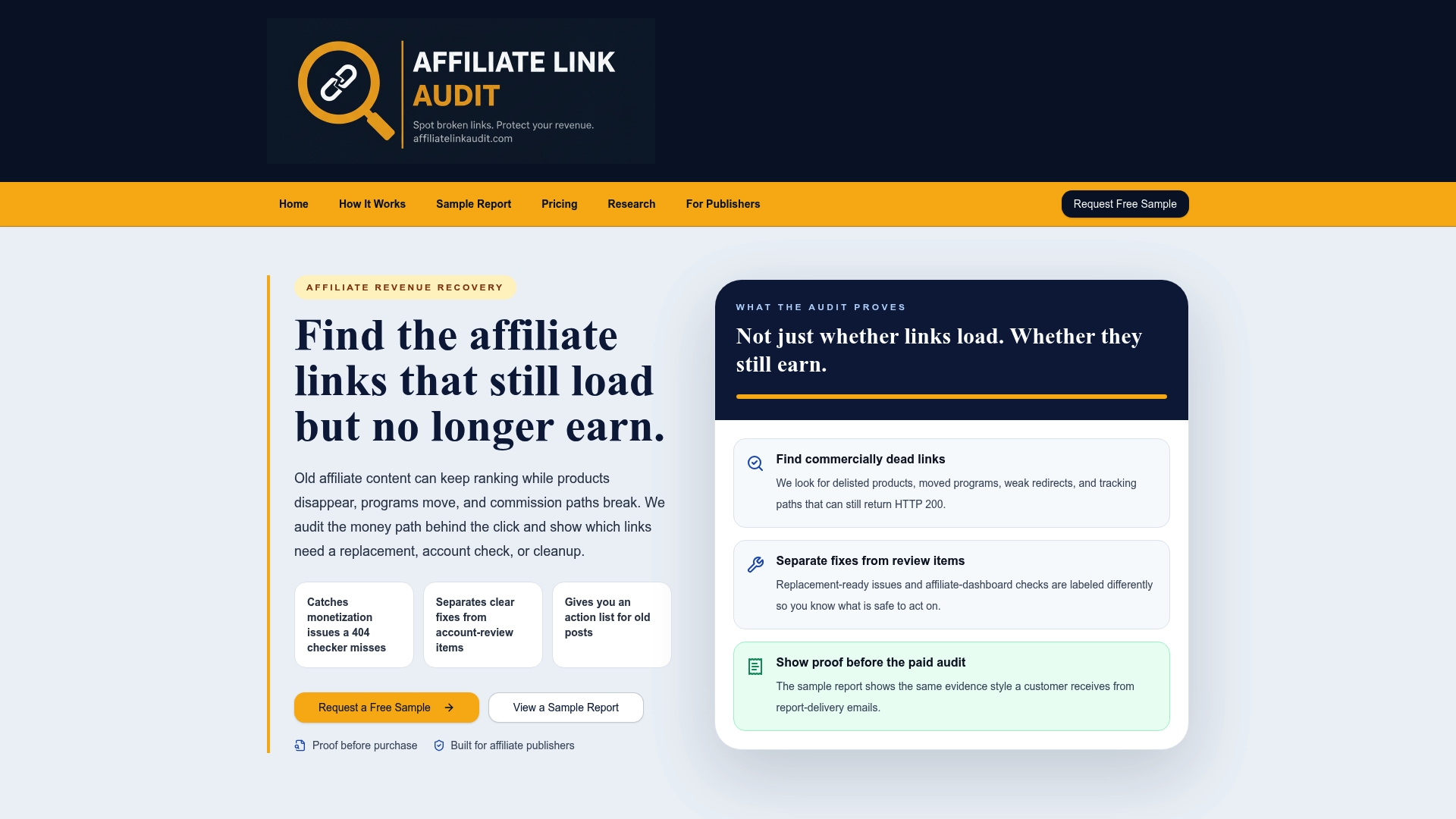
Every audit starts with a free sample report so you can see evidence, the classification into Broken, Needs Attention, and Healthy, and suggested next steps before spending anything. The Full Audit provides a prioritized repair plan separating clear fixes from links that need manual review. Publishers managing older, high-traffic content can see how the audit for publishers applies specifically to archive-heavy sites. Start with the free sample and decide from there.
Sources
- Associates Operating Agreement 6 What's Changed
- Amazon cuts affiliate commissions up to 50% for publishers
FAQ
How long does it take for an Amazon affiliate link to update?
Amazon's own reporting typically reflects tagging and commission data within a day or two, though the April 2026 policy changes narrowed which purchases qualify at all, not how fast reporting updates. If a link's earnings look off, check tag presence directly rather than assuming a reporting delay.
Why isn't my affiliate link showing up on Amazon?
Most missing or non-crediting links trace back to a broken redirect, a discontinued product, or a tag that got stripped during a link-shortening or CMS update. The Link Checker can confirm tagging on links built outside Associates Central, but it does not reliably validate links copied from Associates Central or SiteStripe, so a manual click test is often the more trustworthy check.
Is affiliate marketing still viable after the 2026 Amazon changes?
Yes, though the April 2026 operating agreement update and reported commission cuts mean publishers need tighter link maintenance and more merchant diversification than in past years. Affiliates who audit regularly and act on prioritized fixes are better positioned than those relying on links set up years ago and never revisited.
How do I know if my Amazon affiliate links are actually working?
A link "working" means it loads, carries your tag, and points to a purchasable ASIN variant that still qualifies under current policy, not just that it doesn't return a 404. Running a structured audit that classifies each link as Broken, Needs Attention, or Healthy, such as the approach behind Affiliate Link Audit's sample report, gives you evidence instead of a guess.
Recommended
Made with BabyLoveGrowth, the AI SEO writer
This article was produced with AI assistance and reviewed for accuracy. Findings language ("Broken," "Needs Attention," "Healthy") reflects Affiliate Link Audit's evidence-based classification system.