
An affiliate link that returns clicks but stops earning commissions is what this article means by "affiliate link nofollow": a commercially unhealthy link, not a rel="nofollow" tag. The immediate action is a focused scan of your top-earning pages, sorted into three categories: Broken, Needs Attention, and Healthy.
TL;DR:
- Silent tracking failures, such as lost sub-IDs or expired campaigns, can cause affiliate links to load correctly but no commissions to land, reducing revenue.
- Automated scanners typically detect clear errors like 404s but often miss silent failures, making manual spot-checks crucial for high-revenue pages.
- High traffic and EPC drops on a page are strong indicators of tracking issues, warranting immediate review and fixing those links first.
- Common affiliate link failures include redirects to homepage instead of product pages, missing or stripped sub-IDs, and merchant program closures.
- Regular audits, focusing on top-earning pages, should be performed quarterly with more frequent checks for seasonal or high-value campaigns to maintain link health.
Table of Contents
- What "Affiliate Link Nofollow" Actually Means for Your Revenue
- How to Audit Affiliate Links Step by Step
- Classifying Findings: Broken, Needs Attention, and Healthy
- Common Failure Patterns Worth Knowing by Sight
- Your Audit Cadence Checklist
- Why a Generic Link Checker Isn't the Same Tool
- What a Full Audit From Affiliate Link Audit Delivers
- Sources
- FAQ
What "Affiliate Link Nofollow" Actually Means for Your Revenue
The phrase gets used loosely across affiliate marketing forums, but for a publisher managing monetized content, the real threat isn't a search-engine attribute. It's a link that looks fine on the page and fails commercially. A hard failure is a 404 or 410 response, obvious the moment you click. A silent failure is worse: the page loads at 200 OK, the redirect fires, and no commission ever lands, because a sub-ID got stripped, a campaign expired, or a merchant swapped tracking systems without notice.
The clearest early warning is a falling earnings-per-click on a page that used to convert reliably. When traffic holds steady but EPC drops, that pattern points to tracking failure more often than content decay, according to Impact's affiliate marketing benchmark research. Automated scanners catch the 404s. They routinely miss the silent failures, because the HTTP response looks perfectly normal. That gap is exactly why manual spot-checks on your highest-revenue pages matter more than any crawler alone.

How to Audit Affiliate Links Step by Step
A workable audit moves from broad to narrow: crawl everything, filter to what matters, then verify by hand.
- Crawl the full site and filter outbound links to known affiliate and redirect domains, isolating cloaked URLs from direct merchant links.
- Rank pages by traffic and EPC before you touch anything. A low-traffic page with a broken link waits. A high-traffic page with a falling EPC does not.
- Spot-check live links directly from the published page, not from a spreadsheet export, since cached crawl data can miss recent redirect changes.
- Click through for real and confirm the click registers in the affiliate network dashboard or via an S2S postback, cross-referencing postback logs against click logs the way IAB's attribution research recommends. A discrepancy rate above 15% between postbacks and clicks is a tracking integrity red flag worth escalating to the network.
- Confirm the cloaked redirect preserves its sub-ID and that the final landing page actually matches what the article promised. A redirect that quietly drops its parameters can still "work" while earning nothing.
- Log every finding in a spreadsheet with columns for source page, cloaked URL, final destination URL, HTTP result, affiliate parameters detected, and the fix you've chosen.
Pro Tip: Run your manual spot-checks in an incognito window with no ad blockers active. Cached sessions and blocked trackers both produce false readings that make a healthy link look broken, or worse, a broken one look fine.
This process mirrors the combined automated-plus-manual approach AffBuddy's audit checklist outlines, and it's the same logic behind a structured Affiliate Link Audit engagement.
Classifying Findings: Broken, Needs Attention, and Healthy
Every link you check lands in one of three categories, and the distinctions matter because they drive what gets fixed first.
- Broken: hard 404s, 410s, or redirects that land on a homepage instead of the product page, killing the buying intent the article built.
- Needs Attention: the link resolves and loads content, but something is unverifiable. Missing sub-IDs, no confirmed postback, or a product that appears discontinued without a clear replacement.
- Healthy: the link resolves to the correct product, preserves tracking parameters, and the click confirms in the network dashboard or postback log.
Once findings are classified, rank them using traffic volume, EPC, and the page's revenue share against how complex the fix actually is. A high-traffic page with a Broken link and a one-line fix jumps to the top of the queue. A low-traffic page with a Needs Attention link and a messy redirect chain can wait for a scheduled pass. The triage rule is simple: fix immediately what's both high-value and easy, schedule what's valuable but complicated, and remove links entirely when the product or program is gone for good.
Common Failure Patterns Worth Knowing by Sight
Most commercially unhealthy links fall into a short list of repeat offenders.
- Hard 404s and 410s, the easiest to catch and the easiest to fix, usually with a straightforward swap to an active offer.
- Homepage or category redirects that return 200 OK but drop the reader far from the specific product the article recommended, killing conversion intent even though nothing looks technically broken.
- Stripped sub-IDs or missing click IDs, where the link fires but the network can't attribute the sale back to your account.
- Merchant program closures, the kind BigCommerce's own affiliate program closure notice illustrates: tracking links get disabled wholesale, and publishers who don't monitor merchant notices keep sending traffic to dead ends for months.
- Crawler-blocked merchant pages, JavaScript-only redirects, and long redirect chains, all of which can hide a failure from a standard scanner while still loading fine in a browser.
Partner quality complicates this further. Not every affiliate relationship that shows clicks is actually driving incremental revenue, a point 5W Research's affiliate marketing report raises directly, and it's worth applying that same skepticism to your own outbound links, not just your partners.
Your Audit Cadence Checklist
An audit scan doesn't need to be elaborate. It needs to be repeatable.
- Pull your top 10 earning pages by revenue, not by traffic alone.
- Crawl and export every outbound affiliate link on those pages.
- Filter for redirect domains and cloaked URLs specifically.
- Manually test each one, confirming the click registers where it should.
- Classify each link as Broken, Needs Attention, or Healthy.
- Log the fix, the replacement link, or the removal decision.
For ongoing cadence, weekly checks fit paid and seasonal campaign pages, since those shift fastest. Monthly lightweight passes cover smaller sites, and a full quarterly audit works for most publishers otherwise, a schedule consistent with the cadence AffBuddy recommends. Run an unscheduled check immediately after a platform migration, a merchant program notice, or any sudden EPC drop on a page that previously performed well.
Why a Generic Link Checker Isn't the Same Tool
Most link checkers stop at status codes: 200 means pass, 404 means fail. That binary misses the entire category of links that load fine and earn nothing, which is the more expensive failure for any publisher managing years of monetized content. A commercial audit has to go further, evaluating whether a 200 OK link is still commercially viable, not just technically alive.
Partner quality research backs this up directly: clicks alone don't prove a link, or a partner, is worth keeping, since 5W Research's findings on incrementality show performance metrics can mislead without that deeper check. Human review against a prioritized list, rather than a flat scan report, is what keeps false positives low and focuses remediation on the pages where revenue is actually at risk. Affiliate Link Audit built its Affiliate Link Health Benchmark 2026 research around exactly this distinction, and offers a free sample report so publishers can see the evidence format before committing to anything.
— Michael N.
What a Full Audit From Affiliate Link Audit Delivers
Most link-checking tools hand you a list of status codes and leave the interpretation to you. Affiliate Link Audit does the interpretation: a classified list of every finding as Broken, Needs Attention, or Healthy, backed by evidence, with a prioritized repair plan and suggested replacements ranked by traffic and EPC impact.
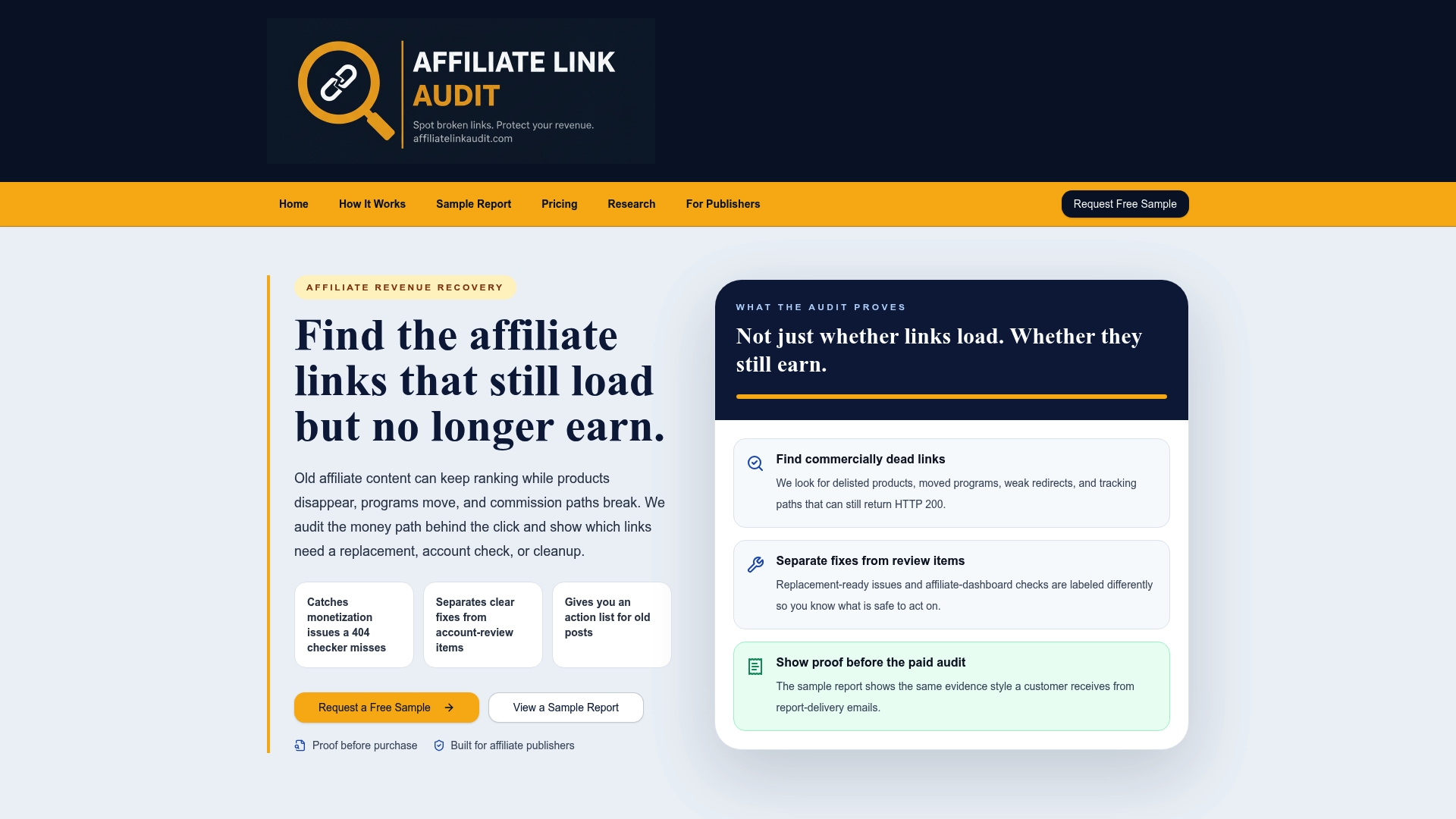
Every engagement starts the same way: with a free sample audit report so you can see exactly what the evidence looks like, page by page, before paying anything. Publishers running large content libraries can also review the publisher-focused audit page for how prioritization works on high-EPC content specifically. Program managers weighing partner incrementality alongside link health may find it useful to compare notes with partner-facing pages like Pilates de Mexico's ambassador program as a reference point for how partner quality gets evaluated elsewhere.
To be clear about scope: an audit identifies commercially unhealthy links and documents the evidence. It does not verify actual commission crediting inside a network's ledger, and it does not automatically repair anything. The publisher decides what to fix, using a prioritized list instead of guesswork. The Full Audit runs $97 one time, and most publishers start by requesting the free sample to see the report format before ordering the full scan.

Sources
The Affiliate Link Health Benchmark 2026 and broader affiliate link health research collection expand on the data behind this article's prioritization framework. Publishers working in travel content specifically may also want the travel publisher link health research.
- Affiliate Marketing Benchmark (Impact)
- Affiliate Marketing Audit: A Step-by-Step Checklist | AffBuddy
- BigCommerce affiliate program closure notice
FAQ
What Does "Affiliate Link Nofollow" Mean in This Context?
It refers to a commercially unhealthy affiliate link, one that still loads and returns clicks but no longer reliably earns commission, whether from a discontinued product, a homepage redirect, or broken tracking. It has nothing to do with the SEO rel="nofollow" attribute.
How Often Should I Audit My Affiliate Links?
Most sites do well with a full quarterly audit paired with lighter monthly checks, while paid or seasonal campaign pages warrant weekly review, following the cadence AffBuddy's audit checklist recommends. Run an extra check immediately after any merchant program notice or platform migration.
Can Automated Tools Catch Every Broken Affiliate Link?
Automated crawlers reliably catch hard failures like 404s, but they routinely miss silent tracking failures where a link returns 200 OK without registering a commission. Manual spot-checks against the live network dashboard or S2S postback log remain necessary to catch what a scanner alone cannot.
What's Included in an Affiliate Link Audit Full Audit?
The Full Audit costs $97 one time and delivers a classified list of findings labeled Broken, Needs Attention, or Healthy, along with a prioritized repair plan and suggested replacement links. A free sample report is available first so buyers can review the evidence format before ordering.
What's the First Sign a Link Has Stopped Earning?
A falling earnings-per-click on a page that previously converted well is usually the earliest signal, often before any visible error appears on the page itself, a pattern documented in Impact's affiliate benchmark data. Steady traffic with declining EPC points to a tracking problem more often than a content problem.
Recommended
This article was produced with AI assistance and reviewed for accuracy. Findings language ("Broken," "Needs Attention," "Healthy") reflects Affiliate Link Audit's evidence-based classification system.